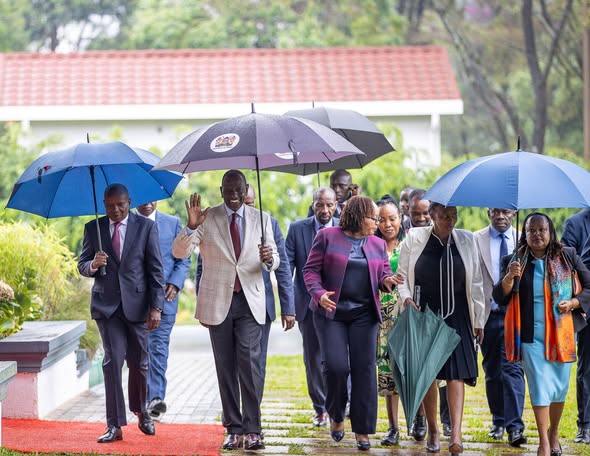
President William Ruto has signed into law three major Bills aimed at strengthening disaster preparedness, enhancing forest conservation, and accelerating development in historically marginalised regions, in what the government describes as a significant step towards improving service delivery and deepening devolution.
The President assented to the National Disaster Risk Management Bill, the Forest Conservation and Management (Amendment) Bill, 2025, and the Equalisation Fund Appropriations Bill, 2025, at State House, Nairobi.
The three laws touch on some of the country's most pressing policy challenges, including climate change, environmental degradation, disaster response, and regional inequalities that have persisted since independence.
"The laws will strengthen disaster response, protect our forests, and deliver equitable development to all parts of the country," President Ruto said after signing the legislation.
New Disaster Framework
The National Disaster Risk Management Act establishes, for the first time, a comprehensive legal framework for coordinating disaster preparedness and response between the national and county governments.
The legislation comes against the backdrop of increasing climate-related disasters, including devastating floods, prolonged droughts, landslides and fires that have repeatedly exposed gaps in Kenya's disaster response mechanisms.
Under the new law, a National Disaster Risk Management Authority will be established to coordinate emergency preparedness, early warning systems and disaster response efforts across the country. County Disaster Risk Management Committees will also be created to coordinate local interventions and ensure resources reach affected communities more efficiently.
Government officials have argued that the absence of a clear legal framework has often led to duplication of roles, delayed responses and confusion between different agencies during emergencies.
The enactment follows severe flooding experienced in various parts of the country in recent years, which displaced thousands of families, destroyed infrastructure and resulted in significant economic losses.
Push to Protect Forest Cover
The President also signed the Forest Conservation and Management (Amendment) Bill, 2025, which seeks to strengthen Kenya's environmental conservation agenda and support efforts to combat climate change.
The law enhances the legal and institutional framework governing the forestry sector, promotes sustainable forest management and supports climate-responsive forestry initiatives.
Significantly, it strengthens the mandate of the Kenya Forest Service (KFS) while re-establishing the Kenya Forestry Research Institute (KEFRI) as the country's lead forestry research institution.
The legislation comes as the government continues to pursue its ambitious target of planting 15 billion trees by 2032, a programme President Ruto has repeatedly described as central to addressing climate change, restoring degraded landscapes and protecting water towers.
Kenya's forest cover has improved in recent years but environmental experts continue to warn that illegal logging, charcoal production and encroachment remain major threats to critical ecosystems.
Sh16.8 Billion for Marginalised Counties
In a move likely to carry significant political implications, President Ruto also assented to the Equalisation Fund Appropriations Bill, 2025, unlocking Sh16.8 billion earmarked for development projects in 34 marginalised counties.
The law seeks to address historical disparities in access to basic services such as water, healthcare, roads and electricity in regions that have lagged behind in development.
The funds will be channelled directly into special-purpose accounts rather than County Revenue Funds, a measure intended to ensure the money is used exclusively for designated projects.
The Equalisation Fund was created under Article 204 of the Constitution to provide basic services to marginalised areas and reduce inequalities across the country. However, implementation of the fund has faced numerous delays over the years due to legal disputes, administrative bottlenecks and disagreements between national and county governments.
The release of the funds is expected to benefit counties in arid and semi-arid regions as well as other historically underserved areas.
Political Significance
The signing of the three Bills comes at a time when the Kenya Kwanza administration is under pressure to demonstrate tangible development outcomes ahead of the 2027 General Election.
By prioritising disaster management, environmental conservation and funding for marginalised regions, the government is seeking to position itself as responsive to concerns raised by county leaders and communities affected by climate-related disasters and uneven development.
The legislation also reinforces President Ruto's broader agenda of strengthening devolution while ensuring greater accountability in the utilisation of public resources.
Political analysts note that the Equalisation Fund law, in particular, could bolster the administration's support in regions that have historically complained of exclusion from national development programmes.
As the government moves to implement the new laws, attention will now shift to how effectively the institutions created under the legislation deliver results and whether the promised resources reach the communities they are intended to serve.


