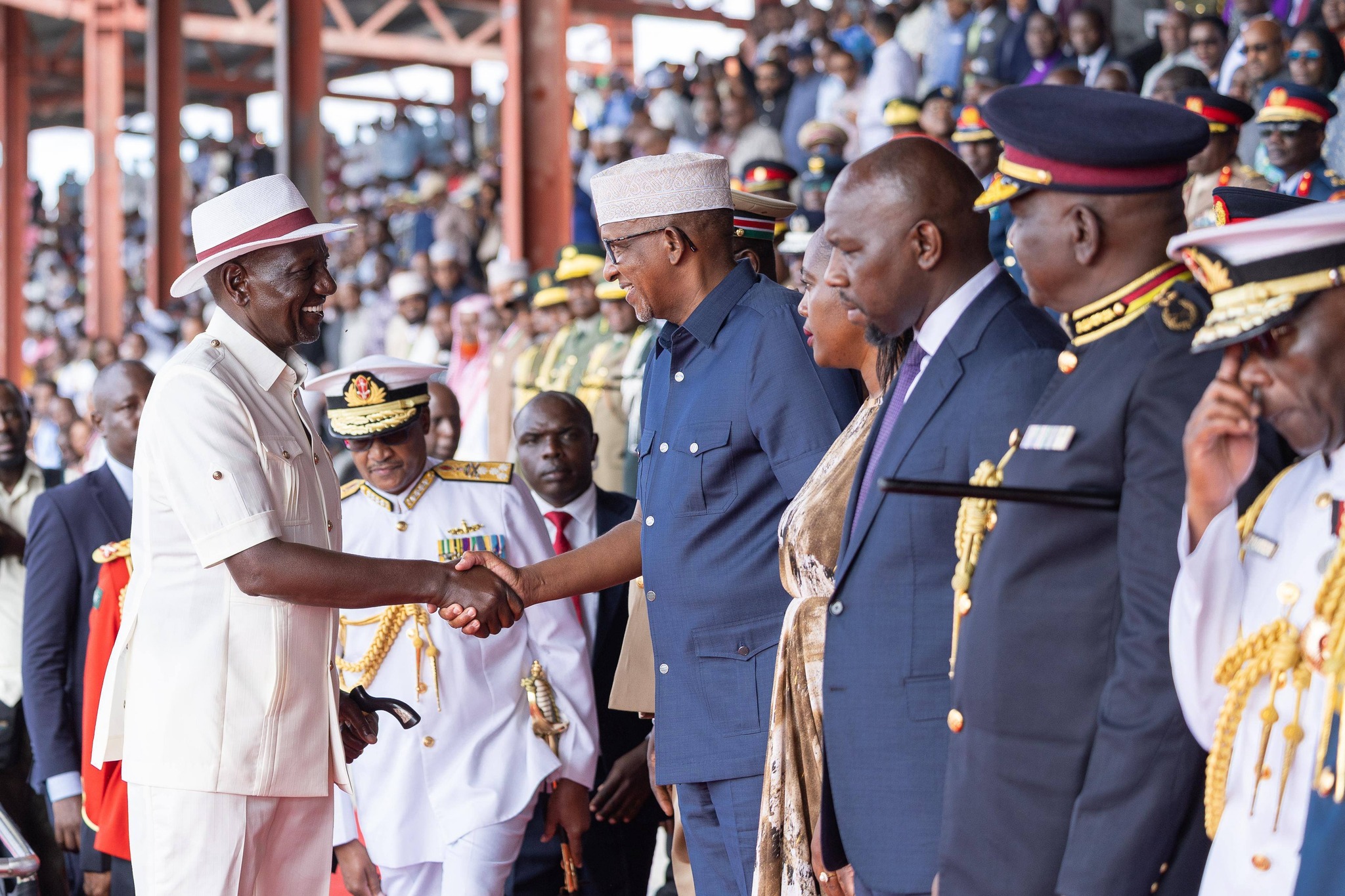
Wajir County entered the national spotlight on Monday as President William Ruto led the country's 63rd Madaraka Day celebrations in the region, using the occasion to showcase his administration's development record in Northern Kenya as political attention gradually shifts towards the 2027 General Election.
For the first time since independence, a county in Northern Kenya hosted the national celebrations, a move that government officials described as a demonstration of inclusion and a commitment to correcting decades of marginalisation in the country's arid and semi-arid regions.
Thousands of residents filled the newly built Wajir Stadium as President Ruto arrived to preside over the event held under the theme, "Education, Skills and the Future."
In his address, the President outlined a raft of development projects targeting the region, including the commissioning of a new Level Five referral hospital, plans for a civilian terminal at Wajir International Airport, and the establishment of Wajir University.
The announcements formed part of a broader message that the Kenya Kwanza administration has frequently advanced—that no region should be left behind in national development.
"We are committed to ensuring every part of Kenya benefits from development and prosperity," President Ruto told the gathering.
The Head of State also announced that the newly constructed stadium would be renamed Ahmed Khalif Wajir Stadium, honouring one of the region's respected historical figures.
The highlight of the day was the commissioning of the ultra-modern Wajir Level Five Referral Hospital. The facility includes three operating theatres, an emergency centre, High Dependency Unit (HDU), Intensive Care Unit (ICU) facilities and a 96-bed ward.
Health Cabinet Secretary Aden Duale said the hospital would improve access to specialised healthcare services in a region where residents have traditionally travelled long distances for treatment.
Why Kenyans Celebrate Madaraka Day
Madaraka Day, observed every June 1, commemorates a defining moment in Kenya's journey to nationhood. On June 1, 1963, Kenya attained internal self-governance from British colonial rule, allowing Kenyan leaders to take charge of the country's affairs while paving the way for full independence on December 12, 1963.
The word Madaraka is derived from the Kiswahili word meaning "authority" or "self-governance." The day honours the sacrifices of freedom fighters, political leaders and ordinary Kenyans who fought for self-rule after decades of colonial administration.
While Jamhuri Day marks Kenya's attainment of full independence and the birth of the republic, Madaraka Day specifically celebrates the transfer of governing powers from the colonial government to Kenyan leadership.
Over the years, the annual celebrations have evolved into a platform for governments to reflect on the country's progress, announce key policy initiatives and showcase development projects in different regions.
Rotating National Celebrations
Since the advent of devolution, successive governments have increasingly rotated national celebrations across different counties to promote national cohesion and highlight regional development.
Recent Madaraka Day celebrations have been hosted in various parts of the country:
-
2025: Raila Odinga Stadium, Homa Bay County.
-
2024: Masinde Muliro Stadium, Bungoma County.
-
2023: Moi Stadium, Embu County.
-
2022: Uhuru Gardens, Nairobi.
-
2021: Jomo Kenyatta International Stadium, Kisumu County.
-
2020: Celebrations were scaled down at State House, Nairobi, due to Covid-19 restrictions.
-
2019: Narok Stadium, Narok County.
-
2018: Kinoru Stadium, Meru County.
Against that backdrop, Wajir's selection for the 2026 celebrations was particularly significant, symbolising the government's effort to bring national events to regions that historically remained on the periphery of major state functions.
Political Undertones Ahead of 2027
Beyond the celebrations, however, the event carried significant political symbolism.
With less than two years before Kenyans return to the ballot in 2027, the President's decision to take the country's second most important national celebration to Wajir was widely viewed as part of a broader strategy to consolidate support in Northern Kenya, a region that overwhelmingly backed his presidential bid in 2022.
The region has become increasingly important in national politics because of its growing voter numbers and strategic influence in coalition building.
Government officials have in recent months intensified development tours across the North Eastern counties of Wajir, Mandera and Garissa, unveiling infrastructure, education and healthcare projects while emphasising the administration's commitment to addressing historical inequalities.
For decades, Northern Kenya lagged behind the rest of the country in infrastructure, education and public investment. Successive governments acknowledged the challenges but residents often complained that development projects remained concentrated in other parts of the country.
The decision to host Madaraka Day in Wajir therefore carried historical significance.
For President Ruto, Sunday's event offered an opportunity to present tangible projects as evidence of his administration's efforts to fulfil campaign promises made to the region in 2022.


