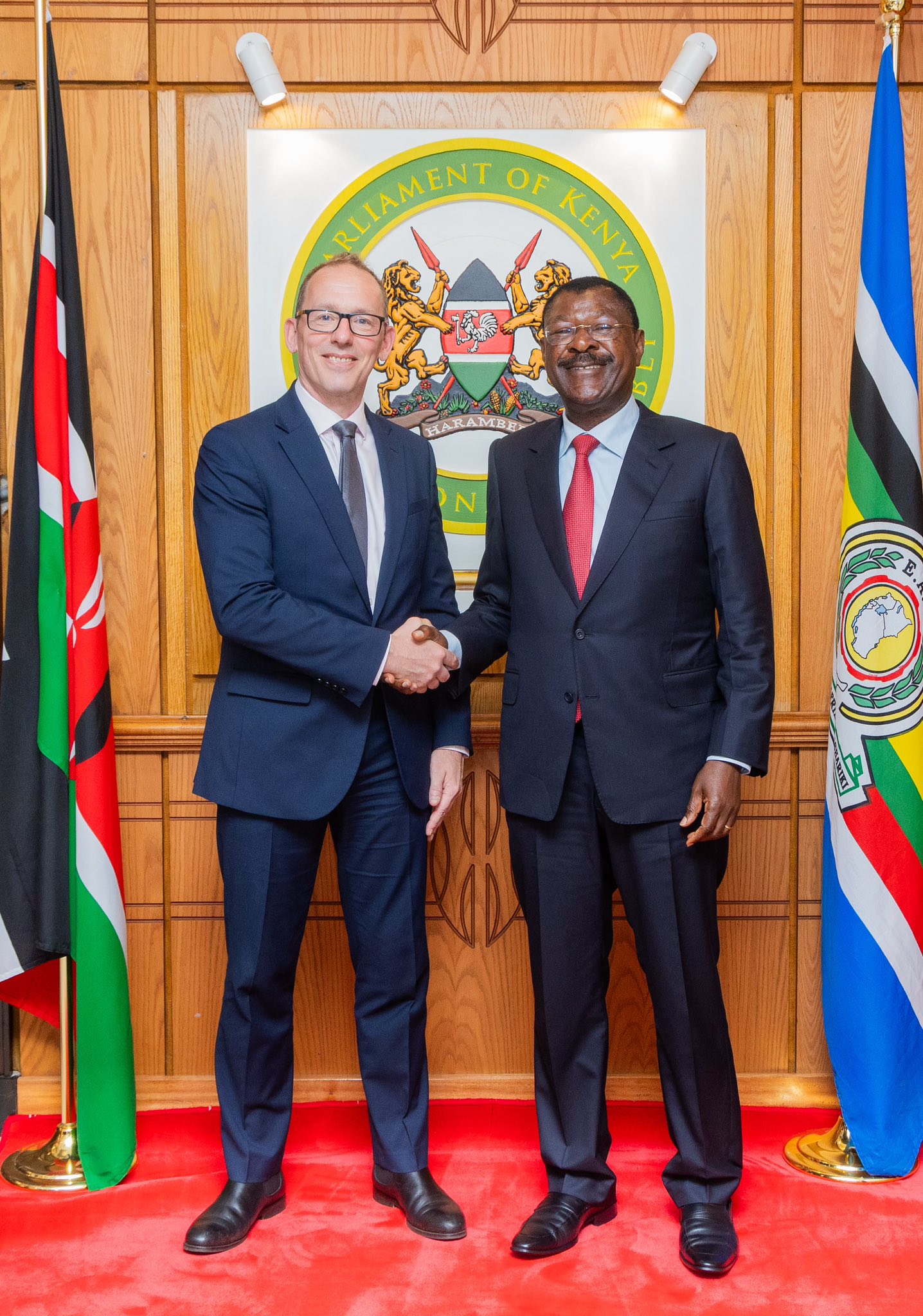
Moses Masika Wetang’ula, Speaker of the National Assembly, held discussions with Matt Baugh, the British High Commissioner to Kenya, focusing on strengthening Kenya–United Kingdom relations, with emphasis on governance cooperation and preparations for the 2027 General Election.
The meeting centred on enhancing institutional collaboration, including capacity building for democratic institutions ahead of the electoral period, as well as deepening parliamentary diplomacy between the two countries.
Wetang’ula noted that the engagement was productive and reaffirmed Kenya’s commitment to maintaining strong bilateral ties with the United Kingdom, particularly in governance, stability, and sustainable development.
A key focus of the discussions was electoral preparedness. Both parties emphasized the importance of free, fair, transparent, verifiable, and credible elections in 2027. Wetang’ula reiterated that the National Assembly remains committed to supporting the Independent Electoral and Boundaries Commission (IEBC) in fulfilling its constitutional mandate, including timely funding and institutional strengthening.
He further assured that Parliament will ensure adequate resource allocation to the electoral body through the budget and appropriation process to enable it to effectively deliver its mandate.
Kenya and the United Kingdom share a long-established relationship built on historical ties, trade, security cooperation, and development partnerships. Over the years, this partnership has expanded to include governance reforms, institutional strengthening, climate action, and regional stability initiatives.
The UK continues to support Kenya through governance and institutional development programmes aimed at strengthening democratic systems and public accountability.
2027 election timeline and process
Kenya’s next General Election is expected to be held in August 2027, in line with the Constitution, which sets national elections for the second Tuesday of August every five years. This means Kenyans will return to the ballot on August 10, 2027, unless otherwise adjusted by legal or constitutional processes.
During the election, voters will elect leaders across multiple levels, including the President, Members of Parliament, Governors, Senators, and Members of County Assemblies. The process is managed by the IEBC and involves voter identification, casting of ballots at polling stations, counting at the station level, and electronic transmission of results to national tallying centres.
After tallying, the IEBC Chairperson is responsible for declaring presidential results. The outcome can be challenged at the Supreme Court, which has final jurisdiction over presidential election disputes, usually within strict constitutional timelines.
Political context and divisions
As the 2027 elections draw closer, political alignments are beginning to take shape, with emerging divisions over succession politics, governance performance, and term-limit interpretations.
President William Samoei Ruto has maintained in various political forums that his focus is on delivering his current development agenda, while also signalling political confidence heading into the next election cycle. His allies have increasingly framed the 2027 contest as a continuation versus disruption debate.
Former Deputy President Rigathi Gachagua has been vocal in mobilising support within his political base, positioning himself within broader opposition and regional realignment conversations following internal political rifts in government.
Nairobi Senator Edwin Sifuna, a key opposition voice, has consistently criticised the current administration’s economic policies and governance approach, arguing that the 2027 election should be a referendum on cost of living, accountability, and institutional integrity.
This has contributed to a widening political divide between what analysts describe as “continuity politics,” largely aligned with the Kenya Kwanza administration, and “change politics,” driven by opposition formations and dissenting voices.
At the centre of the debate is also the broader question of presidential tenure limits, with discussions in political circles oscillating between one-term accountability arguments and two-term constitutional allowances, though the Constitution remains clear on a maximum of two five-year terms.
Wetang’ula on institutional stability
Wetang’ula’s remarks underscore the National Assembly’s role in oversight and funding of key state institutions, particularly in ensuring the electoral body is sufficiently resourced to conduct credible national polls.
As Kenya approaches the next election cycle, such diplomatic engagements highlight continued international cooperation in supporting democratic governance, electoral integrity, and institutional readiness.


