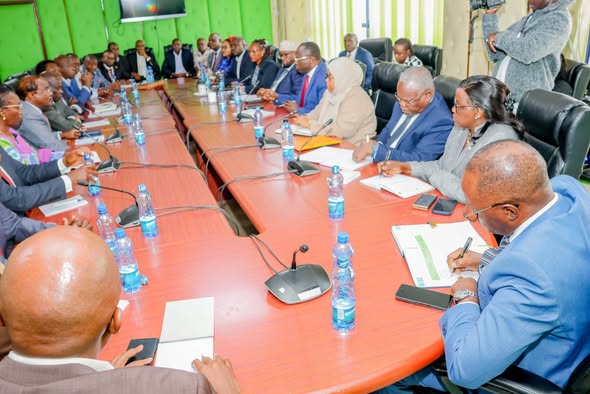
The Independent Electoral and Boundaries Commission (Independent Electoral and Boundaries Commission) has launched a high-level technical workshop to review its Information Security Management System (ISMS) and ICT policy frameworks, in a bid to strengthen digital governance, tighten cyber resilience, and align operations with international ISO standards.
The exercise comes against the backdrop of persistent concerns over election technology performance in past polls, particularly the 2022 General Election, where ICT systems came under intense public scrutiny over transmission delays, equipment failures, and disputes over results management.
The workshop was officially opened by Commissioner Marykaren Sorobit, who represented Commissioner Prof. Francis Aduol, Chairperson of the Research, Innovation, Information & Communication Technology (ICT) Committee. She emphasized the need for continuous institutional strengthening through policy review.
“Robust and up-to-date policy frameworks are essential for building strong, resilient and accountable institutions,” Sorobit said.
Commissioner Dr. Alutalala Mukhwana said the review process is designed to ensure that ICT systems reflect current operational realities and emerging risks in a rapidly evolving digital environment.
“The exercise provides an opportunity for the Commission to align the documents with operational realities, emerging risks and evolving technological demands,” he said, adding that “well-crafted policies are critical in strengthening governance structures, enhancing risk management and supporting the Commission's overall operational effectiveness.”
Ag. Commission Secretary and Chief Executive Officer Moses Sunkuli, OGW, reaffirmed management’s commitment to continuous improvement of institutional systems, noting that policy reform remains central to operational efficiency and long-term sustainability.
“Management remains committed to supporting directorates in the continuous review and improvement of policy documents,” Sunkuli said.
ICT lessons from the 2022 election
The policy review is widely seen as part of IEBC’s effort to address long-standing concerns over election technology, particularly issues raised during the 2022 General Election, where the use of KIEMS kits and the Results Transmission System became a focal point of political contestation and public debate.
During that election, polling officials in several areas reported delays in biometric verification and transmission of results, with some KIEMS kits experiencing connectivity challenges in remote and peri-urban regions. These disruptions contributed to slower-than-expected transmission of Forms 34A from polling stations to the national tallying centre at Bomas of Kenya.
The situation triggered heightened political tension, with stakeholders questioning system reliability and transparency in the electronic transmission process. Disputes over the integrity of the transmission system ultimately became central to post-election litigation and public debate, underscoring the importance of robust ICT governance in electoral management.
At the same time, concerns were also raised about system resilience, cybersecurity safeguards, and the adequacy of contingency measures when digital platforms experienced delays or inconsistencies under peak load.
Strengthening digital election infrastructure
Against this backdrop, the current workshop seeks to modernise IEBC’s ICT architecture by strengthening information security controls, improving risk management protocols, and ensuring compliance with ISO-aligned standards.
Officials say the outcome of the review will directly influence how future elections are managed, particularly in safeguarding transmission systems, securing electoral data, and improving the reliability of digital tools used in voter verification and results processing.
The Commission is expected to finalise updated ICT and ISMS policy documents at the end of the workshop, which will then guide reforms aimed at enhancing transparency, credibility, and efficiency in Kenya’s electoral process.


