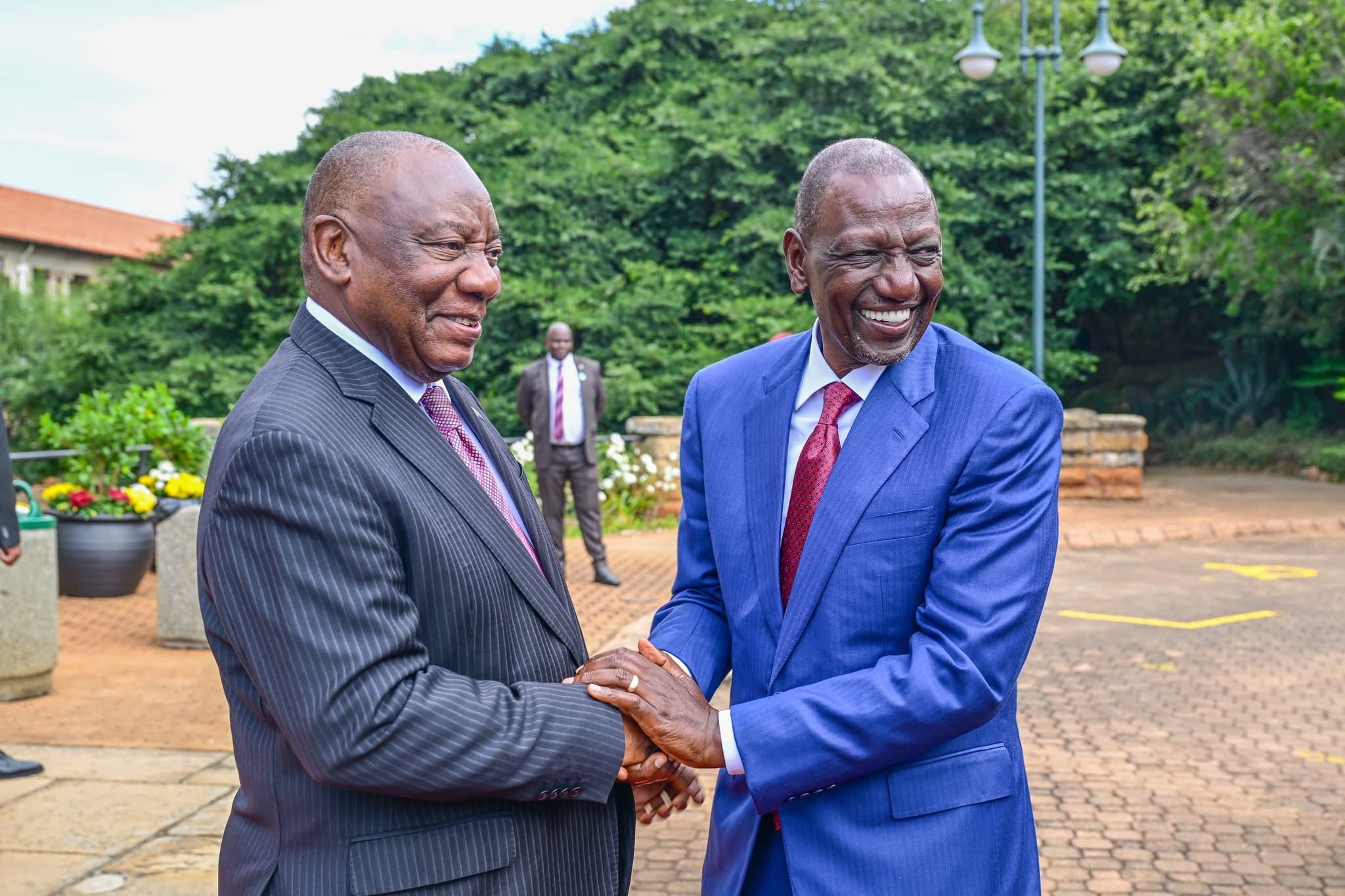
President William Ruto’s state visit to South Africa has drawn a mixed response across Kenya and South Africa, with supporters hailing it as a strategic push to deepen trade and regional integration, while critics question its cost and the extent to which it delivers immediate benefits to citizens facing economic pressures at home.
The two-day visit, which included high-level talks in Pretoria and a business forum in Johannesburg, focused on strengthening bilateral relations between Kenya and South Africa, with emphasis on trade, investment, industrial cooperation and continental economic integration.
Speaking after discussions with South African Deputy President Paul Mashatile, President Ruto said both countries were committed to elevating their partnership and ensuring that agreements reached are implemented effectively for mutual benefit.“We are committed to elevating the already strong relations between our two nations for the mutual benefit of our countries and peoples. We are determined to translating each commitment and agreement into concrete results,” Ruto said.
The visit underscored efforts by Nairobi and Pretoria to deepen economic ties between two of Africa’s most industrialised economies, with leaders pointing to significant untapped potential in manufacturing, infrastructure development and cross-border value chains.
Ruto said Kenya–South Africa trade relations were already strong but still held vast room for expansion.
“Kenya-South Africa trade ties are strong and growing, but much still needs to be done and many opportunities and potential remain unlocked,” he said.
He added that agreements signed during the visit were designed to remove structural barriers to trade and strengthen regional competitiveness.
“The agreements we signed today will help us harmonise regulations and standards, foster regional and continental integration, improve infrastructure, and revitalise value chains, among other critical interventions,” he said.
The President also emphasised the importance of leveraging regional and continental frameworks, including the East African Community (EAC), Southern African Development Community (SADC), Common Market for Eastern and Southern Africa (COMESA), and the African Continental Free Trade Area (AfCFTA).
“We have also resolved to leverage on regional platforms like the East African Community, Southern African Development Community and the Common Market for Eastern and Southern Africa as well as continental initiatives such as the African Continental Free Trade Area to deliver accelerated economic growth,” Ruto said.
A key highlight of the visit was the Kenya–South Africa Joint Business Forum in Midrand, Johannesburg, where President Ruto and South African President Cyril Ramaphosa engaged private sector leaders from both countries.
Ruto encouraged companies to take advantage of emerging cross-border opportunities, particularly in manufacturing, finance, agriculture, logistics and the digital economy.
“Alongside President Cyril Ramaphosa, addressed the Kenya-South Africa Joint Business Forum in Midrand, Johannesburg. Encouraged by the readiness of many companies to expand across borders,” he said.
He described South Africa as a financial and manufacturing powerhouse in the region, while positioning Kenya as a gateway to East and Central Africa, noting that the two economies are naturally complementary and well-placed to drive regional trade expansion.
Supporters of the visit have described it as an important step in strengthening Kenya’s diplomatic and economic footprint in Africa. Government-aligned voices argue that such engagements are essential for attracting investment, opening new markets for Kenyan exports, and reinforcing Kenya’s role in continental trade frameworks.
They point to the agreements signed and high-level engagements as evidence of Kenya’s growing influence in regional economic diplomacy, particularly within the AfCFTA framework, which seeks to boost intra-African trade and industrial collaboration.
However, the visit has also sparked criticism in Kenya, where sections of the public and political commentators questioned its timing and value amid domestic economic challenges.
Critics argue that while foreign policy engagements are important, they must produce clear and measurable benefits for citizens, particularly at a time when households are grappling with high living costs, unemployment and fiscal constraints.
Some questioned whether agreements signed abroad would translate into immediate outcomes such as job creation, increased exports, or direct investment inflows, or whether they remain largely diplomatic in nature.
Others raised broader concerns about the cost of foreign travel and whether government priorities sufficiently reflect pressing domestic economic realities.
In South Africa, reactions to the visit were generally subdued and largely overshadowed by domestic socio-economic issues, including unemployment, inequality and energy challenges.
While business stakeholders welcomed the prospect of deeper Kenya–South Africa cooperation, public discourse was more focused on internal economic pressures than on regional diplomatic engagement.
Analysts noted that such state visits often attract limited public attention in South Africa unless they produce immediate, visible economic impact.
Despite differing reactions, both governments reaffirmed their commitment to strengthening bilateral relations and accelerating African economic integration.
President Ruto has insisted that the success of the visit will be measured not by ceremonial outcomes, but by implementation.
“We are determined to translating each commitment and agreement into concrete results,” he said.
Observers now say the real test lies in whether the agreements signed in Pretoria and Johannesburg will translate into increased trade flows, expanded investment, and tangible economic opportunities for citizens in both countries.


