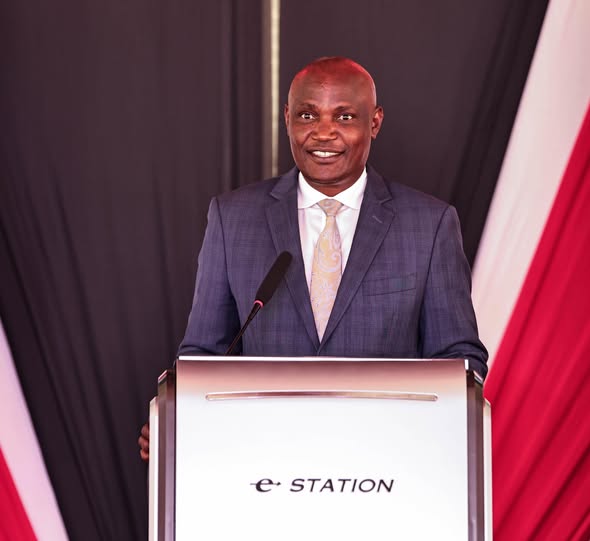
The National Treasury Cabinet Secretary John Mbadi has presented a KSh 4.82 trillion Budget for the 2026/27 financial year before the National Assembly of Kenya, outlining an expansive fiscal plan anchored on education, health, agriculture, and youth employment while signalling continued reliance on domestic borrowing.
Mbadi said the Budget reflects the shared economic transformation aspirations of President William Ruto and the late opposition leader Raila Odinga, noting that it is designed to accelerate Kenya’s transition toward a more inclusive and industrialised economy.
Of the total expenditure framework, KSh 3.57 trillion has been allocated to recurrent expenditure, while KSh 750 billion has been set aside for development spending, including domestically and externally financed projects, the Contingency Fund, and the Equalization Fund.
County governments are set to receive KSh 502 billion through equitable share and additional allocations supported by national government revenue, loans, and development partner grants.
Education once again dominated ministerial allocations, receiving KSh 784.5 billion, reaffirming its position as the government’s largest spending priority.
The allocation includes KSh 424.3 billion for the Teachers Service Commission, KSh 136.6 billion for basic education, KSh 163.9 billion for higher education, KSh 58.5 billion for Technical and Vocational Education and Training (TVET), and KSh 1.3 billion for science, innovation and research.
Mr Mbadi further announced major staffing reforms in the sector, saying 20,000 intern teachers will be absorbed into permanent and pensionable terms from January 2027 at a cost of KSh 4.9 billion. A further 24,000 intern teachers will be regularised in July 2027, with KSh 8.2 billion allocated to support the exercise.
The health sector has been allocated KSh 177.2 billion to strengthen Universal Health Coverage (UHC) and improve access to essential services.
Key allocations include KSh 8.6 billion for salaries of UHC staff and KSh 19.1 billion for the Primary Healthcare Fund aimed at strengthening frontline services. In addition, KSh 18.5 billion has been allocated to the Global Fund, while KSh 6.4 billion will support vaccines and immunisation programmes.
“These investments will protect children and communities and reduce health-related economic shocks,” Mr Mbadi told the House.
The agriculture sector has been allocated KSh 64 billion, with a significant portion directed towards input subsidies aimed at lowering production costs for farmers. This includes KSh 18 billion for fertiliser subsidies, KSh 2 billion for the seed subsidy programme, and KSh 1 billion for coffee seedlings.
Youth-focused programmes also received expanded funding, including KSh 12.5 billion for the National Youth Service, KSh 4.9 billion for the NYOTA project, KSh 1.6 billion for youth employment support, and KSh 1 billion for film development services.
Mr Mbadi told lawmakers that the fiscal deficit, including grants, is projected at KSh 1.146 trillion. It will be financed through net external borrowing of KSh 116.2 billion and net domestic borrowing of KSh 1.03 trillion, underscoring continued reliance on the domestic debt market.
Outlook
While the Budget prioritises social sectors such as education, health, agriculture, and youth empowerment, concerns are likely to persist over the high recurrent expenditure and the growing dependence on domestic borrowing, which could exert pressure on the country’s fiscal stability in the medium term.


