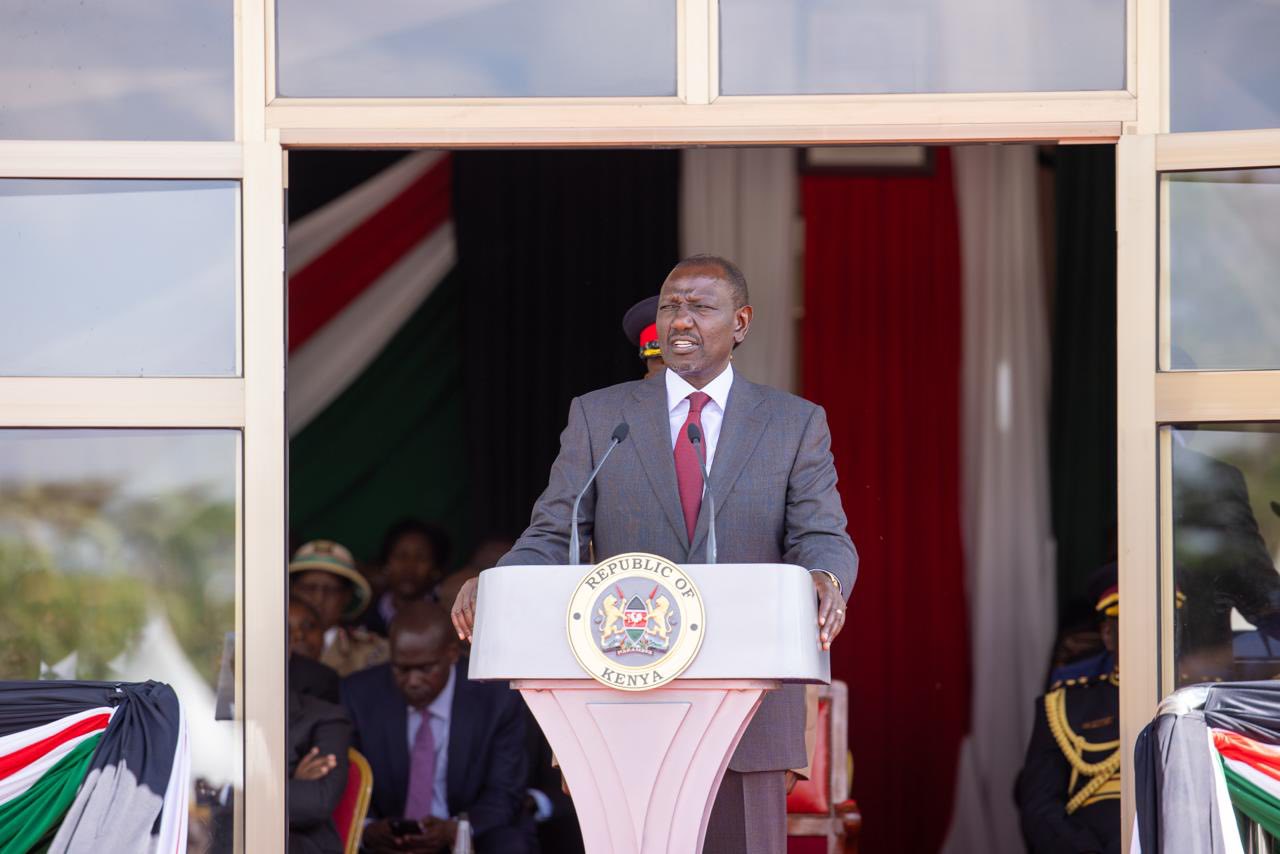
President William Samoei Ruto has unveiled a government-backed framework to compensate victims of human rights violations arising from protests and picketing, in what is shaping up to be one of the most consequential policy responses to Kenya’s long-running crisis over policing of demonstrations.
The announcement, made at State House Nairobi during the receipt of a report by the Kenya National Commission on Human Rights (KNCHR), comes at a time when Kenya’s record on civil liberties is once again under sharp domestic and international scrutiny, with renewed allegations of abductions, enforced disappearances, and excessive use of force by security agencies.
The report, titled Framework for Compensation and Reparations for Victims of Human Rights Violations During Protests and Picketing, seeks to establish a structured mechanism for identifying victims, verifying claims, and offering state compensation for harm suffered during public demonstrations.
“For far too long, whenever Kenyans have exercised their constitutional and democratic rights to assemble, picket, demonstrate and petition, the outcome has too often been marked by violence, injury, loss of life, destruction of property, bitterness, and division,” President Ruto said.
He acknowledged that in some instances, the response of security agencies to protests had involved “excessive force”, resulting in further violations of rights and, tragically, the loss of innocent lives. He added that successive governments had repeatedly condemned such incidents but failed to fundamentally resolve the underlying challenge.
“Today, we have chosen to act. We do so because the cost of inaction is far greater than the cost of undertaking the difficult but necessary work of reform,” the President said.
The Head of State linked the initiative to the National Dialogue Committee process initiated in 2023, which brought together leaders from across the political divide, including former Prime Minister Raila Odinga, with the aim of addressing long-standing political grievances, stabilising the country, and strengthening democratic institutions.
However, the announcement comes against a backdrop of intensified scrutiny over Kenya’s human rights environment, particularly during the Ruto administration, which has faced sustained criticism from civil society organisations over alleged abductions and extrajudicial killings linked to protest cycles and government critics.
According to KNCHR reports and civil society documentation covering recent protest periods, dozens of deaths have been recorded during demonstrations over the past few years, alongside hundreds of reported injuries and arrests. Rights groups further allege that at least 15 to 20 cases of abductions were documented within a single year during heightened political tensions, with several victims still unaccounted for.
Human rights organisations have consistently warned that enforced disappearances have become a recurring feature of Kenya’s protest policing landscape, with families of victims often left without information on the whereabouts of their relatives or the circumstances surrounding their disappearance.
International watchdogs, including Human Rights Watch, have also raised concerns over what they describe as a pattern of unlawful detentions, excessive force, and lack of accountability for security officers implicated in protest-related abuses. Some reports have further alleged that victims were subjected to torture or inhumane treatment while in custody, with limited judicial recourse available to survivors.
Civil society groups have gone further, alleging the existence of covert security units allegedly involved in abductions and intimidation of activists and critics of the government. These claims, which have not been independently verified, have nonetheless fuelled public anxiety and deepened mistrust between sections of the public and security institutions.
The government has consistently denied operating any illegal or “killer squads”, insisting that all security operations are conducted within the law and that any officers implicated in wrongdoing are subject to internal disciplinary processes and judicial action.
Nonetheless, the persistence of allegations has continued to cast a shadow over Kenya’s human rights reputation, with critics arguing that the country has experienced one of its most challenging periods in recent memory in terms of civil liberties and protest management.
President Ruto, while not directly addressing the full extent of the allegations, maintained that the new reparations framework was part of a broader effort to restore dignity to victims and rebuild trust in public institutions.
“Our duty is not only to protect these freedoms, but also to ensure that they are exercised in an environment where human dignity is respected, lives are protected, and justice is upheld,” he said.
The compensation plan is expected to be operationalised through further policy guidelines following the KNCHR report, and will likely involve coordination between the Interior Ministry, Treasury, and human rights bodies to establish eligibility criteria and funding mechanisms.
The announcement is expected to ignite renewed political debate in Parliament and among civil society actors over accountability for past protest-related deaths, the conduct of security agencies, and whether the state is doing enough to confront allegations of systemic abuses.


