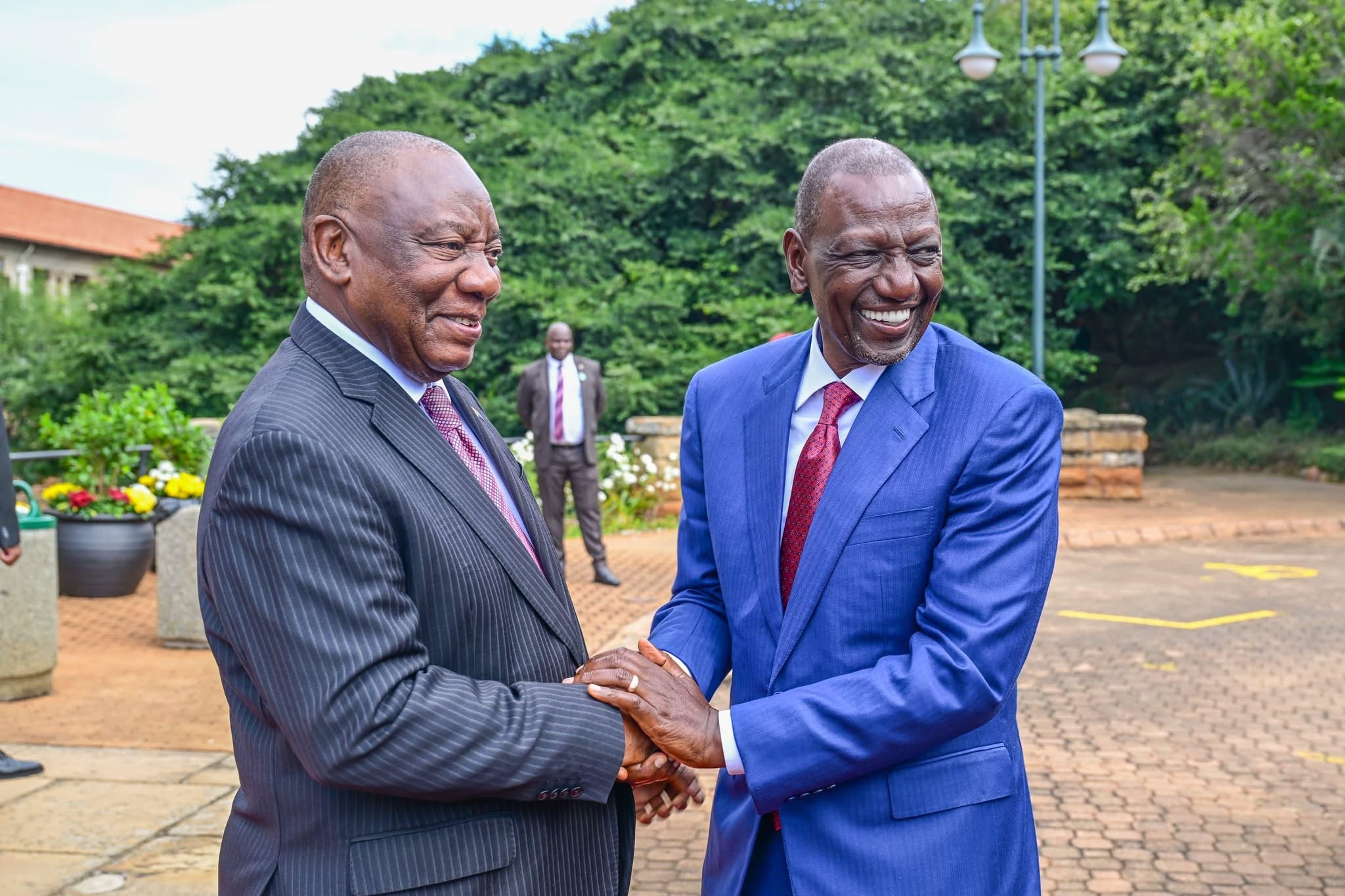
President William Ruto has called on the international community to support Africa's industrialisation and value-addition agenda, arguing that the continent holds the key to the next phase of global economic growth.
Speaking during the G7+ Working Session on Reviving Balanced and Shared Growth for All in Évian, France, the President said Africa should no longer be viewed merely as a source of raw materials but as a partner capable of driving manufacturing, innovation and industrial expansion.
"The international community must pay attention to Africa. Our continent is central to the future of global growth and shared prosperity," President Ruto said.
With some of the world's fastest-growing economies, a youthful population and abundant natural resources, Africa is uniquely positioned to shape the future of the global economy, he added.
However, the President insisted that the continent's development must be anchored on local value addition rather than the continued export of raw materials for processing abroad.
"But Africa is not seeking partnerships built on the extraction of raw materials for processing elsewhere. We seek a different model of growth, one that creates value on our continent," he said.
"Let us process our minerals in Africa, manufacture in Africa, build industries in Africa, and create jobs in Africa, while sharing the benefits through partnerships that create prosperity for both Africa and our global partners."
The Head of State argued that a stronger African economy would benefit the rest of the world through stronger supply chains, larger markets and greater investment opportunities.
"A stronger Africa will mean stronger supply chains, larger markets, greater investment opportunities and more resilient global growth," he told the forum attended by leaders of major economies.
The remarks are in line with Kenya's push for industrialisation and value addition, particularly in agriculture, mining and manufacturing, sectors the government views as critical to job creation and export growth.
Yet even as President Ruto positioned himself as a champion of Africa's economic transformation on the global stage, his message is likely to face scrutiny back home where critics say the administration's lofty ambitions contrast sharply with the economic realities confronting many Kenyans.
Opposition leaders have argued that while the government speaks about shared prosperity and industrial growth, many households continue to struggle with the high cost of living, unemployment and rising taxes.
Former Deputy President Rigathi Gachagua, now one of the President's fiercest critics, has repeatedly accused the administration of overburdening citizens through taxation and failing to address the economic hardships facing ordinary Kenyans.
The criticism has been amplified by memories of the 2024 anti-Finance Bill protests, which saw thousands of young Kenyans take to the streets in opposition to proposed tax measures. The demonstrations culminated in the withdrawal of the Finance Bill after widespread public opposition, marking one of the most significant political setbacks of President Ruto's administration.
Critics argue that the protests exposed a disconnect between the government's economic policies and public sentiment, particularly among young people facing unemployment and rising living costs.
Opposition leaders have also questioned Kenya's readiness to become a manufacturing hub, citing concerns over the cost of doing business, energy prices and the pace of industrial growth.
For the government, however, the push for value addition remains central to its long-term economic strategy. Officials argue that industrialisation is necessary to create jobs, expand exports and reduce dependence on imported goods.
The debate highlights the competing narratives surrounding President Ruto's economic agenda. Abroad, he is presenting Africa as the next frontier of global growth and investment. At home, critics are demanding tangible improvements in livelihoods before embracing broader visions of continental transformation.


