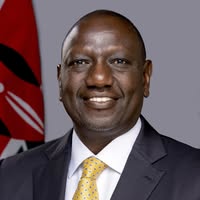
President William Ruto's latest attack on Standard Media Group has triggered a fierce public debate about media freedom, democratic accountability, and the role of independent institutions in Kenya.
Speaking on Wednesday, Ruto took aim at KANU Chairman Gideon Moi and the media house associated with his family, accusing The Standard of running what he termed an "extortionist propaganda" campaign against his administration.
"Gideon Moi, your Standard Media's five-days-a-week extortionist propaganda headlines on me and my administration's transformative track record will not distract us from delivering to the people of Kenya," the President said.
The remarks came amid growing tensions between the Kenya Kwanza administration and sections of the media that have consistently scrutinized government policies, taxation measures, governance decisions, and economic performance.
However, the President's comments immediately drew criticism from political commentator Maliba Arnold, who framed the confrontation as part of a wider struggle over democratic institutions.
In a strongly worded statement, Arnold argued that democracy rests on five pillars — Parliament, the Executive, the Judiciary, the Media, and Civil Society — and claimed that several of those institutions have come under increasing pressure.
"Parliament has become an annex of the Executive. Civil society was systematically weakened and is only now struggling to regenerate. The Judiciary, despite underfunding and its many faults, remains the last refuge of the ordinary citizen. The media has been starved, threatened and squeezed by a state that understands one truth: accountability is inconvenient," Arnold wrote.
He singled out Standard Group for what he described as its role in holding power to account, arguing that the media house has continued to perform a watchdog function even as other institutions face challenges.
"Yet through it all, Standard Group has stood watch. At times, it has done the work civil society should have been doing. It has carried the torch when others dropped it," he said.
Arnold went further, linking the current political climate to what some activists have described as a "Third Liberation" movement aimed at defending constitutionalism, accountability, and democratic freedoms.
"As the forces of the Third Liberation march into the city, they may well be wearing Standard Group t-shirts," he remarked.
The commentator also took issue with Ruto's characterization of Gideon Moi, suggesting that the President's criticism raised broader questions about the concentration of power within the state.
"Today, the President suffered a public meltdown and called Gideon Moi greedy. If Gideon is greedy, then what do we call a man who wants Parliament, the courts, the media, civil society, and every inch of the Republic under his control?" Arnold posed.
He concluded with a sharp rebuke directed at the Head of State.
"Greedy is too small a word. Tumbo lisiloshiba."
The exchange highlights the increasingly adversarial relationship between the government and parts of the media establishment as political temperatures begin to rise ahead of the 2027 General Election.
While supporters of the President argue that some media outlets have adopted partisan editorial positions, critics maintain that robust journalism and institutional independence are essential safeguards in a constitutional democracy.
The latest confrontation is therefore about more than a disagreement between President Ruto and Standard Media Group. It has evolved into a wider contest over the role of the media, the strength of democratic institutions, and the limits of executive power in Kenya's evolving political landscape.


