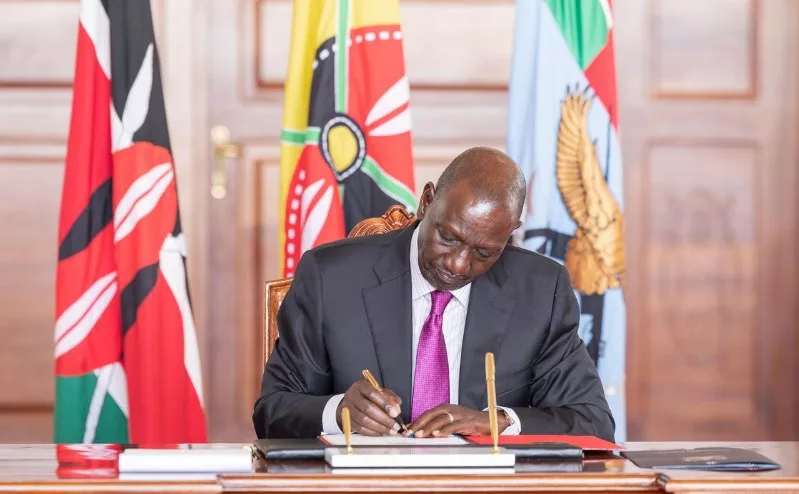
President William Ruto has assented to the Central Bank of Kenya (Amendment) Bill, 2026, and the Parliamentary Pensions (Amendment) Bill, 2023, during a ceremony held at State House, Nairobi.
The signing marks the final stage in the legislative process for the two Bills, paving the way for the implementation of significant reforms in Kenya's financial sector and parliamentary pension system.
The Central Bank of Kenya (Amendment) Act, 2026, introduces wide-ranging changes to strengthen the country's monetary and financial stability framework.
Among the key reforms is the separation of routine monetary policy operations from Emergency Liquidity Assistance (ELA), with the new law establishing stricter conditions under which commercial banks can access emergency financial support from the Central Bank of Kenya (CBK).
The legislation also elevates financial stability as a secondary objective of the CBK, reinforcing the institution's role in safeguarding the country's financial system alongside its core mandate of maintaining price stability.
Additionally, the law requires Deputy Governors of the Central Bank to undergo approval by the National Assembly before appointment, introducing an additional layer of parliamentary oversight.
The amendments further formalise the CBK's role in capacity building and institutional collaboration, update references relating to the Kenya Deposit Insurance framework, and empower the Bank to deal in gold and other precious metals as part of its financial operations.
President Ruto also signed the Parliamentary Pensions (Amendment) Bill, 2023, which updates the parliamentary pension scheme to align it with the Constitution of Kenya, 2010, following the establishment of a bicameral Parliament.
The new law extends pension benefits to members of both the National Assembly and the Senate, replacing provisions that previously applied only to a unicameral legislature.
It also redefines a child for pension purposes as a person below the age of 18 years and restructures the management committees overseeing the pension scheme to include representation from both Houses of Parliament.
Another notable provision limits gratuity payments to legislators who serve for less than five years, bringing greater clarity to the administration of parliamentary retirement benefits.
The enactment of the two laws forms part of the government's broader legislative reform agenda aimed at strengthening financial governance, improving institutional accountability, and updating existing laws to reflect the country's constitutional framework.


