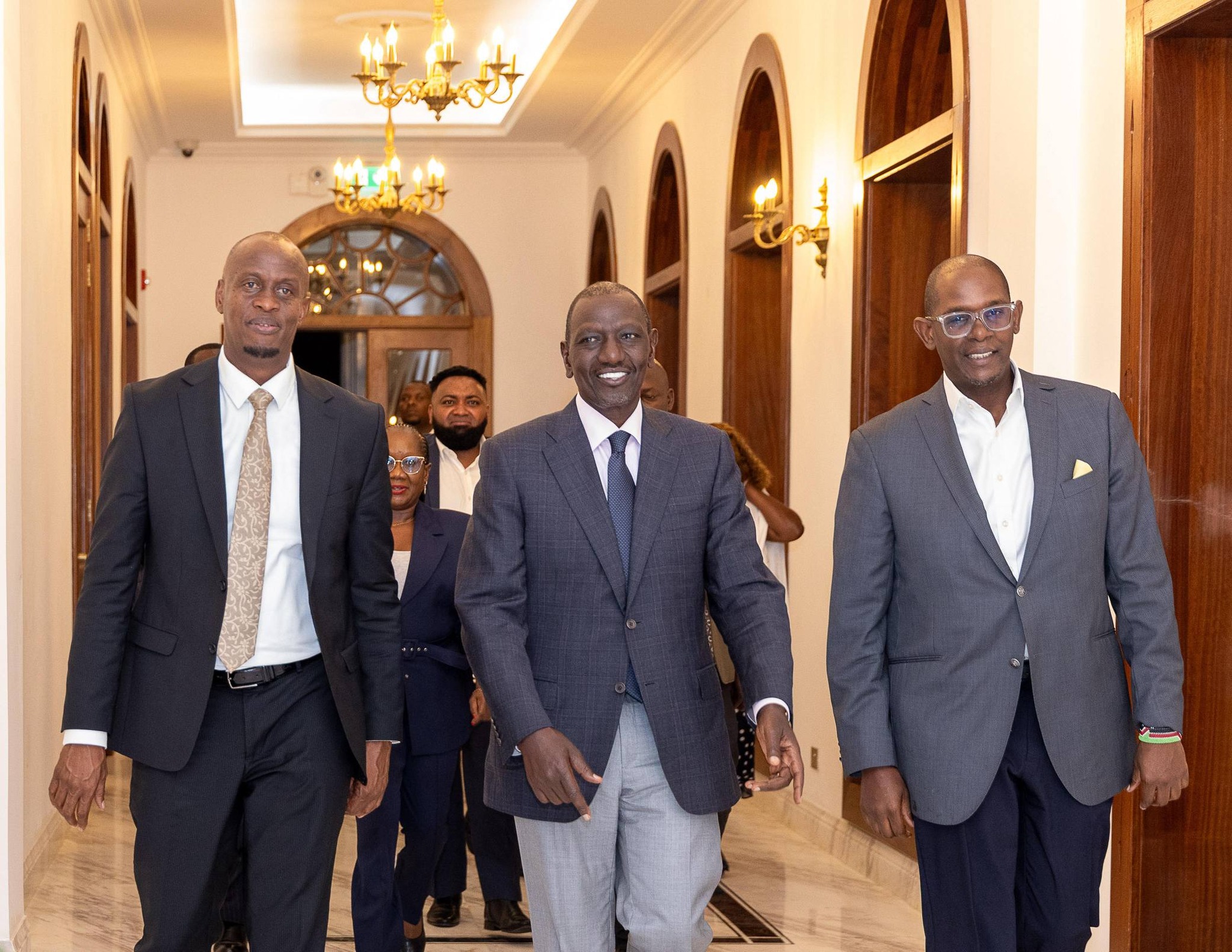
President William Ruto has doubled down on his administration's controversial health reforms, announcing that 32 million Kenyans have been registered under the Social Health Authority (SHA) even as critics continue to question the rollout of the universal healthcare programme.
Speaking after a meeting with telecommunications industry leaders at State House, Nairobi, the President said mobile service providers would play a bigger role in expanding registration and introducing flexible payment options to boost enrolment.
"I am pleased to note that 32 million Kenyans are already registered with SHA and are accessing healthcare services paid for by Government," President Ruto said.
He said the government had agreed with telecommunications companies to introduce Lipa SHA Pole Pole, allowing Kenyans to make health insurance contributions in flexible instalments. The firms will also be integrated into the SHA platform to simplify registration and payments.
The President's latest defence of SHA comes against the backdrop of mounting political criticism over the programme, which replaced the National Health Insurance Fund (NHIF) as the cornerstone of the Kenya Kwanza administration's Universal Health Coverage (UHC) agenda.
Since its rollout, SHA has faced persistent complaints from patients, hospitals and healthcare workers. Some private and faith-based hospitals have periodically suspended services, citing delayed reimbursements, while patients have reported difficulties accessing treatment due to system downtimes, registration challenges and uncertainty over benefit packages. Medical associations have also raised concerns over the pace of implementation, arguing that operational gaps have disrupted service delivery.
The reforms have become one of the administration's most politically contested programmes.
Former Deputy President Rigathi Gachagua has emerged as one of SHA's fiercest critics since his fallout with President Ruto. Addressing public rallies in recent months, Mr Gachagua has claimed the new system has left vulnerable Kenyans struggling to access healthcare, accusing the government of dismantling NHIF before putting in place a fully functional replacement.
"There was no need to kill NHIF before ensuring the new system was working. Ordinary Kenyans are suffering because of poor planning," Mr Gachagua said during a recent address in the Mt Kenya region.
He has also accused the government of turning healthcare into a political experiment, arguing that patients should not bear the cost of what he describes as policy failures. Mr Gachagua has called for a comprehensive review of SHA and compensation for hospitals affected by delayed payments.
Opposition leaders have echoed similar concerns.
ODM Secretary-General Edwin Sifuna has questioned the government's repeated assurances that the programme is working, arguing that official registration figures do not necessarily translate into quality healthcare.
"Kenyans are not interested in registration statistics. They want to walk into a hospital and receive treatment without being turned away," Mr Sifuna said during a recent media interview.
Wiper leader Kalonzo Musyoka has also accused the administration of rushing the reforms without adequate public participation, while DAP-K leader Eugene Wamalwa has urged the government to address funding gaps and restore confidence among healthcare providers.
The government has, however, maintained that implementation challenges are expected in any major reform programme. President Ruto has insisted that Universal Health Coverage remains central to his administration's Bottom-Up Economic Transformation Agenda, arguing that the transition from NHIF was necessary to create a more equitable and sustainable healthcare financing system.
Health Cabinet Secretary Aden Duale has similarly defended the reforms, saying the government is working to resolve payment delays, improve digital infrastructure and ensure that all eligible facilities are brought onto the SHA platform.
With less than two years before the next General Election, political analysts say the performance of SHA could become one of the defining issues of the 2027 campaigns. For the Kenya Kwanza administration, proving that the reforms can deliver affordable and reliable healthcare may be as important politically as it is economically, while the opposition continues to frame the programme as evidence of failed policy implementation.


