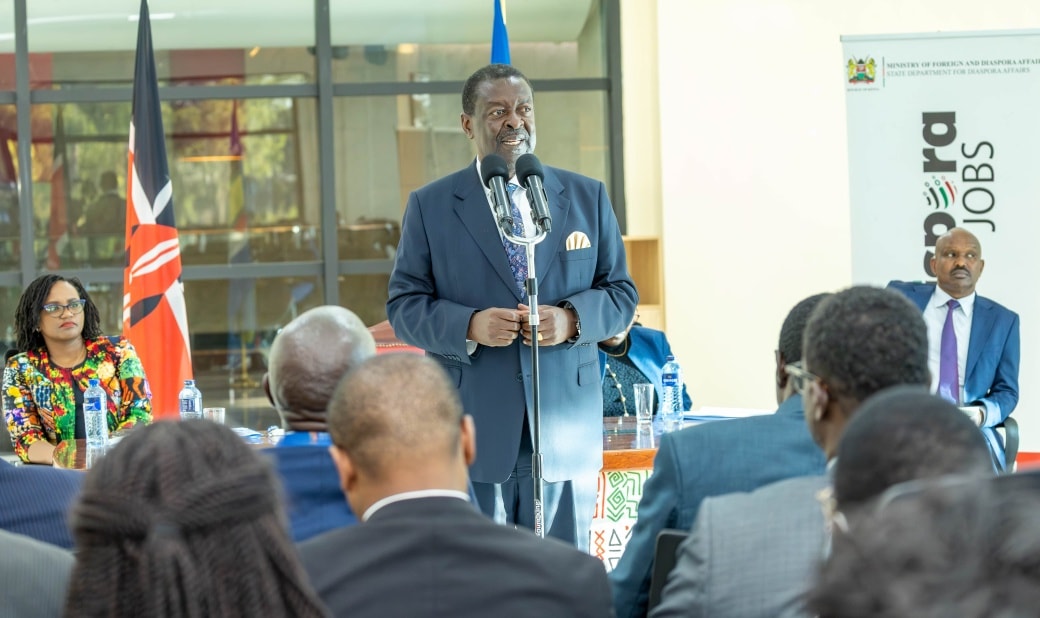
Prime Cabinet Secretary Musalia Mudavadi has warned that political divisions among leaders in Western Kenya could hand Trans Nzoia Governor George Natembeya a strategic advantage ahead of the 2027 General Election, underscoring the intensifying battle for control of one of the country's most influential voting blocs.
Addressing leaders from the region, Mr Mudavadi urged them to close ranks behind the Kenya Kwanza administration, arguing that internal rivalries risk weakening Western Kenya's political influence while giving opponents an opportunity to consolidate support.
"Politics is about numbers. When we are divided, we weaken ourselves and strengthen our competitors," he said, as he appealed for unity within the ruling coalition.
The remarks are widely seen as an acknowledgement of Mr Natembeya's growing political influence, with the Trans Nzoia governor increasingly positioning himself as the face of an alternative political movement in Western Kenya through his Tawe Movement.
Mr Natembeya has spent the past year traversing the region, accusing the Kenya Kwanza administration of neglecting Western Kenya despite its support for President William Ruto in the 2022 General Election. He has urged leaders to unite under a regional political vehicle capable of negotiating for the area's interests from a position of strength.
The governor's rise has unsettled the region's traditional political establishment led by Mr Mudavadi and National Assembly Speaker Moses Wetang'ula, both of whom have urged residents to rally behind the ruling coalition.
Their rivalry has grown increasingly public.
Last November, Mr Mudavadi warned Mr Natembeya against persistently attacking Kenya Kwanza leaders, saying: "If you live in a glass house, don't throw stones because you also live in a glass house." He also declared that the coalition would field a strong candidate to challenge the governor in the 2027 elections, saying, "We will have our candidates in Trans Nzoia who will remove you."
Mr Natembeya responded by accusing the Prime Cabinet Secretary of losing touch with ordinary Kenyans' concerns.
"Kenya does not need more political lectures. Kenyans want solutions. People are struggling with the cost of food, education and healthcare," he said earlier this year while dismissing Mr Mudavadi's call for a referendum.
The exchange highlighted the widening ideological and political divide between the two leaders, with Mr Mudavadi championing unity within Kenya Kwanza while Mr Natembeya argues that Western Kenya requires independent leadership capable of demanding a greater share of national resources.
Political analysts say Mr Mudavadi's latest warning reflects growing concern within Kenya Kwanza over Mr Natembeya's expanding influence, particularly among young voters frustrated by the high cost of living, unemployment and what they see as slow implementation of development projects.
For decades, Western Kenya politics has revolved around Mr Mudavadi and Mr Wetang'ula, whose political parties eventually aligned with President Ruto's coalition. However, Mr Natembeya's emergence has disrupted that dominance and introduced a new contest for regional leadership.
Mr Mudavadi insisted that Western Kenya would wield greater influence by remaining united within Kenya Kwanza rather than splintering into competing political formations.
He also reaffirmed his commitment to President Ruto's re-election bid, saying the coalition remained the best platform for advancing the region's development agenda.
The contest is expected to intensify as political realignments gather pace ahead of the 2027 General Election, with both Kenya Kwanza and Mr Natembeya seeking to win over the region's sizeable voting bloc. Analysts believe the outcome could determine not only who speaks for Western Kenya but also its bargaining power in the next national government.


