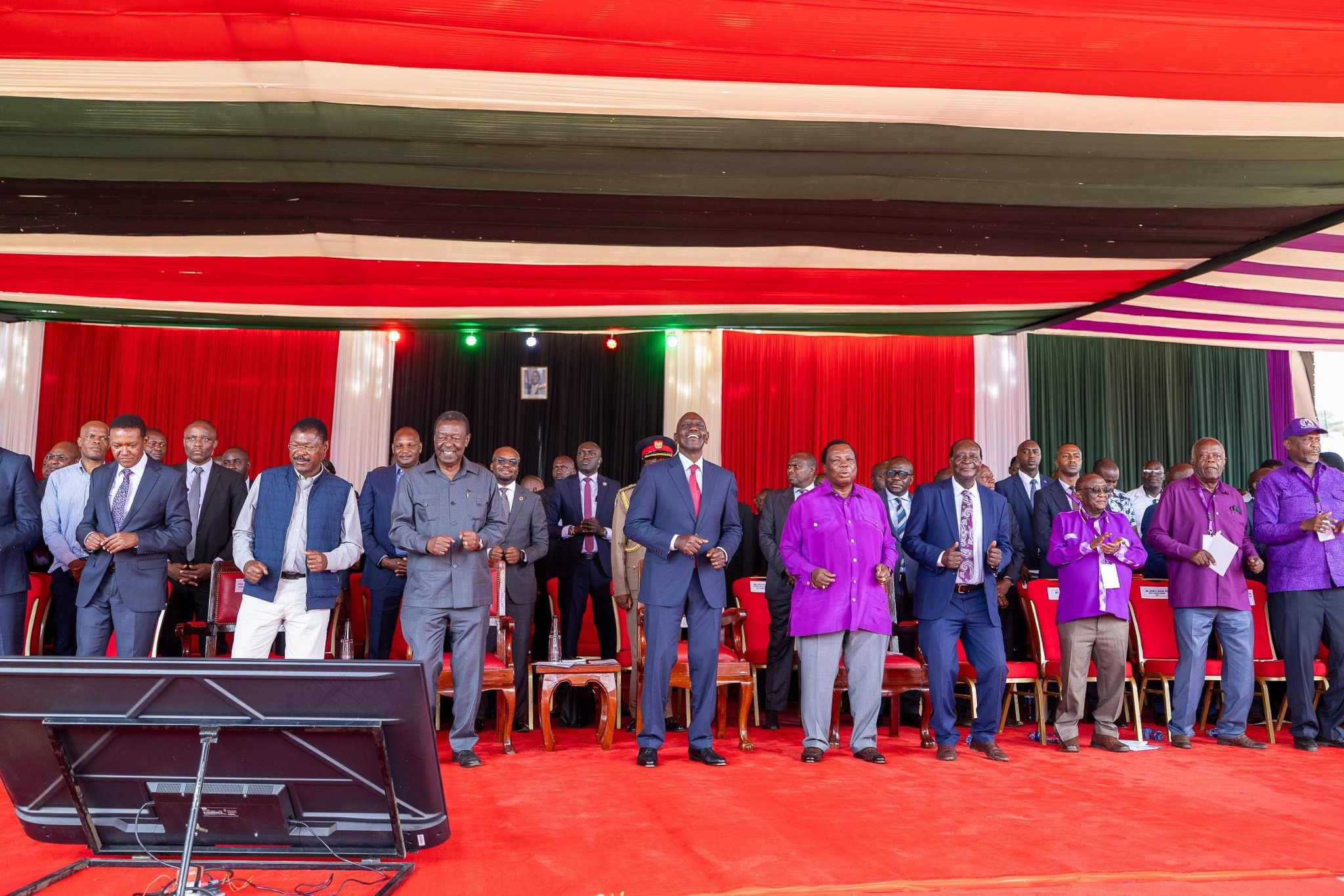
National Assembly Speaker Moses Wetang'ula has moved to challenge a High Court judgment that declared President William Ruto's Cabinet unconstitutional for failing to comply with the Constitution's two-thirds gender rule.
The Speaker has filed an appeal against the June 30 decision by a three-judge bench comprising Justices Eric Ogola, Stephen Githinji and Jairus Ngaah, which found that the composition of the Cabinet violates Article 27(8) of the Constitution.
The judges held that the Cabinet does not meet the constitutional requirement that no more than two-thirds of members of appointive public bodies should be of the same gender.
The ruling marked a significant setback for the Kenya Kwanza administration, with the court finding that President Ruto had failed to fulfil the constitutional obligation of ensuring gender balance in one of the country's highest decision-making organs.
In his appeal, Mr Wetang'ula argues that the judges erred in their interpretation of the Constitution and the role of Parliament in approving Cabinet appointments.
He is expected to ask the Court of Appeal to overturn the judgment, arguing that the National Assembly lawfully vetted and approved Cabinet nominees presented by the President in accordance with the Constitution and existing statutes.
The appeal also raises questions over whether the High Court properly interpreted the application of Article 27(8), which requires the State to take legislative and other measures to implement the principle that no more than two-thirds of members of elective or appointive bodies shall be of the same gender.
The June 30 judgment followed a petition challenging the legality of the Cabinet's composition, with the petitioners arguing that the Executive had failed to uphold constitutional provisions on gender equality and inclusivity.
In their decision, the judges agreed, declaring that the Cabinet's composition did not satisfy constitutional standards despite previous court decisions directing the State to implement the two-thirds gender principle.
The ruling renewed debate over the State's continued failure to fully implement the gender rule more than a decade after the promulgation of the 2010 Constitution.
While the Constitution entrenches the two-thirds gender principle, successive governments have struggled to comply fully with the requirement, particularly in elective bodies such as Parliament. The issue has repeatedly been the subject of litigation and unsuccessful legislative attempts to enact mechanisms for implementation.
Mr Wetang'ula's appeal now shifts the dispute to the Court of Appeal, where judges will determine whether the High Court correctly interpreted the constitutional provisions governing Cabinet appointments and gender representation.
The outcome of the appeal could have far-reaching implications for the composition of President Ruto's Cabinet and the implementation of the two-thirds gender rule in appointive public offices.
If the Court of Appeal upholds the High Court decision, the government could be compelled to reconstitute the Cabinet to comply with the Constitution. However, if the appeal succeeds, the current Cabinet would remain intact unless the matter is escalated to the Supreme Court.


