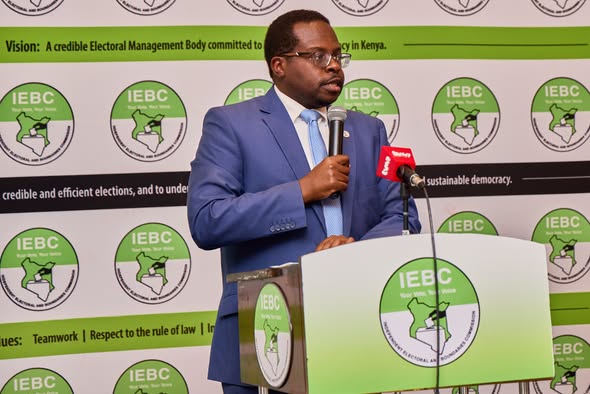
The credibility of Kenya's future elections will largely depend on the Judiciary's ability to independently resolve electoral disputes, the Law Society of Kenya (LSK) has said, warning that public confidence in election management could significantly decline if the courts fail to effectively discharge their constitutional mandate.
Speaking during the launch of the Pre-Election Dispute Resolution Report and the Case Digest on Decisions of the IEBC Dispute Resolution Committee for the 2022 General Election, Charles Kanjama said electoral justice is central to safeguarding democracy and maintaining public trust in elections.
"The level of trust in election management will be much lower if the Judiciary does not play its role," Kanjama said.
His remarks come as the Independent Electoral and Boundaries Commission (IEBC) and key stakeholders begin reviewing lessons from the 2022 General Election ahead of preparations for the 2027 polls.
Kanjama revealed that the Law Society has established a committee on election operations to review previous electoral processes, identify shortcomings and recommend reforms that will strengthen the country's electoral legal framework.
He said the committee will examine both the successes and failures witnessed during past elections with a view to improving the handling of election-related disputes before and after polling day.
"We hope to learn from the mistakes and gaps from past elections while benefiting from the good experiences," he said.
The LSK President also announced that the society is ready to partner with the IEBC in developing a comprehensive casebook on post-election dispute resolution to complement the Commission's newly launched publications on pre-election disputes.
The proposed casebook is expected to document key court decisions arising from election petitions, providing guidance to judges, lawyers, election administrators, political parties and scholars involved in electoral governance.
Kanjama said documenting electoral jurisprudence would help improve consistency in judicial decisions while strengthening the legal framework governing elections.
The IEBC's latest publications capture how its Dispute Resolution Committee handled nomination and other pre-election disputes during the 2022 General Election, offering lessons and recommendations for future polls.
The Commission has maintained that strengthening dispute resolution mechanisms is one of the key reforms necessary to enhance public confidence ahead of the 2027 General Election.
Election-related disputes have historically been among the most contentious aspects of Kenya's electoral cycle, with disagreements over party nominations, candidate eligibility and election outcomes often ending up before tribunals and the courts. Stakeholders argue that a predictable, independent and efficient dispute resolution system will be critical in ensuring peaceful and credible elections in 2027.


