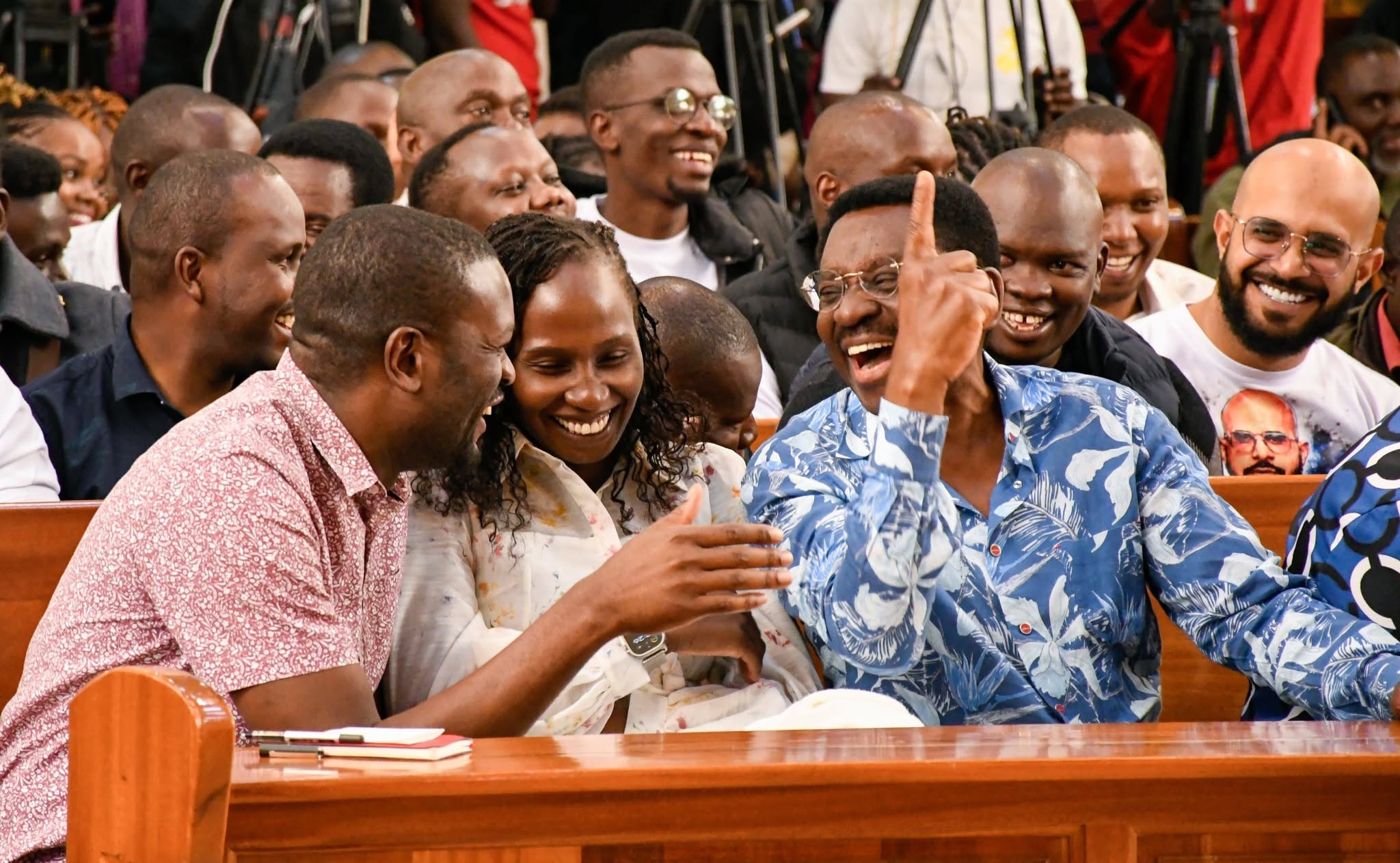
President William Ruto and his allies face a fresh battle for Western Kenya as Nairobi Senator Edwin Sifuna and the Linda Mwananchi movement step up their campaign to capture the region ahead of the 2027 General Election.
Sifuna has in recent weeks taken his presidential ambitions directly to the grassroots, touring counties across the region and presenting Linda Mwananchi as a vehicle through which Western Kenya can seek a greater role in national leadership.
The campaign has already attracted support from a growing group of politicians, including Trans Nzoia Governor George Natembeya, Vihiga Senator Godfrey Osotsi, Bumula MP Jack Wamboka, Kabuchai MP Majimbo Kalasinga and former Kakamega Senator Cleophas Malala.
Malala, who is Deputy Party Leader of the Democracy for the Citizens Party, on Sunday openly endorsed Sifuna for the 2027 presidential race, pledging to stand with the Nairobi senator.
The developments could complicate Ruto's efforts to reproduce the political coalition that helped him secure substantial support in Western Kenya in the 2022 election.
The region has consequently emerged as one of the key battlegrounds in the race to State House, with both camps seeking to convince voters that they offer the best route to national power.
For Sifuna and his allies, the argument is that Western Kenya has for decades been courted for its votes but has failed to convert its electoral strength into political power.
They want the region to move from being a voting bloc for presidential candidates from elsewhere to producing its own candidate capable of competing for State House.
Sifuna has increasingly placed himself at the centre of that argument.
During his recent tour of Western Kenya, the senator declared that his experience in the Senate had prepared him for the presidency.
“I have been a senator for one term. I have seen enough and I have the experience to be President,” Sifuna said during a Linda Mwananchi rally in Butula, Busia County, on August 7.
The senator has also stepped up his criticism of the Ruto administration, telling supporters that the President should not be given another term.
The message is being reinforced by Natembeya, who has become one of the most prominent faces of the Linda Mwananchi campaign in Western Kenya.
Natembeya has challenged religious leaders who supported Ruto in 2022 to reconsider their position and back efforts to remove him from office in 2027.
The governor's involvement gives Sifuna's campaign a significant regional anchor, particularly in Trans Nzoia, where Natembeya commands an influential political network.
But the campaign is no longer confined to Trans Nzoia.
Linda Mwananchi has moved through Bungoma, Busia, Kakamega, Vihiga and other parts of Western Kenya, holding rallies and meeting local political leaders.
The movement's leaders say their objective is to build a political organisation from the grassroots rather than depend solely on established regional kingpins.
That strategy presents a direct challenge to the political arrangement through which Ruto's allies have sought to consolidate Western Kenya behind his re-election bid.
Ruto allies fight back
Ruto's camp has not been sitting back.
National Assembly Speaker Moses Wetang'ula has been at the forefront of efforts to rally Western Kenya behind the President.
In Bungoma, Wetang'ula urged residents to support Ruto's re-election, arguing that the Kenya Kwanza administration had delivered development projects and deserved another term to complete its agenda.
“We came out in large numbers and created the government in 2022. I want you to do the same in 2027,” Wetang'ula said.
He has pointed to projects in infrastructure, healthcare, agriculture and the revival of industries as reasons for Western Kenya to remain in the Kenya Kwanza camp.
Wetang'ula has also framed continued support for Ruto as a strategic calculation, arguing that backing the incumbent could strengthen the region's bargaining position in the succession politics expected to follow the 2027 election.
“We as your leaders want the leadership of this country, and if you want to get leadership you have to pass through the existing leadership to get it easily,” Wetang'ula said.
Bungoma Governor Kenneth Lusaka, who chairs Ruto's re-election campaign in Western Kenya, has similarly been mobilising support for the President.
Lusaka has urged voters to judge the administration by its development record, citing infrastructure, health and transport projects in the region.
Kakamega Governor Fernandes Barasa has also maintained that Western Kenya is united behind Ruto and should support him for a second term.
Barasa has argued that the region's longer-term ambition should be to position itself to produce the President after Ruto's two terms, rather than disrupt the current political arrangement.
Prime Cabinet Secretary Musalia Mudavadi has similarly remained a key voice in the Ruto camp.
Mudavadi has previously predicted that Ruto will win a second term and urged Western Kenya to support the President before looking beyond 2027.
“I am telling the people of Western Kenya region that President Ruto is going to be re-elected,” Mudavadi said in December 2025.
The competing messages reveal the central political question facing Western Kenya: whether the region should continue backing Ruto in 2027 in exchange for a stronger position in the post-2027 succession, or attempt to produce its own presidential contender now.
Sifuna changes the conversation
Sifuna's campaign is seeking to change that conversation.
Instead of asking voters to choose between competing national coalitions, Linda Mwananchi leaders are asking Western Kenya residents to consider whether the region has enough political weight to produce the next President.
The movement has repeatedly criticised what its leaders describe as decades of inadequate political direction from Western Kenya's established leadership.
Its leaders contend that the region has repeatedly delivered votes to presidential candidates only to see its political influence diminish after governments are formed.
That message has given Sifuna an opening among voters seeking generational change.
It also allows him to present himself as different from the older political establishment while building alliances with both experienced politicians and younger leaders.
The endorsement by Malala could further strengthen that strategy.
Malala previously served as Kakamega Senator and has retained political networks in the county and beyond. His decision to publicly back Sifuna adds another prominent voice to a campaign that is seeking to expand beyond the senator's ODM political base.
Sifuna has also sought the support of former Kakamega governor Wycliffe Oparanya, an influential figure in the county who is now serving in the national government.
The approach suggests that Linda Mwananchi is attempting to combine established political networks with a new grassroots campaign.
The Oparanya factor
Kakamega could prove particularly important.
The county is one of the region's political centres and has traditionally been strongly associated with Oparanya, whose two terms as governor gave him an extensive political network.
Sifuna has sought Oparanya's blessing for his presidential ambitions even as the former governor remains associated with the Ruto administration.
That courtship illustrates the complexity of the political contest.
Western Kenya's political leaders are not divided neatly into two camps. Some are in government, others are aligned with the opposition, while several are keeping their options open ahead of the 2027 contest.
Sifuna's challenge will therefore be to turn the growing number of endorsements into a coherent political machine.
The movement has already signalled that it wants influence beyond the presidency, including gubernatorial, parliamentary and county-level contests.
In Bungoma, Sifuna said Linda Mwananchi was engaging potential candidates and predicted that the movement would produce the county's next governor.
That approach could give the movement a deeper political presence while providing Sifuna with structures capable of mobilising voters beyond major rallies.
Ruto's Western gamble
For Ruto, the stakes are equally high.
Western Kenya was an important component of his 2022 coalition, with Wetang'ula and Mudavadi playing central roles in delivering support from the region.
The two leaders remain key figures in his administration, while other Western politicians have been brought into government.
The strategy has been to demonstrate that supporting Ruto gives the region access to national power and development resources.
Wetang'ula has explicitly linked the 2027 election to the region's longer-term ambitions.
But the emergence of Sifuna and Linda Mwananchi is testing whether that argument remains sufficient.
The senator is offering a different proposition: that Western Kenya should seek the presidency directly rather than negotiate for influence within another leader's administration.
That message could resonate if the movement succeeds in convincing voters that the region's political interests have been underserved by previous alliances.
The contest is also taking place against a broader reshaping of Kenya's opposition.
Sifuna's presidential ambitions, Gachagua's campaign and other opposition initiatives are creating a fluid political environment in which alliances are likely to shift before the final presidential field emerges.
Battle for the bloc
For now, neither side can claim ownership of Western Kenya.
Ruto retains powerful political allies in Mudavadi, Wetang'ula, Barasa and Lusaka, as well as a network of politicians benefiting from their association with the national government.
Sifuna, meanwhile, has demonstrated an ability to draw crowds and attract politicians who believe the region should pursue a different political direction.
The coming months will determine whether Linda Mwananchi can convert its current momentum into an organised electoral structure.
It will also test whether Sifuna can expand his appeal beyond Western Kenya and persuade voters elsewhere that his presidential bid is a national project.
For Ruto, the challenge is equally clear.
His allies must demonstrate that the President still commands sufficient goodwill in a region where rival leaders are increasingly asking voters to reconsider the political bargain made in 2022.
The battle is no longer simply about which presidential candidate Western Kenya will support.
It is increasingly about whether the region will continue to be a kingmaker — or attempt to become the home of the next occupant of State House.
With the 2027 election approaching, both Ruto and Sifuna are betting that they can answer that question in their favour.


