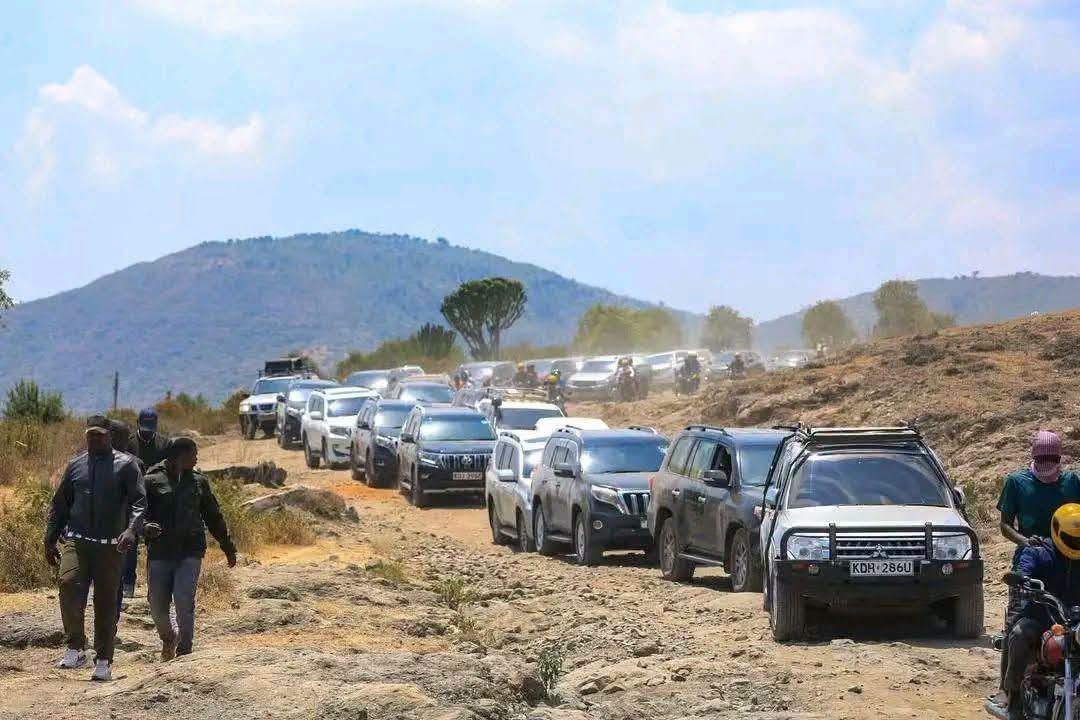
Homa Bay Governor Gladys Wanga has turned the controversy over dusty and unfinished roads encountered by the Linda Mwananchi team into a wider political argument over decades of development neglect, while defending President William Ruto’s administration against criticism from the opposition movement.
In a lengthy statement, Wanga argued that images of rough roads in Suba South should not be used to ridicule Homa Bay residents, saying the poor infrastructure reflected a historical deficit that successive governments had failed to address.
“The dust on the Mbita–Sindo–Kiabuya–Sori corridor tells a story,” Wanga said. “But it is not the story of a people who have failed. It is the story of a region that has waited far too long for the infrastructure required to unlock its potential.”
The governor’s intervention came after a Linda Mwananchi tour of Homa Bay, led by Nairobi Senator Edwin Sifuna and Siaya Governor James Orengo, drew attention to the condition of some roads in Suba South.
Photographs and videos showing members of the delegation covered in dust became part of the political contest, with the condition of the roads used to question the development record of leaders in the county.
Wanga, however, sought to shift the debate from the current state of the roads to the history behind it.
She said the infrastructure deficit in Homa Bay was not the product of a single administration, arguing that successive governments since independence had failed to invest adequately in regions that historically suffered economic marginalisation.
“Those roads have their origins in independent Kenya, and their neglect spans every administration,” Wanga said, referring to the governments of Jomo Kenyatta, Daniel arap Moi, Mwai Kibaki and Uhuru Kenyatta.
The governor cited the Mbita road as an example of what she described as a longstanding infrastructure problem.
According to Wanga, the 74-kilometre road was first awarded in 2016 under the Uhuru Kenyatta administration to Put Sarajevo but stalled because of inadequate funding, with only 7km completed.
She said the road was re-awarded in 2020 but again made little progress before work accelerated in the past two years.
“In the last two years, 28km have so far been tarmacked, with works currently ongoing,” Wanga said.
She argued that roads of that scale could not be addressed through county government resources or the Constituency Development Fund.
“It is important to note that a 74km trunk road is not something that devolution or CDF can address,” she said.
Turning the tables
Wanga’s response effectively turned what had become an embarrassment for the county into an argument over the political history of development in Homa Bay.
She said residents should not be ashamed of the condition of roads that had remained neglected for decades.
“We are not embarrassed by that history,” Wanga said.
“If images of rutted roads earned Homa Bay comparisons to conflict zones, we take that as a badge of honour to our marginalisation and resilience, not an insult requiring our silence,” she said.
The governor also invoked the region’s political history, linking its development challenges to the deaths and political exclusion of some of Nyanza’s most prominent leaders.
She said Homa Bay would have been better developed had former politicians Tom Mboya and Jaramogi Oginga Odinga remained in government.
“Jaramogi was forced out in 1966, Mboya assassinated in 1969, both on a path toward the presidency,” Wanga said.
She also invoked Raila Odinga’s presidential bids, arguing that his failure to ascend to the presidency had affected the region’s development trajectory.
“Raila Odinga, many believe, would have delivered that infrastructure as president, but when Kenyans elected him, that mandate was denied to him by force,” Wanga said.
The comments come at a politically sensitive moment for Nyanza, where the death of Raila has opened a contest among politicians seeking to inherit his political influence.
Linda Mwananchi is seeking to establish itself as a new opposition platform, with Sifuna and Orengo among its most prominent figures.
Its Homa Bay tour was therefore closely watched as an early test of whether the movement could mobilise support in one of Raila’s traditional political strongholds.
Wanga backs Ruto projects
Despite defending Homa Bay’s historical record of marginalisation, Wanga said the region was now seeing increased investment in infrastructure under the Ruto administration.
She pointed to a series of road, market, port and sporting projects which she said demonstrated a shift from promises to implementation.
“There is compelling evidence that something has changed, particularly since 2024,” Wanga said.
She listed the Mbita–Sindo–Kiabuya–Sori corridor and other roads across the county, including Lala–Ruga, Nyalkinyi–Imbo, the GOR Mahia Ring Road, Rangwe–Oboke, Rangwe–Ndiru, Kadel–Kanyadhiang–Kilusi–Opanga–Ramba, Kadongo–Lida, Adiedo–No. Karabok and Agolo Muok–Seka–Otati.
Wanga also cited Lwanda–Osodo–Kanyakiamo, Nyabera–Corner Koguta, Njeri–Pala and roads within Sindo town.
Beyond roads, she listed the Homa Bay Pier, Modern Fish Market, Raila Odinga Stadium, Economic Stimulus Programme markets, Rusinga Road and Mfangano Ring Road among projects she said were part of the transformation underway in the county.
Her argument places Homa Bay’s development debate in an unusual political position.
The governor is defending a national administration led by Ruto, despite coming from the ODM establishment that has historically opposed the President.
Her position also comes against the backdrop of ODM’s cooperation with the Kenya Kwanza administration, with several ODM politicians serving in Ruto’s government.
Devolution defence
Wanga also defended devolution, saying it had given counties greater control over resources and development priorities.
She credited leaders including Raila with championing the system long before its implementation under the 2010 Constitution.
“It is devolution, championed for decades by leaders including Raila Odinga, that has begun to give counties like Homa Bay a say over their own development and a share of resources once concentrated at the centre,” Wanga said.
She argued that devolution had transformed the fight against historical marginalisation from an appeal to national goodwill into a constitutional entitlement.
The governor urged residents to look beyond the political controversy generated by the Linda Mwananchi visit and assess projects being implemented in the county.
“We appeal to our people to take this week's mockery in stride,” Wanga said.
“There is little hardship this region has not already endured since 1963,” she said.
Wanga then directly connected the infrastructure debate to the current political contest, urging Homa Bay residents to support the administration she said was finally addressing the region’s historical marginalisation.
“We urge our people to look past sideshows and support an administration that has shown genuine willingness to correct the marginalisation of Nyanza and other underserved regions,” Wanga said.
Her intervention has therefore moved the dispute beyond the condition of one road.
The dusty roads photographed during the Linda Mwananchi tour have become a symbol in a much larger political argument — between those seeking to use Homa Bay’s development challenges to attack the government and county leadership, and those arguing that the same challenges demonstrate why residents should support the current administration.
“The dust is real. The historical deficit is real. But so is the transformation now underway,” Wanga said.
“Beyond the dust lies the Homa Bay we have always deserved,” she said.


