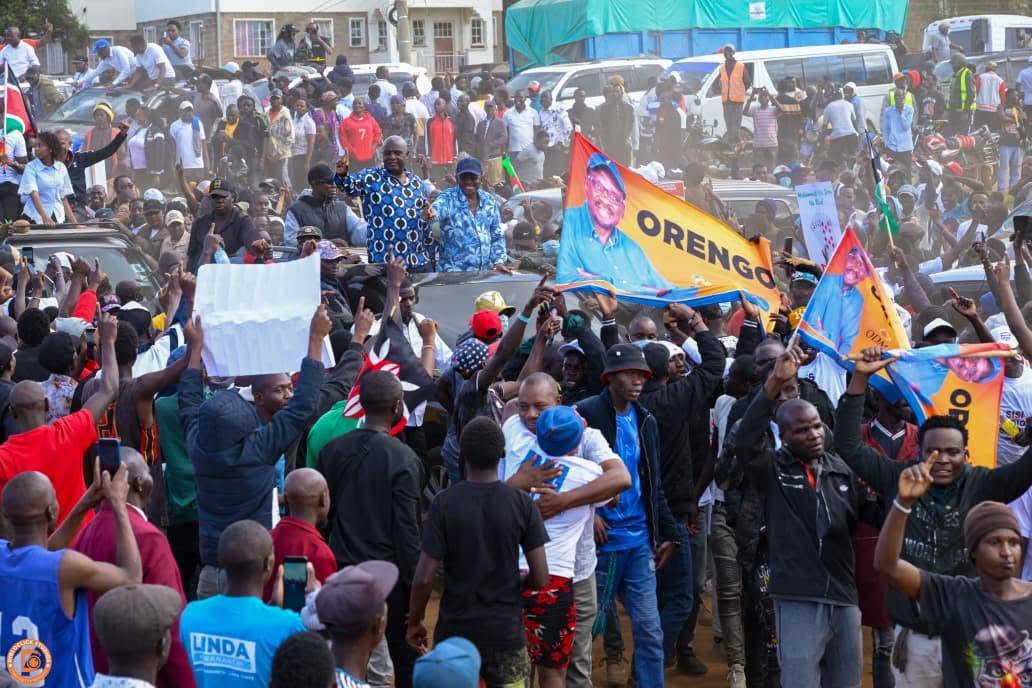
Investigations into the violence that disrupted the Linda Mwananchi political tour of Homa Bay have widened, with police saying they are now pursuing not only suspected goons arrested during the chaos but also those who may have recruited, financed, mobilised and facilitated them.
The National Police Service has arrested 37 suspected gang members following the August 16 violence, with police saying the suspects were found with crude weapons, including machetes, ropes, metal rods, knives, rungus, batons and torches.
“Police are also pursuing other actors who may have participated in the mayhem, with a view to ensuring that all those responsible, including organisers, facilitators and sponsors of criminal activities, are identified and held accountable in accordance with the law,” the NPS said.
The arrests followed a dramatic day of violence that turned what had been planned as a political tour into a deadly confrontation.
Roadblocks and hostile crowds
The Linda Mwananchi team, led by Nairobi Senator Edwin Sifuna, Embakasi East MP Babu Owino and other leaders, had embarked on a tour of Homa Bay County on Sunday.
The group held activities in Nyandiwa and Sindo before heading towards Homa Bay Town. Along the way, the convoy encountered roadblocks and groups of hostile youths, with vehicles reportedly pelted with projectiles.
The situation deteriorated as the convoy moved through the county, with attacks and confrontations reported at different points. The Linda Mwananchi leaders later alleged that armed individuals had been positioned along their route and accused some security officers of failing to stop the violence. The allegations remain contested and have not been independently established.
“Most alarming was the presence of armed individuals positioned in bushes along our route who fired directly at the Linda Mwananchi convoy,” the group said in a statement.
“This was not crowd chaos. It was an ambush!”
The group also accused some police officers of failing to protect their supporters.
“Rather than standing between citizens and those perpetrating violence, some officers appeared to facilitate the disruption and intimidation of our supporters,” the leaders said.
Police, however, said security had been deployed in proportion to the anticipated requirements of the event under the coordination of the Nyanza Regional Police Commander.
The NPS said several criminal incidents were recorded during the chaos, including attacks on journalists, damage to five police vehicles and destruction of civilian vehicles.
“Regrettably, several criminal incidents were recorded, including an attack on journalists performing their lawful duties, damage to five police vehicles deployed for public order maintenance, and damage to several civilian motor vehicles,” the police said.
According to police, one police vehicle lost control during the incidents, leading to the death of its driver and injuries to five other officers.
The NPS said the incidents came after three officers had been injured on August 15 during the arrest of 15 suspected gang members along the Kisumu-Kericho Road, bringing the total number of injured officers in the Kisumu and Homa Bay incidents to eight, in addition to the officer who died in Homa Bay.
The Linda Mwananchi team also reported civilian casualties and said two people had succumbed to injuries following the violence, while others required treatment, including specialised medical attention.
Questions over who organised the goons
The focus has now shifted to whether the violence was spontaneous or the result of a coordinated operation.
Police have warned that their investigation will extend beyond those caught carrying weapons or directly participating in the attacks.
“Those who recruit, finance, mobilise, arm or otherwise facilitate criminal elements to cause violence and disorder will be pursued and brought to justice,” the NPS said.
Media reports show that Homa Bay chaos was preceded by days of mobilisation and that some youths were allegedly paid up to Sh4,000 to take part. Those claims are part of the wider scrutiny surrounding the violence and remain subject to investigation.
The police investigation has therefore raised questions about a possible chain of command behind the violence.
If the 37 suspects were merely the foot soldiers, investigators will face pressure to establish who recruited them, who transported them, who armed them, who coordinated their movements and who financed their activities.
The NPS has said no one will be shielded because of political connections.
“No individual, regardless of their position, influence or political affiliation, should mistake the Service's commitment to facilitating peaceful assembly for weakness or an abdication of its duty to enforce the law,” the police said.
The Homa Bay violence has since developed into a major political controversy, with the Linda Mwananchi leadership demanding accountability and insisting that political violence was used to disrupt its activities.
“Political violence on this scale does not organise itself. It requires coordination, local knowledge of routes and movements, access to resources, and political protection,” the group said.
The outcome of the investigation could now be crucial as Kenya moves closer to the 2027 General Election.
For Homa Bay, the immediate question is no longer only about the 37 suspected goons arrested after the violence.
It is about whether detectives will uncover the people behind them.


