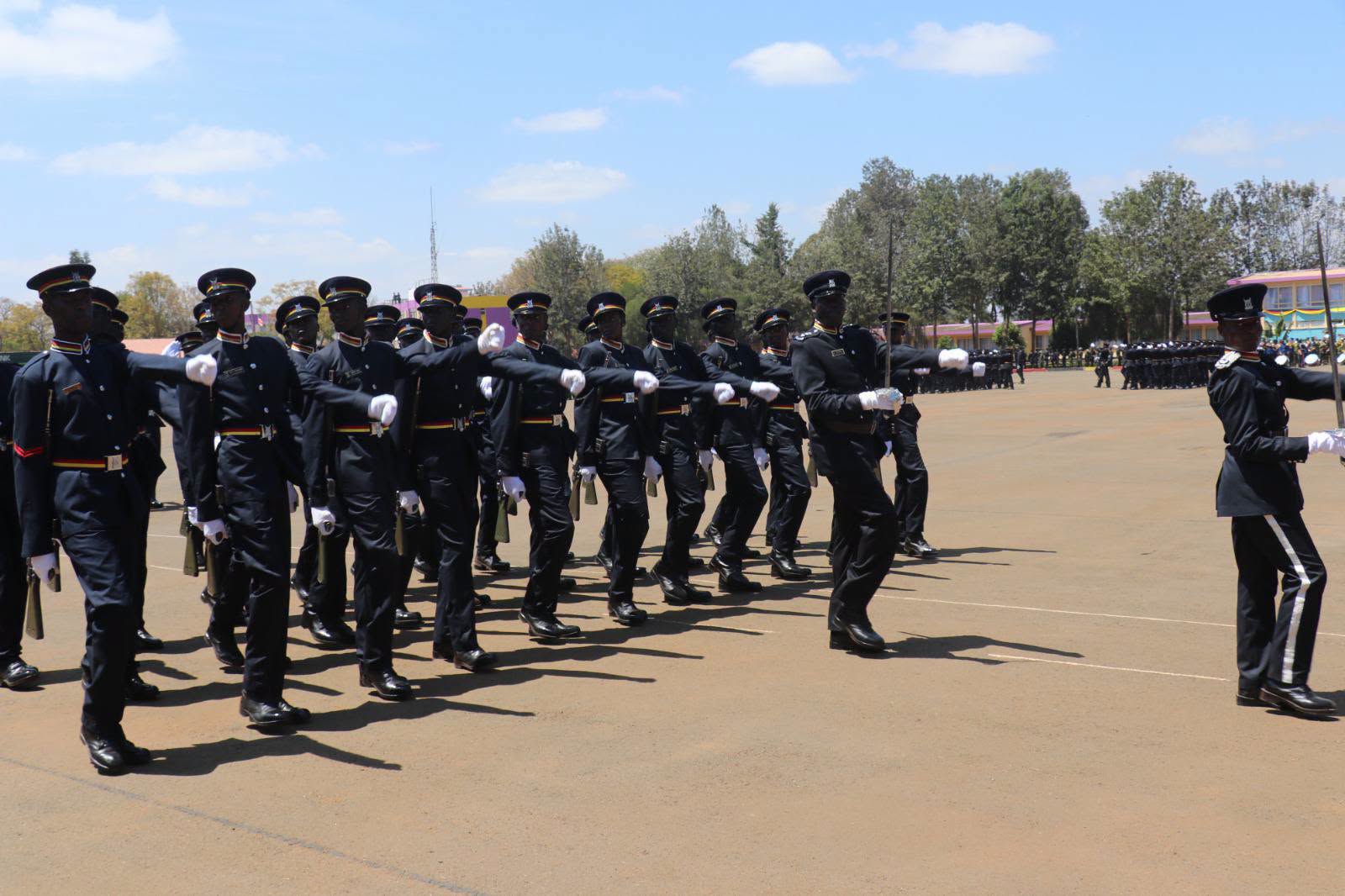
The National Police Service is set to deploy 10,000 newly trained officers as Kenya steps up preparations for the 2027 General Election amid growing concerns over criminal gangs, firearms and political violence.
The officers will graduate from the National Police Service Training College in Kiganjo, Nyeri County, on August 28, marking one of the biggest additions to the police establishment after years of recruitment gaps.
Deputy Inspector General Eliud Lang’at said the new officers would help ease pressure on a service that has struggled with shortages caused by inadequate recruitment and natural attrition.
“We are happy that we will be injecting another good number of police officers into our national security architecture,” Lang’at said on Friday during a rehearsal for the passing-out parade.
His remarks came as the National Assembly Departmental Committee on National Administration and Internal Security visited the college to assess the implementation of the police budget and inspect preparations for the graduation.
The recruitment comes at a politically sensitive time, with parties already laying the groundwork for the 2027 elections and concerns mounting over the possible use of criminal gangs to disrupt political activities.
Lang’at said the additional officers would strengthen the police response to security threats across the country as the election approaches.
He also warned about the spread of illegal firearms and organised criminal groups, saying the police had put measures in place to deal with the threats.
The Deputy Inspector General urged politicians, religious leaders, community elders and young people to work with security agencies to prevent the growth of criminal gangs.
He rejected claims that police officers were involved in disrupting political meetings or facilitating violence, insisting that the service would enforce the law without favour.
“Our laws and security procedures require that all of us deal with these criminal gangs as per the law. There is no complicity by any security officers,” Lang’at said.
His comments came against the backdrop of heightened political activity ahead of the 2027 elections, with opposition rallies and other political gatherings already becoming a feature of the political landscape.
Narok West MP Gabriel Tongoyo, who chairs the committee, however, raised a more serious concern — alleged political sponsorship of criminal gangs.
Tongoyo said the committee would demand answers from the Interior Ministry and police leadership over claims that politicians were financing or using criminal groups.
“It is true, absolutely true. What you are seeing in the country, these gangs, criminal groupings, are almost entirely, if not all, being sponsored by politicians,” Tongoyo said.
He said the committee would raise the issue when it meets Interior Ministry officials on Tuesday, and urged the police to arrest and prosecute anyone found financing criminal gangs, irrespective of their political connections.
The MP said the country had gone for about four years without recruiting new police officers, creating a significant staffing gap as officers retired, died or left the service.
He said the new recruits had also been trained to deal with emerging threats such as cybercrime, which he said required a more sophisticated policing response.
“I have no doubt in my mind, having seen what these officers have been trained to do, including tackling modern-day challenges such as cybercrime, that we are going to see a total different change in matters of security in the country,” Tongoyo said.
The committee also raised concerns over police funding, with Tongoyo saying only a relatively small proportion of the service’s budget is allocated to operations.
He said MPs had pushed for the operational allocation to increase from about 19 per cent to 25 per cent in the current financial year.
The additional funding, he said, would improve the ability of officers to respond to security threats and acquire the equipment needed for modern policing.
Parliament has also backed efforts to modernise the police service, including the acquisition of equipment deployed in areas affected by insecurity in the North Rift, northern Kenya and the Kerio Valley.
The committee said police welfare was another priority, with discussions ongoing with the Ministry of Housing over better accommodation for officers through the affordable housing programme.
Improved uniforms and working conditions are also being considered as part of efforts to boost morale within the service.
The National Police Service has also established a Directorate of Community Policing, headed by Assistant Inspector-General Judy Chebet, to strengthen cooperation between officers and communities.
Lang’at urged Kenyans to work with the police by sharing information and helping identify criminal groups before they become a bigger security threat.
The August 28 graduation will therefore come at a crucial moment for the police service.
Beyond filling vacancies, the deployment of the 10,000 officers will test the government's ability to maintain security and public confidence as Kenya enters an increasingly competitive political season.
For the police, the challenge will be ensuring the new officers are deployed professionally and that the service remains impartial as political competition intensifies ahead of the 2027 polls.


