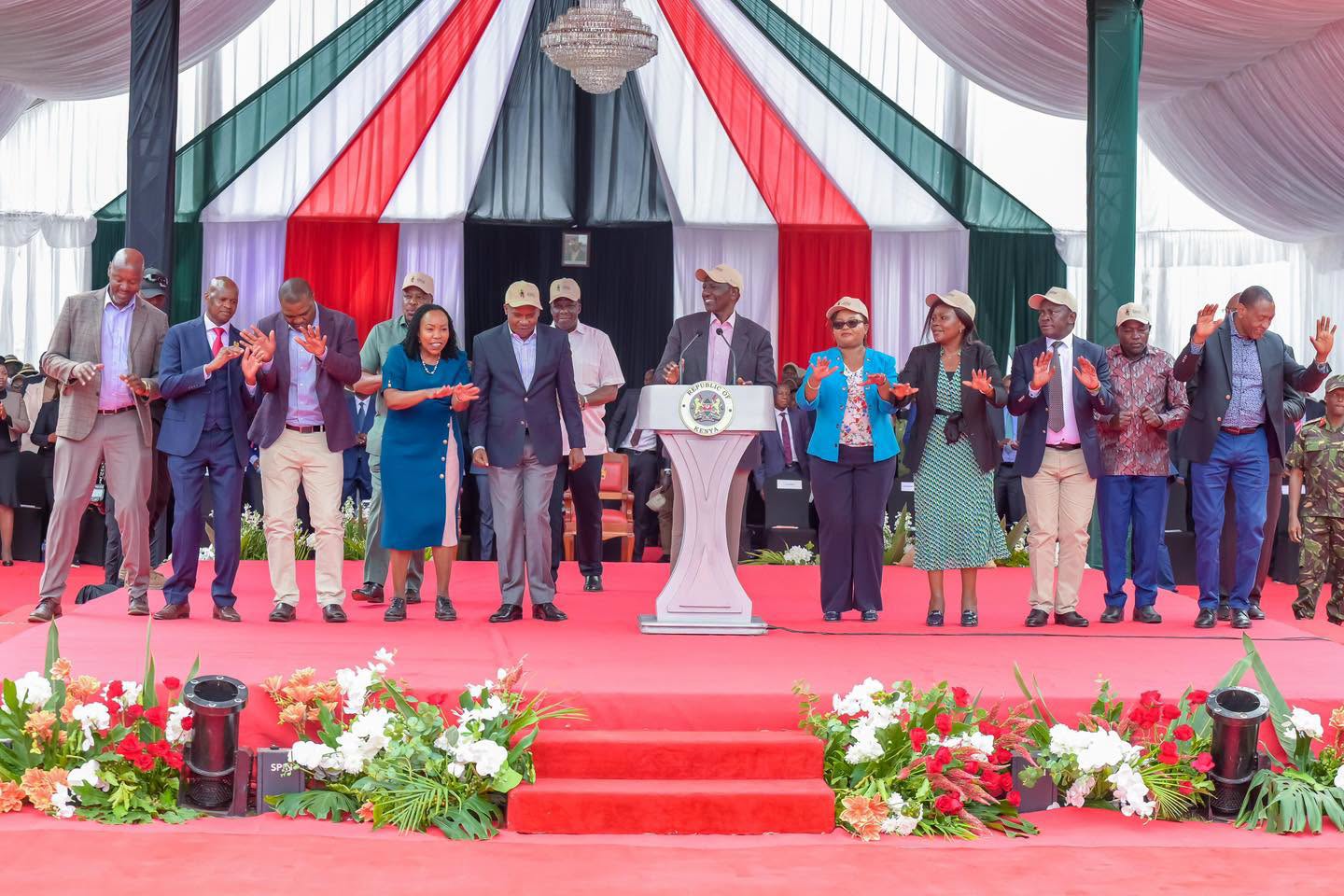
President William Ruto on Wednesday announced Sh2.6 billion for 13,000 people evicted from the Mau Forest, moving to address a dispute that has remained a political thorn in Narok and the wider South Rift for years.
The President also lifted restrictions on land bordering the forest and said the government had bought 5,800 acres of the Cheluget farm in Narok South, where more than 600 families have been living amid a long-running ownership dispute.
Speaking at Sogoo in Narok South, Ruto said each of the 13,000 beneficiaries would receive Sh200,000 to help them settle elsewhere after six years of uncertainty following their eviction.
“We are today officially closing the long and painful chapter of people who were removed from the Mau Forest,” Ruto said.
He said the latest payment followed an earlier intervention in 2023, when the government gave 2,000 families living in tents Sh300,000 each to leave the forest and buy land elsewhere.
The Mau Forest dispute has remained one of the most difficult political questions in Narok, bringing together conservation, land ownership, evictions and the demands of displaced families.
Ruto said previous leaders had turned the issue into an election subject without resolving the grievances of the affected families.
“Many politicians have talked of the Mau question, but I talked of the Mau answer. This is why we are here today closing this chapter,” the President said.
The announcement came as the South Rift emerges as an increasingly contested political region ahead of the 2027 election, with Ruto's opponents accusing his government of failing to fulfil some of its promises.
Former Deputy President Rigathi Gachagua, who toured the area days before Ruto, said the opposition would return to the region and accused the government of only bringing development projects when political pressure mounted.
“After my tour to the South Rift, President Ruto and his people will troop in with development projects they have not been able to implement despite the pre-election and post-election promises,” Gachagua said.
Ruto's Narok visit followed that opposition activity, with the President announcing a series of projects and using the tour to defend his administration.
He said the government had also lifted a caveat placed on land bordering the Mau Forest, allowing owners to continue farming after the boundary of the protected forest was established.
“We have also lifted the caveat that had been placed on land bordering the Mau Forest, giving owners the freedom to continue with agricultural activities without hindrance,” Ruto said.
He added that securing the forest with a title deed would help protect it from further encroachment.
“With the Mau Forest now with a definite title deed, we will be better placed to prevent further encroachment and strengthen conservation of the critical water tower,” he said.
The forest is a critical water catchment, and successive governments have faced the difficult task of protecting it while dealing with families displaced during eviction exercises.
The human cost of the evictions has kept the matter alive politically. Human Rights Watch reported in 2020 that more than 50,000 people had been evicted from Mau Forest lands since 2018, with thousands left in makeshift camps and facing difficulties in securing alternative settlement.
Ruto told residents that his administration was now seeking to prevent the issue from returning to the political agenda every election cycle.
“This brings to an end the culture of doing politics with the Narok Mau Forest every election year by providing a clear and long-lasting answer,” he said.
But whether the latest intervention takes the Mau question completely out of Narok politics will depend largely on whether the promised compensation reaches all the affected families and whether they can successfully resettle.
The President also announced progress in resolving the Cheluget land dispute, saying the government had bought the 5,800-acre property to end a dispute that has affected hundreds of families for about 30 years.
“We are processing title deeds of the people living on the land after buying the Cheluget farm,” Ruto said.
The government said the acquisition would pave the way for the issuance of title deeds to more than 600 families living on the property. The dispute over the farm has been the subject of litigation and negotiations involving the family of former Provincial Commissioner Isaiah Cheluget and settlers.
The announcements give Ruto fresh material as he makes his case for re-election, particularly in a region where his political rivals are seeking to make unfulfilled promises and economic grievances central to the 2027 campaign.
Narok Governor Patrick Ntutu said during the President's tour that Kenya Kwanza remained strong in the region, while local leaders dismissed opposition claims that the Maasai and Kipsigis communities were shifting their support.
Narok Woman Representative Rebecca Tonkei told opposition leaders they would be surprised by the outcome of the next election.
“There are leaders dreaming that members of the Maasai and Kipsigis communities will support the opposition in the next general election. We are telling them that they will be shocked when the vote is cast and counted in the 2027 poll,” she said.
For Ruto, however, the immediate test will be the implementation of Wednesday's promises.
The 13,000 beneficiaries are expected to receive Sh200,000 each, while the government has promised to complete the Cheluget settlement process and issue title deeds to affected families.
The President told the Mau evictees that they would not have to wait for the money.
“Munajaa hio pesa mnapata lini, si kesho ni leo,” Ruto said, indicating that the payment would be made immediately.
If the compensation and land settlement are completed as promised, Ruto will be able to argue that his administration finally dealt with a problem that has troubled successive governments and repeatedly returned to Narok's political agenda.
But any delay or fresh dispute over the beneficiaries, compensation or land titles could ensure that the Mau question remains the thorn in Narok politics that it has been for decades.


