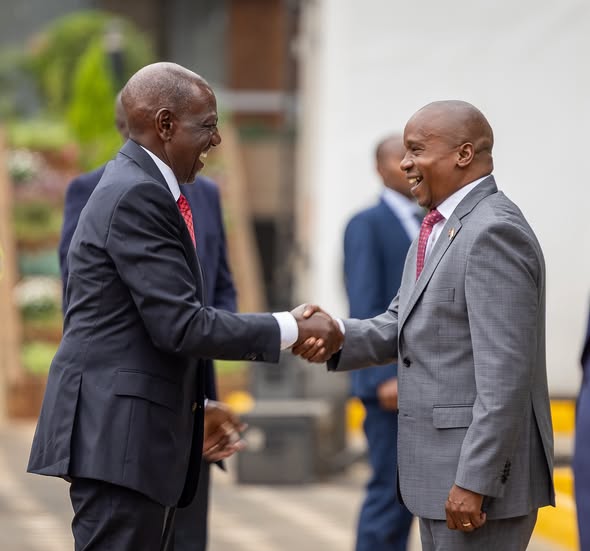
President William Ruto has vowed to crack down on political goons, warning that his administration will not allow violence to derail political campaigns as Kenya heads towards the 2027 General Election.
Speaking in Emurua Dikirr, Narok County, on Wednesday, Ruto said political differences should not be allowed to degenerate into violence, amid growing accusations between the government and opposition over attacks at political rallies.
“We want peace in this area. We want unity among the people here so that we can plan and pursue development together. We do not want hostility, conflict or chaos,” Ruto said.
The President's warning follows a series of violent incidents involving political leaders and their supporters, with the most serious reported in Homa Bay on August 16, when clashes around a Linda Mwananchi rally left two people dead and dozens injured. The violence has since become a major issue in the political debate, with opposition leaders accusing the government of failing to protect them.
“As for the issue of goons, we will deal with it,” Ruto said.
The President did not identify the politicians or groups he believed were behind the violence. His remarks came two days after Interior Cabinet Secretary Kipchumba Murkomen warned politicians against recruiting young people to disrupt rallies and political meetings.
“There are a few politicians who hire and deploy goons at their functions,” Murkomen said, adding that security agencies were monitoring networks suspected of recruiting youths to cause disorder.
Murkomen said the government had intensified intelligence-led operations to identify suspected organisers before violence occurs, promising that those involved would face the law.
“The Government would not allow political competition to descend into violence,” Murkomen said.
The Homa Bay violence has nevertheless placed the government under increasing scrutiny, particularly after opposition leaders accused allies of the administration of mobilising groups to disrupt their rallies.
Former Deputy President Rigathi Gachagua has directly blamed Ruto for the violence, alleging that the attacks were part of a broader strategy to intimidate opponents ahead of the election.
“Kenya has become a country of goons. Homa Bay is like Vietnam right now and all the chaos there were planned by Ruto,” Gachagua said.
The President's allies have rejected such accusations, while the government has maintained that security agencies are acting against violence regardless of the political affiliation of those involved.
Former Interior Cabinet Secretary Fred Matiang'i has also accused the administration of using violence as a political tool, citing attacks reported in Homa Bay, Nakuru and other parts of the country.
“It is now abundantly clear that the President and his government have chosen violence as a weapon for political survival and engagement,” Matiang'i said.
Matiang'i, who is positioning himself for the 2027 presidential race, has called for a political response to what he describes as growing “goonism”, warning that the country risks sliding into a more dangerous period as the election approaches.
The accusations have come as opposition leaders step up efforts to build a united front against Ruto. The United Opposition has already pledged to support a single presidential candidate in an effort to make Ruto a one-term President.
The Linda Mwananchi movement, led by Nairobi Senator Edwin Sifuna and other opposition figures, has been at the centre of the recent political mobilisation. Its rallies have attracted large crowds but have also become flashpoints for confrontations.
The EastAfrican, citing political violence analysts, said the Homa Bay clashes raised concerns about the possible use of organised gangs in the 2027 election campaign. ACLED analyst Ladd Serwat warned that violence by groups linked to political actors could become more coordinated if rival political coalitions consolidate ahead of the election.
“The violence in Homa Bay signals a dangerous trajectory for the upcoming election cycle,” Serwat said.
The debate has also revived memories of Kenya's past elections, when political leaders were accused of recruiting and financing criminal gangs to attack opponents and intimidate voters.
The government's latest warnings are therefore being closely watched as political parties begin their campaigns more than a year before the August 2027 election.


