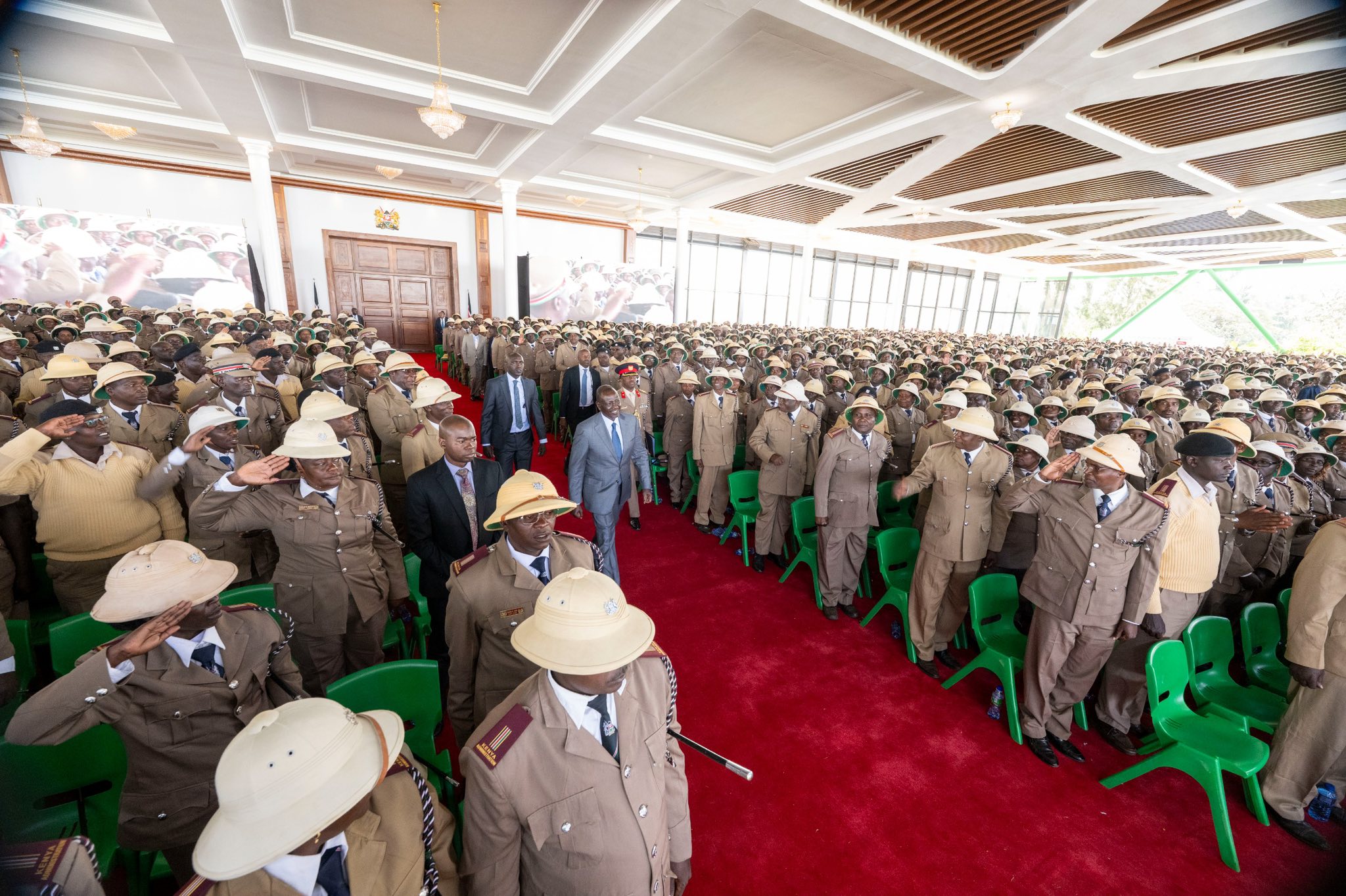
President William Ruto has ordered security agencies to pursue politicians and other individuals behind hired gangs and political violence, issuing the directive against the backdrop of media reports and opposition allegations that have previously linked some groups accused of disrupting protests and political meetings to individuals associated with the government.
Speaking on Friday during the passing-out parade of more than 6,000 police recruits at the National Police College in Kiganjo, Nyeri County, President Ruto said Kenya's democracy must not be taken over by hired gangs, intimidation, ethnic mobilisation or violence.
“There is no room for politically-sponsored violence in Kenya. Our democracy must never be hijacked by hired gangs, intimidation, ethnic mobilisation or violence,” President Ruto said.
He directed the police to take what he described as firm, lawful and impartial action against people who finance, organise, incite or perpetrate political violence.
The President said security agencies should not only target young people found carrying out violence but also pursue those who recruit, transport and finance them.
His warning comes after a series of incidents over the past year in which armed groups have been accused of infiltrating protests, attacking political opponents and disrupting public meetings.
Some of those incidents have generated claims that the groups enjoyed the protection or backing of politically connected individuals, allegations that government officials have repeatedly denied.
In June 2025, demonstrations in Nairobi over the death of blogger Albert Ojwang in police custody were disrupted by groups of armed youths carrying crude weapons.
Media footage showed some of the youths operating in areas where police officers were present, prompting questions over whether they had been deployed to confront demonstrators.
An investigation by Citizen TV later reported that some of the youths had admitted they were hired to infiltrate and disrupt the protests. The broadcaster reported that the men said they had been recruited and assigned meeting points before being deployed into the city, although the identities of those who financed the operation were not established.
The same protests sparked allegations linking Nairobi County officials and politicians associated with the government to the deployment of the groups.
Nairobi Governor Johnson Sakaja denied sponsoring the youths, describing accusations against him as false and politically motivated. Government officials also denied that the State had hired or deployed irregular groups to deal with protesters.
But the issue remained in the public spotlight after some of the youths told media organisations they had been promised payment for participating in operations to disrupt demonstrations.
Citizen TV reported that some of those interviewed after the June 2025 protests said they had been hired and later complained that they had not received the money they had been promised.
Other media reports have also documented hired groups being used during political events and protests.
The Standard, in a June 2025 report, alleged that an operation involving State House operatives, ruling party figures and other officials was being planned to infiltrate demonstrations marking the first anniversary of the June 25, 2024 protests. The allegations were not independently established in the report cited, and those accused have denied State involvement in sponsoring violence.
Opposition leaders have separately accused the government of using State-sponsored groups to disrupt their political activities.
In July 2025, opposition leaders including former Deputy President Rigathi Gachagua and Wiper leader Kalonzo Musyoka accused President Ruto and his allies of organising goons to disrupt their rallies, claims that have not resulted in a public finding linking the President to the alleged groups.
The allegations have persisted into 2026.
Earlier this year, the BBC, in a report carried by The Standard, examined the growing fears over political gangs and violence ahead of the 2027 General Election, noting that government spokesperson Isaac Mwaura had denied claims that criminal groups were State-sponsored. The report also documented allegations by politicians who said they had been targeted by groups they believed were politically motivated.
Interior Cabinet Secretary Kipchumba Murkomen has also rejected claims that the government uses hired gangs, maintaining that security operations are handled by the National Police Service.
“The government does not handle goons,” Mr Murkomen said in June, according to KBC Digital, as he dismissed allegations linking the State to irregular groups deployed during political activities and protests.
President Ruto's latest directive now puts renewed focus on the question of who finances and organises the groups that have appeared during demonstrations and political events.
The President said no politician was entitled to maintain a private militia and told security agencies to follow those responsible for recruiting and paying young people to commit violence.
Recent months, he said, had seen growing concern over young people being recruited and paid to disrupt meetings, intimidate political opponents and provoke violence.
The President's remarks were made as he presided over the graduation of more than 6,000 police recruits at Kiganjo.
He congratulated the recruits on completing their training and told them they were joining the National Police Service at a time when the country needed professional officers capable of protecting lives, maintaining law and order and safeguarding constitutional rights and freedoms.
President Ruto also broke ground for a new Chief Physical Training Instructor Grounds at the college, a project supported by the United States government in partnership with the United Nations Office on Drugs and Crime.
He said the new facilities would help modernise police training as the country sought to build a service that was physically prepared, professionally competent, technologically proficient and psychologically resilient.
The President said the government would continue investing in police equipment, training and welfare, citing the completion of a three-phase review of police remuneration.
He said entry-level basic pay for police constables had risen from Sh21,645 to Sh29,360, while salaries for other ranks had also been reviewed.
The government was also addressing the shortage of police housing through the National Institutional Housing Programme, which comprises 47,464 housing units across 165 projects, with more than 2,000 units completed and another 9,500 at different stages of construction.
But even as he outlined the investments in policing, President Ruto's strongest message was directed at those behind political violence.
“Do not arrest only the young person holding a weapon while allowing the person who recruited, transported, and paid him to escape responsibility,” the President said.
His directive means the security agencies will now face pressure to demonstrate whether the crackdown will extend to the financiers and organisers of political gangs whose activities have been the subject of media investigations, opposition accusations and repeated public denials by government figures.


