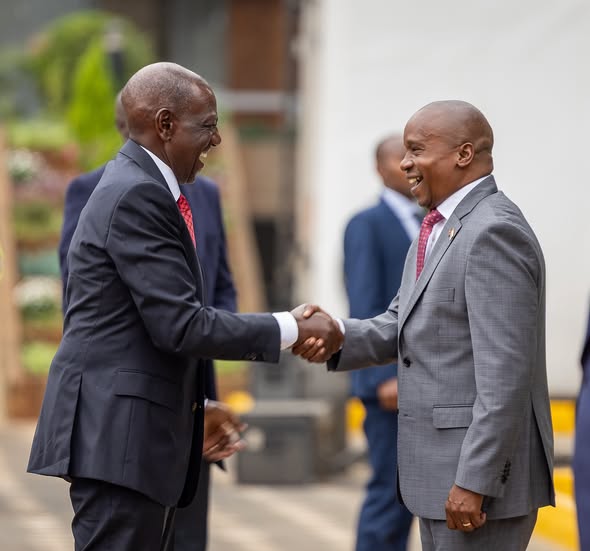
President William Ruto has declared the 2027 General Election “decisive and consequential”, promising to replace what he calls the politics of division and marginalisation with a new political order built around unity and inclusion.
Ruto made the declaration while hosting Iteso grassroots leaders at State Lodge, Eldoret, where His Royal Highness Papa Emorimor Paul Sande Emolot Etomeileng III installed him as an elder of the Iteso community and bestowed on him the name Ojokotau.
“Next year’s General Election will be decisive and consequential,” Ruto said.
He pledged to pursue a political approach that, he said, would ensure every community and region has a stake in Kenya's development.
“We will bring to an end the stale politics of division, fragmentation and marginalisation, and usher in a new politics of unity, inclusion and transformation—one that leaves no community and no part of Kenya behind,” he said.
The remarks come as political parties and opposition formations intensify preparations for the August 2027 elections, with the question of national unity emerging as a central theme of the contest.
Ruto's message appears aimed at presenting his re-election bid as a continuation of a national transformation agenda, while portraying his opponents as representatives of an older politics built around regional and political divisions.
But opposition leaders have been advancing their own version of the unity argument.
Wiper leader Kalonzo Musyoka, former Deputy President Rigathi Gachagua and DAP-K leader Eugene Wamalwa have held a series of consultations as opposition formations seek to establish a broad alliance capable of challenging Ruto in 2027.
Kalonzo has dismissed reports of cracks within the opposition and urged Kenyans not to be distracted by claims that the emerging alliance is falling apart.
“We are a team. Kenyans, don’t fall into that trap of propaganda so that you get disorientated,” Kalonzo said.
The opposition has also sought to make inclusion and transparency central to its own political message.
Former Interior Cabinet Secretary Fred Matiang’i has argued that a credible opposition coalition must involve Kenyans in decisions affecting its leadership, particularly the process of identifying a presidential candidate.
“If our interest is unity and bringing everybody together, then honestly there is no substitute for inclusion, including the public, and ensuring that we are open and transparent about these issues and engage the people,” Matiang’i said.
The debate over unity comes against the backdrop of an opposition coalition that is yet to settle on its presidential flagbearer.
Gachagua has previously argued that there is no need to rush the process, while other opposition leaders have insisted that their priority is to build a broad-based coalition before deciding who will face Ruto.
The competing approaches have created an emerging political paradox: both sides are presenting themselves as champions of national unity, but from markedly different perspectives.
For Ruto, unity is being presented as an alternative to what he describes as divisive and exclusionary politics. For the opposition, unity is increasingly being framed as the vehicle through which different political formations and communities can combine to challenge the incumbent.
The President's installation as an Iteso elder adds a cultural and political dimension to his message.
By accepting the name Ojokotau and meeting Iteso grassroots leaders, Ruto was not only participating in a traditional ceremony but also continuing his efforts to build relationships with communities across the country ahead of the next election.
The opposition's ongoing consultations, meanwhile, point to an increasingly competitive race in which regional support will have to be converted into a national coalition.
The decisive question as the 2027 contest approaches may therefore not be who can claim the language of unity, but which political formation can convince voters that its version of inclusion will translate into tangible representation, development and political participation.


