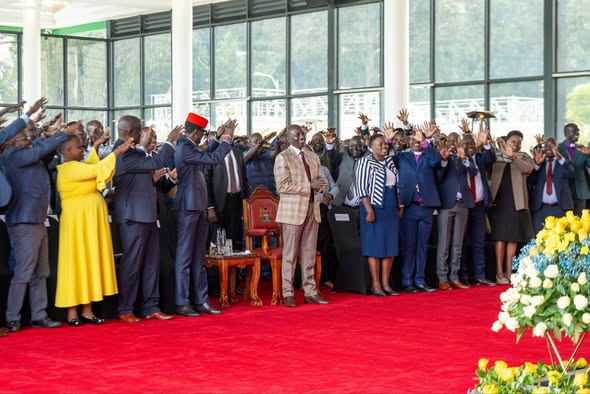
President William Ruto is increasingly putting his administration's development record at the centre of his defence ahead of the 2027 General Election, challenging his critics to judge his government by what it has delivered since taking office.
Ruto has pointed to education, healthcare, agriculture, infrastructure and economic reforms as evidence that his administration is fulfilling the agenda on which he was elected in 2022.
During his South Rift tour last week, the President rejected claims that his government had over-promised and under-delivered, saying Kenyans could now see the results of his administration's work.
“They went around for three years saying we had over promised, today we are telling them that our delivery can be seen,” Ruto said.
“You spoke too early my friends, we have delivered on our promises.”
The President has increasingly framed the coming political contest around his record, urging Kenyans to assess his administration through projects and reforms rather than the criticism directed at his government.
His administration points to cheaper fertiliser, teacher recruitment, road construction, affordable housing, expansion of healthcare registration under the Social Health Authority and the Hustler Fund among its key interventions.
Ruto said that his government his adminstration has constructed more than 2,669 kilometres of roads completed, more than 260,000 affordable housing units under construction and more than 28 million Kenyans registered under SHA.
But critics have challenged the administration's assessment of its own record, arguing that implementation should be measured against the specific promises Ruto made during the 2022 campaign.
One of the biggest areas of contention is the cost of living.
Ruto campaigned on reducing the price of basic commodities, including unga, fuel and cooking gas. Critics argue that while inflation has fallen from the highs experienced after he took office, the prices of many essential goods remain significantly higher than they were in 2022.
The criticism has also focused on jobs, with opponents questioning whether government programmes have created employment on the scale promised by the President.
Housing has become another point of contention. The administration has presented the affordable housing programme as a major source of construction activity and employment, while critics have questioned the number of houses actually completed compared with the targets announced by Ruto.
Independent fact-checking has also challenged some of the figures used by the President to describe progress in jobs, agriculture and infrastructure. In a 2025 review of several presidential claims, Africa Check found one claim correct, seven incorrect, two misleading and one unproven.
The organisation, for example, found that a claim that fertiliser subsidies had increased food production by 50 per cent was not supported by available agricultural production data. It also questioned figures given by Ruto on jobs created through the housing programme.
The administration has nevertheless maintained that its record is measurable.
Treasury Cabinet Secretary John Mbadi has urged political leaders to subject both government achievements and criticism to scrutiny using verifiable data.
“Don't let politicians go scot-free with mediocre reasons and arguments. And that calls for serious research,” Mbadi said recently.
Ruto's defence is particularly focused on sectors that formed the backbone of his 2022 campaign.
In agriculture, the government points to the reduction of fertiliser prices and increased distribution to farmers. In education, it cites the recruitment of tens of thousands of teachers. In healthcare, it points to the establishment of SHA and the expansion of registration. Infrastructure remains another prominent part of the President's message, with roads, housing, markets, electricity and other projects being showcased during his tours.
Critics, however, argue that the existence of projects does not by itself settle whether the original promises have been met.
They have questioned the pace of delivery, the difference between projects launched and those completed, and whether government programmes have translated into lower household costs and more employment.
The debate is now moving beyond whether Ruto's administration has delivered anything to the more specific question of how much of what was promised in 2022 has actually been delivered, what remains under implementation and what has not been achieved.
Ruto's administration says the country is already seeing the results of its economic transformation agenda.
His critics want the assessment to be made against the targets and timelines the President himself set when he sought the presidency.


