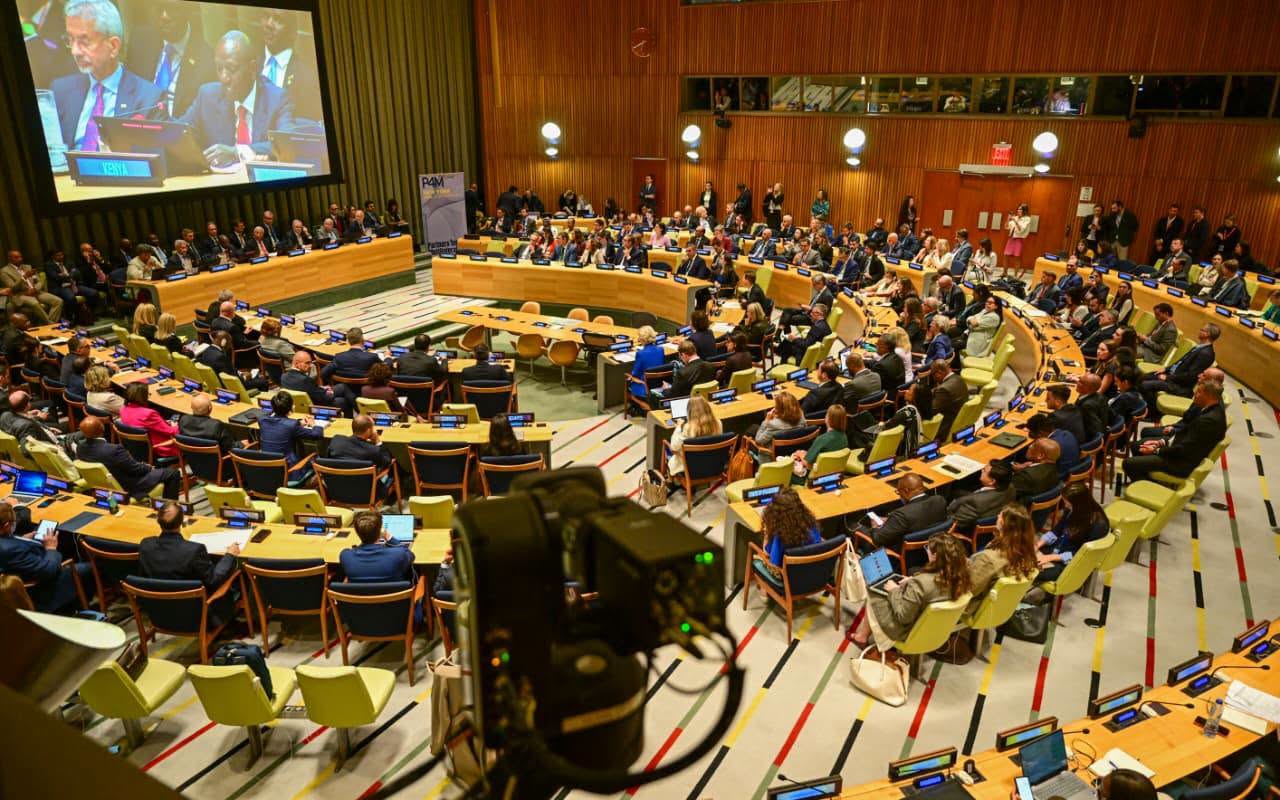
President William Ruto has taken his 2027 political message to Kenyans in the United States, using his first engagements in New York to defend his record and warn voters about the consequences of choosing the wrong leader.
Ruto, who is in New York for the 81st United Nations General Assembly, told Kenyan diaspora members that the next election would be about the quality of leadership, in remarks that placed domestic politics alongside his international agenda.
“I am very confident about the future of our country. We will succeed,” Ruto said during an engagement with Kenyans in New York on Sunday.
“The one mistake we must never do is to elect a fool to be our president.”
He went further, saying leadership was more important than the country's natural resources in determining whether Kenya succeeds.
“Because the difference between us succeeding and failing is leadership, period. It is not minerals, it is not all those other things, it is leadership. If you do not have the right leadership, we will fail,” he said.
The remarks give a political edge to Ruto's New York trip, coming less than a year before the 2027 General Election and as opposition parties intensify efforts to agree on a candidate to challenge him.
Ruto has in recent weeks increasingly framed the next election around his government's record, telling voters in Nyanza that they should judge him on development rather than political rhetoric. During his tour of Migori last week, he said the 2027 election would be a referendum on his administration's delivery record.
In New York, he continued that argument, highlighting what he described as improvements in the economy since he took office.
“Inflation has come down, interest rates have come down, our foreign exchange reserves have grown from $5.7 billion to $15.3 billion and I can confidently say that we've stabilised the economy,” he said.
He also told the diaspora to disregard reports questioning the state of the economy.
“Forget about the fake stories, these are numbers that you can verify with our Central Bank,” Ruto said.
The President used the meeting to defend his administration's programmes in health, housing, agriculture, education and infrastructure. He said the Social Health Authority had registered 33 million Kenyans since its establishment, compared with six to seven million members under the former National Health Insurance Fund.
His government also used the New York engagement to unveil the Kenya Diaspora Impact Platform, a partnership involving the government, the United Nations and Equity Group aimed at connecting Kenyans abroad with investment opportunities at home.
“We are building a stronger bridge between Kenyans abroad and opportunities at home, founded on trust, transparency and measurable results,” Ruto said.
But the President's political message was only one part of his UNGA programme.
Ruto has also been pursuing trade, investment and diplomatic engagements, including talks with US Secretary of State Marco Rubio on trade, technology, critical minerals, energy and regional security.
“We welcome the extension of AGOA, which will strengthen trade between Africa and the United States and expand economic opportunities,” Ruto said after the meeting.
He has also used the New York meetings to push for changes to the global financial system, arguing that Africa has substantial capital but needs reforms to channel it into infrastructure and other productive investments.
“Africa is not short of capital. Our domestic capital pools have surpassed $4 trillion,” Ruto said at an Africa We Build high-level roundtable.
“What stands between these savings and the infrastructure we need are the rules that determine where capital can go.”
The President's New York engagements have therefore combined his international agenda with a domestic political pitch centred on his economic record, government programmes and the quality of leadership Kenyans will choose in 2027.
His official UNGA programme includes delivering Kenya's statement during the General Debate, alongside meetings on development, multilateralism, trade, technology and global governance.


