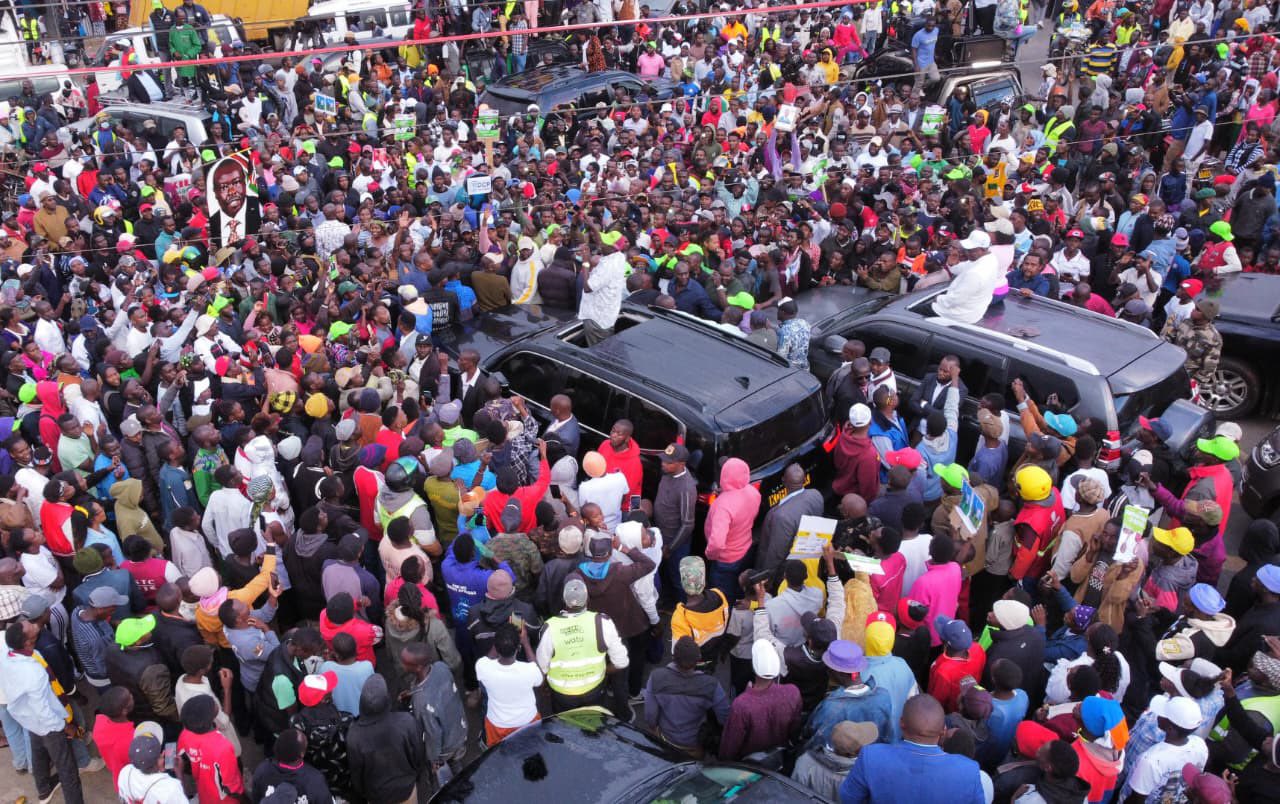
Former Deputy President Rigathi Gachagua has proposed that opposition leaders agree privately on a joint presidential candidate and reveal their choice only five months before the August 2027 General Election, warning that an early announcement could expose the candidate to government pressure.
Speaking during a KTN News interview on Wednesday, Gachagua accused President William Ruto of targeting political opponents he considers a threat, citing himself, Wiper leader Kalonzo Musyoka and Nairobi Senator Edwin Sifuna.
“William Ruto is a vicious, brutal president who harasses his opponents. If we unleash a candidate now, you have seen what he has done,” Gachagua said.
He claimed that publicly identifying the opposition’s candidate too early could trigger investigations, police action and intimidation that would interfere with the individual’s campaigns.
“If today we say it is so-and-so, they will send KRA. They will send anti-corruption. They will send goons. They will put him under house arrest,” he said.
Gachagua’s proposal comes as opposition leaders hold consultations on how to select a common presidential candidate to challenge Ruto, with the question of who should lead the coalition remaining unresolved.
“In my view, we agree quietly on the candidate early enough, but we unleash the candidate at the earliest five months before the election so that we build the right momentum,” he said.
The Democracy for the Citizens Party leader said the opposition needed to reach a consensus on its flag bearer before making the decision public, arguing that keeping the process confidential would help protect its strategy.
He maintained that his experience in successive election cycles, including his time as Ruto’s deputy, gave him an understanding of the President’s political approach.
“I also know William Ruto. I was his deputy; none of my colleagues was his deputy. I worked with this man,” he said.
Gachagua invokes 2002 election
Gachagua also likened the current political climate to the 2002 General Election, when opposition parties rallied behind Mwai Kibaki and defeated KANU, ending the party’s nearly four-decade hold on power.
“We are having a 2002 moment in all facets, and we are having a moment where the country has decided in unison without holding any meeting anywhere, from the Coast to Nyanza, from western to Rift Valley, from central to northeastern, Nairobi here, Kenyans have decided they want change, and they have decided that William Ruto must be one term,” he said.
The opposition has been exploring ways to avoid splitting its support among multiple presidential aspirants, with Gachagua warning that leaders who refuse to support the eventual flag bearer risk undermining the coalition.
He urged those seeking the presidential ticket to accept that one of them would have to step aside if another candidate emerged through the agreed selection process.
The former Deputy President also cautioned against political demands that could complicate negotiations, saying opposition leaders needed to put their ambitions aside in pursuit of a common objective.
However, Gachagua acknowledged that the opposition had not settled on a definitive formula for choosing its candidate.
“We have not agreed exactly how we will do it. Part of the ongoing conversation, I am persuading my colleagues what I think should be done,” he said.
Gachagua reconciles with Sifuna
In the interview, Gachagua also addressed his relationship with Sifuna, who participated in the political process that led to his impeachment in October 2024.
Gachagua said he had confronted the senator over his role in the impeachment during their meeting at his Wamunyoro residence in Nyeri County on October 20.
He said Sifuna explained that he had acted in the interests of the Orange Democratic Movement, which was then politically opposed to Gachagua and Ruto’s Kenya Kwanza administration.
Gachagua said he accepted the explanation, arguing that the two had belonged to opposing political camps at the time.
“Number two, in my community, a betrayal by an outsider is not betrayal. Sifuna and I were not in the same camp; he did not vote for me, so how does he betray me?” he said.
He maintained that his main grievance was with former allies who had campaigned alongside him in 2022 before their relationship with him deteriorated.
The engagement between Gachagua and Sifuna, alongside consultations involving Kalonzo, is part of broader efforts to bring opposition factions together ahead of the 2027 election.
Despite the meetings, the opposition has yet to publicly settle on a joint presidential candidate, leaving questions about the selection process and the timing of the announcement at the centre of its preparations.


