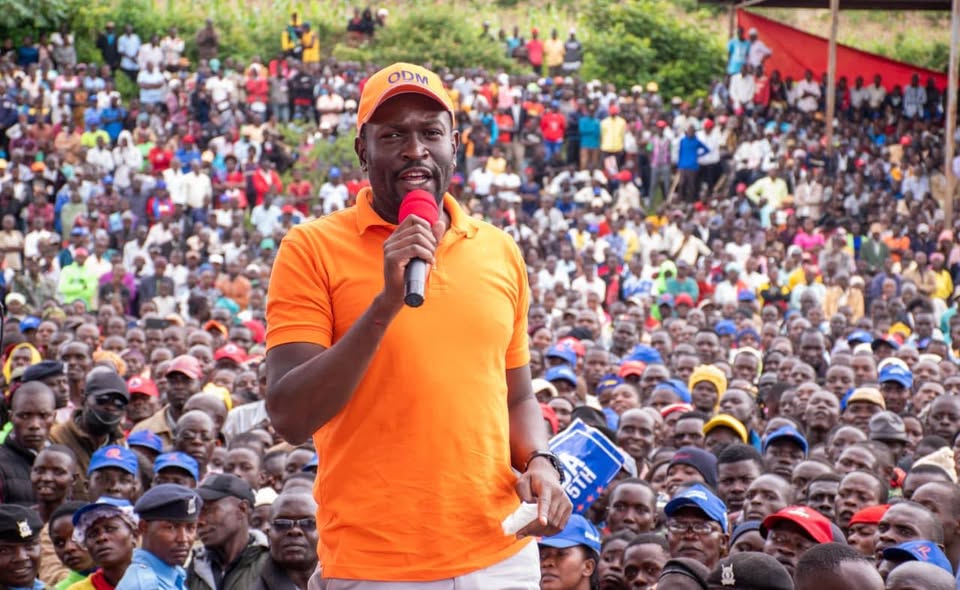
Nairobi Senator Edwin Sifuna has ruled out rushing into opposition coalition talks, saying his immediate priority is building a political movement to challenge President William Ruto in the 2027 General Election.
Sifuna, who is positioning himself for the presidency through The Equitable Party (TEP), said his team would first establish grassroots structures before engaging other opposition leaders on possible alliances.
“My party right now is completing the rebranding process, we have IEBC and ORPP registrations to think about. Conversations about coalitions and alliances will come later,” he said during a media roundtable in Nairobi on October 9.
His remarks come as opposition leaders explore ways to unite against Ruto, with Wiper leader Kalonzo Musyoka among those pushing for cooperation ahead of the election.
Sifuna said his immediate focus was building his political base rather than negotiating positions in a coalition whose leadership and presidential candidate have yet to be settled.
The senator also accused Ruto of orchestrating his removal as ODM secretary-general, deepening his dispute with the party leadership over ODM’s cooperation with the President’s administration.
“The only person to blame (for my removal) is William Ruto. They say give a man an inch and they take a mile,” Sifuna said.
“All decisions were undertaken on the directive of Ruto.”
He, however, said he held no grudges against the ODM officials involved in his removal.
“Personally, I hold no grudges. I have forgiven all those who insulted me and I wish them well,” he said.
Sifuna maintained that he had not resigned from ODM, although he would not seek the party’s ticket in 2027. He argued that the party had moved away from the political direction he believed it should pursue.
“I am still a member of ODM. I have not resigned. I am just saying I will not run on ODM in 2027,” he said in a television interview on October 9.
He further claimed that ODM was now under Ruto’s influence, an allegation that places the party’s relationship with the President at the centre of the dispute.
Sifuna also questioned demands that he surrender his Senate seat following his political realignment, arguing that other politicians had changed parties without resigning from elected office.
“When did William Ruto resign to join UDA? It is hypocrisy that the question is only being asked on Sifuna,” he said.
The senator has also defended his relationship with the late former Prime Minister Raila Odinga, rejecting claims that the two had fallen out before Raila’s death.
He said Raila had wanted him to remain ODM secretary-general and believed the party should consider fielding its own presidential candidate in 2027.
“I suspect and believe Baba would run in the 2027 elections,” Sifuna said, recounting a meeting at which, according to him, Raila had discussed the party’s prospects in the coming election.
Sifuna’s political repositioning follows months of divisions within ODM over its cooperation with Ruto’s administration and the party’s direction after Raila’s death.
His new political vehicle is undergoing a rebranding process intended to adopt the Linda Mwananchi Movement identity, which has featured prominently in his mobilisation campaign.
Beyond the political dispute, Sifuna has sought to distinguish his agenda from the government’s development record, arguing that public accountability, constitutionalism and the cost of living should be central to the 2027 contest.
He has proposed cutting wasteful public expenditure to create room for lower taxes, claiming that the government could save more than Sh500 billion by addressing wastage in public offices.
“We will work on taxation, wastage in the public space and debt. By addressing wastage, we will be able to save Sh500 billion. When you do that, you can reduce taxation,” he said.
He has also argued that government performance should not be judged solely by visible infrastructure projects, insisting that public spending must comply with the Constitution and be subject to transparency.
“You cannot just say that because Talanta has been built, a beautiful stadium, we should be clapping for you. No. We want transparency,” he said.
For now, Sifuna has left open the question of which opposition leaders he might work with, insisting that coalition discussions will come after his movement has established itself.
The challenge will be turning his growing political profile into a national organisation capable of competing with Ruto and persuading other opposition leaders to rally behind a common candidate.