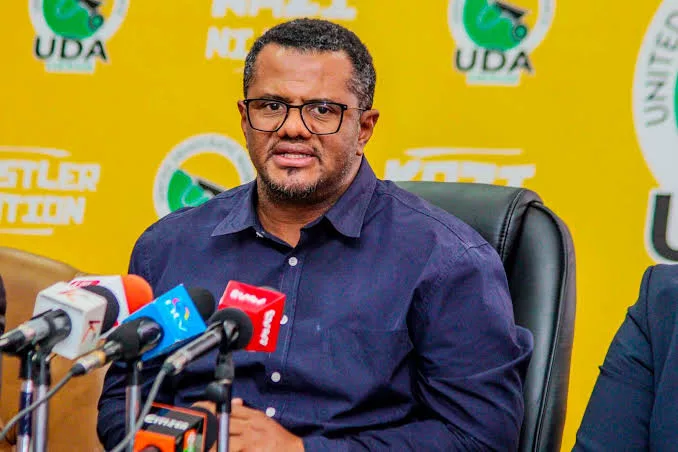
United Democratic Alliance (UDA) Secretary-General Hassan Omar has pledged to exercise greater caution in his choice of words during political campaigns following his appearance before the Independent Electoral and Boundaries Commission (IEBC) Electoral Code of Conduct Committee over controversial remarks concerning deceased voters.
Omar appeared before the committee on Wednesday, October 21, 2026, to respond to allegations that comments he made during a political rally in Mombasa County on September 11, 2026, suggested that UDA would use the biometric details of deceased voters to help secure President William Ruto’s re-election.
The committee, chaired by IEBC Commissioner Moses Alutalala Mukhwana, questioned Omar about the remarks under the Electoral Code of Conduct, which establishes standards for political parties, candidates and their supporters during elections.
Omar Says Remarks Were a Joke
Addressing the committee, Omar maintained that his comments had been taken out of context, arguing that he had been speaking jokingly during a gathering involving local elders and administrators in Changamwe Sub-County.
He explained that the event focused on the issuance of national identity cards and voter registration rather than electoral malpractice. Omar said he was addressing local administrators about an administrative process and insisted that the audience understood his remarks as political humour.
According to the UDA official, the reaction of those present indicated that they had interpreted his comments as a joke and part of the language commonly used in political campaigns.
Omar also attributed the controversy to political competition, arguing that statements made by politicians could be amplified or interpreted differently by their opponents to advance competing interests.
Denies Using Deceased Voters’ Details
The UDA secretary-general questioned the reporting surrounding his remarks, claiming that a media report suggesting the party intended to use deceased voters’ details emerged after the comments had initially attracted limited attention.
He argued that politicians frequently criticised one another during campaign periods and maintained that his statements had been presented without sufficient consideration of the broader context.
Omar denied that he or other government officials had previously used the details of deceased people to influence an election. He also rejected the suggestion that UDA was seeking biometric voter registration kits to register deceased individuals.
He maintained that the party had no intention of engaging in such practices, defending his remarks as a joke rather than a declaration of electoral misconduct.
Promises More Careful Campaign Language
Despite disputing the interpretation of his comments, Omar said he had taken the electoral commission’s concerns into account and would be more careful when addressing political gatherings.
He pledged to use simpler language during campaigns to minimise the risk of his statements being misunderstood or interpreted as inflammatory.
Omar further argued that the controversy had focused on a short excerpt from a much longer speech, saying his full address had lasted about an hour while public attention centred on a brief sound bite.
The IEBC is assessing the allegations under the Electoral Code of Conduct provided for in the Elections Act, 2011. The code outlines expectations for political parties, candidates and supporters throughout the electoral process.