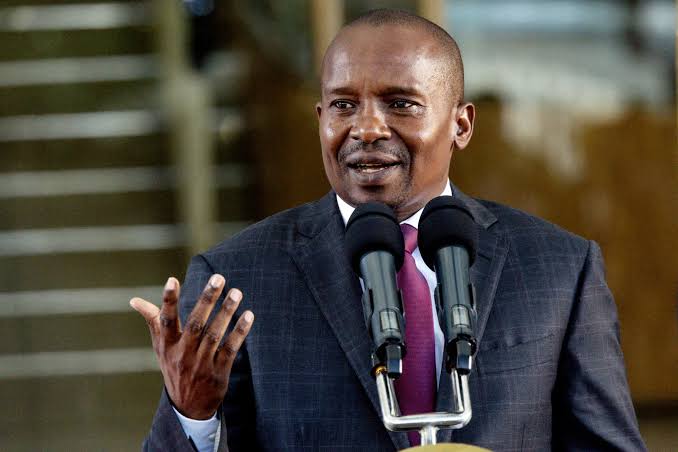
Deputy President Kithure Kindiki has intensified political and development engagements across the larger Mt Kenya region as President William Ruto’s administration seeks to strengthen its support base ahead of the 2027 General Election.
Kindiki’s outreach has focused on infrastructure development, improving farmers’ incomes, fighting illicit alcohol and promoting regional unity. The strategy comes amid growing opposition activity and concerns about public dissatisfaction in a region that contributed significantly to Ruto’s victory in the 2022 presidential election.
Since his appointment as Deputy President in October 2024, Kindiki has gradually increased his presence across Mt Kenya, with his grassroots engagements gaining momentum throughout 2026. The region comprises Nyeri, Meru, Kirinyaga, Embu, Tharaka-Nithi, Kiambu, Murang’a, Laikipia, Nyandarua and Nakuru counties.
Mt Kenya contributed approximately 3.5 million of the 7.1 million votes Ruto secured nationally against the late Raila Odinga, who contested under the Azimio la Umoja coalition. However, the impeachment of former Deputy President Rigathi Gachagua and subsequent political realignments have complicated the ruling party’s efforts to maintain its influence in the region.
Kindiki has responded by taking the government’s development agenda directly to residents while presenting himself as a leader capable of advancing the region’s interests within the administration.
Development Tours and Grassroots Mobilisation
Kindiki began undertaking more visible development inspections across Mt Kenya in March 2025, including visits to projects in Murang’a and Tharaka-Nithi counties. He later accompanied Ruto on a multi-county development tour in April that year.
His individual visits increased in 2026, combining project inspections and launches with political meetings aimed at strengthening the United Democratic Alliance’s (UDA) grassroots networks.
On March 1, he began a series of planned engagements across Mt Kenya East, with activities scheduled to continue through April 27. By September, media reports indicated that his outreach had expanded to more than 30 targeted visits across the wider region.
In August, regional elders reportedly endorsed Kindiki as a spokesman for Mt Kenya East. He subsequently stepped up mobilisation efforts, including meetings with UDA polling centre officials, beginning at Kinoru Stadium in Meru County.
The tours have provided the Deputy President with opportunities to highlight government projects while engaging local leaders and residents over development priorities and political concerns.
Infrastructure Projects at the Centre of the Strategy
Infrastructure development has featured prominently in Kindiki’s engagements, with the Deputy President highlighting road construction and improvements to transport links across the region.
In Kiambu County, he has pointed to 1,285 kilometres of roads reportedly under construction at a cost of KSh152 billion. In Nyeri, he has highlighted plans to upgrade 775 kilometres of roads to bitumen standards at an estimated cost of KSh45 billion.
Kindiki has also promoted the proposed KSh7 billion redesign of the Nithi Bridge in Tharaka-Nithi County. The bridge is an important transport link that has been associated with fatal road accidents.
Other projects featured during the tours include the Sagana County Aggregation and Industrial Park, Maua Modern Market and the KSh800 million Gakoromone Market in Meru County.
The government has additionally highlighted affordable housing, student hostels and information and communications technology hubs as initiatives intended to create jobs and expand economic opportunities.
Through these projects, Kindiki is seeking to demonstrate that the administration remains committed to its development promises despite criticism from political opponents.
Coffee Bonuses and Farmers’ Incomes
Agriculture remains a major economic activity across Mt Kenya, making farmers’ earnings an important issue in the region’s political debate.
Kindiki has highlighted government interventions intended to strengthen agricultural value chains, improve access to markets and increase returns for farmers. He has particularly pointed to coffee bonus payments, noting that farmers in Mt Kenya counties were among those who received substantial payouts.
Political analyst Javas Bigambo argues that such interventions have helped address some of the dissatisfaction directed at the government.
Bigambo says Kindiki has made progress through what he describes as timely interventions aimed at reducing public anger towards the administration. He maintains that although the fulfilment of government promises has been gradual, measures addressing farmers’ needs have demonstrated a response to concerns raised in the region.
The analyst believes the payments and other agricultural interventions could make it more difficult for opposition leaders to convince residents that the government has neglected Mt Kenya.
However, the long-term political impact of these measures will depend partly on whether farmers continue to experience improvements in their earnings and whether the government sustains its commitments.
Crackdown on Illicit Alcohol Intensifies
The campaign against illicit alcohol has become another important element of Kindiki’s outreach, particularly amid concerns about substance abuse and its impact on young people and families.
On October 2, the Deputy President issued a warning to traders selling harmful alcoholic products, threatening arrests and prosecution for those involved.
Kindiki made the remarks at the Limuru Milk Processing Plant grounds in Kiambu County, where he presided over the distribution of milk coolers to dairy cooperative societies. He said the government would not tolerate the sale of dangerous substances disguised as alcoholic drinks.
The administration has also moved to treat the manufacture, distribution and sale of illicit alcohol as organised criminal activity, calling for coordinated action against the networks involved.
On Wednesday, October 21, Kindiki led the establishment of a permanent secretariat in the Office of the Deputy President to coordinate the government’s campaign against illicit alcohol and drugs.
Based at Harambee House, the secretariat brings together representatives from the National Police Service, Kenya Bureau of Standards, National Authority for the Campaign Against Alcohol and Drug Abuse, Anti-Counterfeit Authority, National Intelligence Service, Directorate of Criminal Investigations and Ethics and Anti-Corruption Commission, alongside relevant ministries and other agencies.
Bigambo says the crackdown is already gaining momentum, pointing to the government’s efforts to curb the sale and distribution of illicit alcoholic products.
The campaign provides Kindiki with another platform to address concerns affecting households and communities across the region, although its effectiveness will depend on sustained enforcement and measurable results.
Kindiki Pushes Regional Unity Amid Political Rivalry
Beyond development and security initiatives, Kindiki has sought to counter political divisions within Mt Kenya by rejecting attempts to separate Mt Kenya East from Mt Kenya West.
His message of unity comes amid an increasingly competitive political environment, with Gachagua and other opposition figures seeking to mobilise support among residents dissatisfied with the government.
Political analyst Martin Andati has interpreted Ruto’s absence from several of Kindiki’s recent tours as a sign of confidence in the Deputy President’s ability to advance the administration’s political and development agenda independently.
Andati observed that Ruto initially accompanied Kindiki during public engagements but that the Deputy President has increasingly conducted his own tours and responded directly to political challenges from figures such as Gachagua.
The analyst also pointed to infrastructure projects, including the Mau Mau roads and the Rironi-Mau Summit highway, as examples of development commitments being pursued by the government.
Kindiki’s growing independence gives him greater room to communicate the administration’s agenda and engage local political leaders. At the same time, it places more responsibility on him to demonstrate that government initiatives are delivering practical benefits to residents.
The Challenge Ahead of the 2027 Election
As the next general election approaches, Kindiki’s strategy combines development visibility, agricultural interventions, law enforcement and grassroots political mobilisation in an effort to strengthen the government’s position across Mt Kenya.
The region’s political significance means that changes in public sentiment could have implications for the ruling coalition’s campaign. However, the impact of Kindiki’s tours will depend on how residents assess the delivery of development projects, the sustainability of improvements in farmers’ incomes and the government’s response to local concerns.
His efforts also unfold against a backdrop of shifting alliances and competition among leaders seeking to represent the region’s political interests.
Ultimately, Kindiki faces the challenge of translating frequent visits, government project announcements and local mobilisation into lasting public confidence as political activity intensifies ahead of the 2027 General Election.