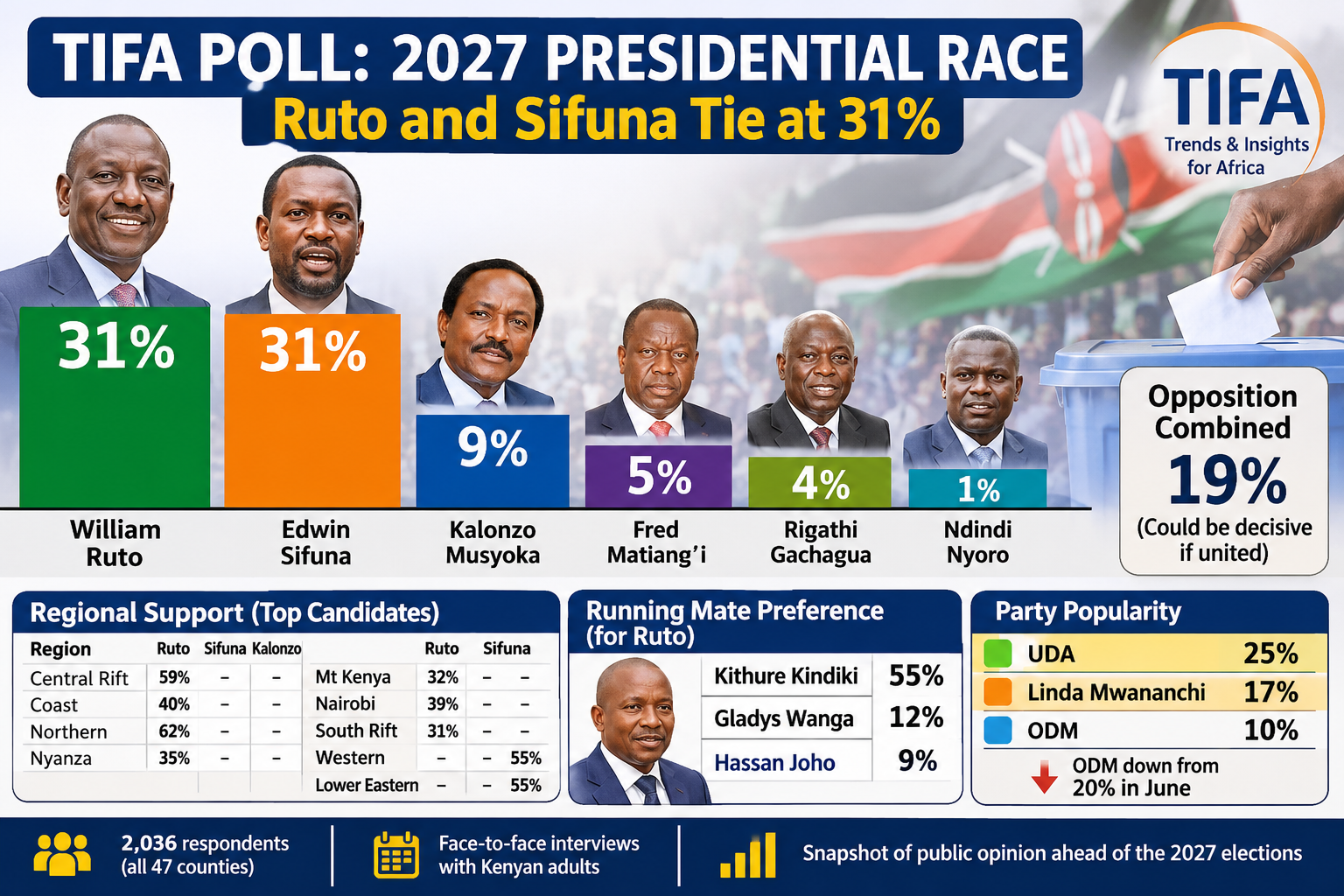
President William Ruto and Nairobi Senator Edwin Sifuna have recorded equal support in a new survey examining Kenyans’ preferred candidates for the 2027 General Election.
The poll, conducted by Trends and Insights for Africa (TIFA), placed both politicians at 31%, with other potential presidential candidates recording lower levels of support.
Wiper Party leader Kalonzo Musyoka was placed at 9%, followed by Jubilee Party leader Fred Matiang’i at 5%. Former Deputy President Rigathi Gachagua recorded 4%, while Kiharu Member of Parliament Ndindi Nyoro received 1%.
According to the survey, opposition candidates collectively accounted for 19% of respondents’ preferences. TIFA noted that this combined support could be politically significant if opposition supporters rallied behind a single candidate. However, the figures represent respondents’ stated preferences and do not establish how voters would behave in an actual election.
TIFA Poll Reveals Regional Support Patterns
The survey also highlighted differences in support for the leading candidates across the country’s regions.
Ruto recorded support of 59% in the Central Rift, 40% at the Coast, 62% in the Northern region and 35% in Nyanza.
Sifuna, meanwhile, registered 32% in the Mt Kenya region, 39% in Nairobi, 31% in the South Rift and 55% in Western Kenya.
Kalonzo Musyoka recorded 55% support in Lower Eastern, according to the poll.
The survey further identified Mt Kenya and Nairobi as regions with relatively high proportions of undecided respondents, at 21% and 17% respectively.
Kindiki Leads Preferences for Ruto’s Potential Running Mate
TIFA also asked respondents who they would prefer to deputise President Ruto if he contested the 2027 presidential election.
Deputy President Kithure Kindiki received 55% support among those surveyed, while Homa Bay Governor Gladys Wanga was preferred by 12%. Mining Cabinet Secretary Hassan Joho received 9%.
The findings provide a snapshot of public preferences regarding possible political partnerships ahead of the next General Election.
UDA Leads Party Popularity as ODM Rating Declines
The survey also examined the popularity of political parties and movements in the country.
The United Democratic Alliance (UDA) recorded 25%, placing it at the top of the party popularity findings.
Sifuna’s Linda Mwananchi movement followed with 17%, while the Orange Democratic Movement (ODM) registered 10%.
TIFA reported that ODM’s rating had fallen from 20% in its June survey to 10% in the latest findings.
The figures indicate changes in respondents’ stated party preferences between the two surveys, although they do not necessarily translate into future election results.
How TIFA Conducted the Survey
The findings were based on household, face-to-face interviews with 2,036 randomly selected Kenyan adults aged 18 and above.
The survey covered all 47 counties, providing a nationwide snapshot of public opinion at the time the interviews were conducted.
As with other opinion polls, the findings reflect the views of the sampled respondents and may change as political campaigns develop, candidates emerge and voters reassess their preferences ahead of the 2027 General Election.