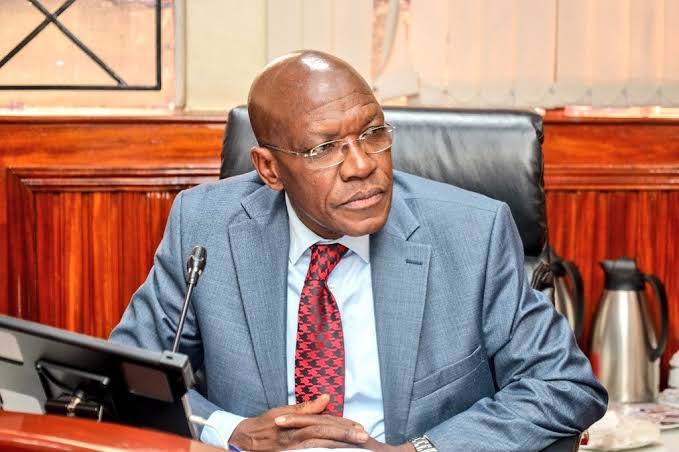
During a strategic stakeholder engagement, Independent Electoral and Boundaries Commission (IEBC) Chairperson Erastus Edung Ethekon addressed political reporters. Independent Electoral and Boundaries Commission (IEBC) Chairperson Erastus Edung Ethekon addressed political reporters during a strategic stakeholder engagement forum, emphasizing the vital role of responsible journalism in preserving national peace before the 2027 general elections.
Reflecting on Kenya’s electoral history since the 2007 post-election violence. Ethekon noted that collaborative agreements with media editors and owners fostered peaceful polls in 2013, 2017, and 2022. In deciding how to package electoral news, he assured journalists that he has never threatened any media house and respects their editorial independence.
"What I was just saying is we have to act responsibly and we have to know we have a country to preserve." Turning to the contentious debate surrounding the live streaming of polling station proceedings. Ethekon dismissed proposals to install video cameras inside every voting room across the country as logistically and financially untenable. He explained that continuous video recording would capture sensitive moments. Including voters entering booths and officials taking restroom breaks, while creating an unmanageable CCTV-style surveillance network.
With roughly 50,000 polling stations projected for 2027. The Chairperson argued that consolidating live feeds into a single central viewing room would be practically impossible. With the high cost of conducting general elections, "Who will have the time to consolidate all the what is happening in the 50,000 and then put it in a central room?" Ethekon highlighted the staggering financial burden that live-streaming infrastructure would impose on Kenyan taxpayers, who are already grappling.
He noted that each polling station at present requires about 11 personnel, including a presiding officer, deputy, clerks, and security officers, alongside Kenya Integrated Election Management System (KIEMS) kits costing over 10 billion shillings. Adding camera equipment and hiring extra technical staff for 50,000 stations would duplicate the work already performed by Kenya’s vibrant media.
In Kenya are expensive, "Already we are complaining the elections. Now you want to add another layer of us procuring cameras." Instead of state-run cameras in polling booths. The IEBC Chairperson underscored that electoral transparency is already safeguarded through accredited party agents, local and international observers, and widespread media coverage across the 290 constituency tallying centers.
He reminded journalists that under electoral law, results declared by the presiding officer and pinned on school doors at the polling station are final. Ethekon affirmed that the commission is strengthening its electoral operations communication hub to supply timely. Accurate data directly to media houses.
"The law says the moment the presiding officer announces the results at the polling station the results are final." Defending the reliability of the commission's electoral technology, Ethekon noted that IEBC systems and KIEMS kits performed seamlessly across 32 by-elections conducted over the past year. Even in fiercely contested races such as the Isiolo South parliamentary by-election, candidates had already tallied their own figures from polling station forms and verified that their numbers matched IEBC’s official results to the exact digit.
He maintained that while stakeholders are welcome to critique processes. The commission’s technological infrastructure is thoroughly tested and ready. Just let's hear what you are telling,' and their tally was to the digit." Addressing concerns over premature political campaigns and the proliferation of billboards and posters across the country. The commission clarified its legal limitations.
For IEBC to punish offenders, Citing the June 9, 2025 High Court ruling in Kituo Cha Sheria versus IEBC and Four Others, officials explained that while a three-judge bench declared early campaigning unconstitutional, it noted that no enabling legislation exists. Because the Attorney General did not enact a campaign regulation law within the court’s 12-month window ending June 2026, IEBC can only enforce campaign rules starting May 29, 2027.
"So in conclusion, there is no electoral law that the commission may use to impose sanctions on candidates for conducting early campaigns." On the enforcement of campaign spending limits, IEBC’s legal directorate declared a significant courtroom victory that clears the path for strict financial oversight before 2027. Although the Kiambu High Court had previously issued conservatory orders halting the enforcement of the Election Campaign Finance (ECF) framework. IEBC’s in-house legal team successfully had the orders vacated.
With enforcing contribution and spending caps, with the case transferred to Milimani Law Courts for consolidation and no active injunctions remaining, the commission will proceed. It means that the commission can proceed and enforce ECF because there are no restraining orders." The commission also provided an update on procurement litigation. Revealing that eight legal challenges had been filed over the past three months before the Public Procurement Administrative Review Board and the High Court regarding ballot papers and election technology.
After the Milimani High Court’s dismissal of the latest technology case, a fresh constitutional petition was immediately lodged, though the judge declined to issue conservatory orders. On the final ballot paper dispute, Consequently, tender evaluations for election technology are proceeding unhindered while the commission awaits a November 26 ruling.
For mention on 30th o, "Luckily enough, the learned judge did not grant conservatory orders yesterday, though the matter is fixed.
Source: Signs Tv. Read the original report.