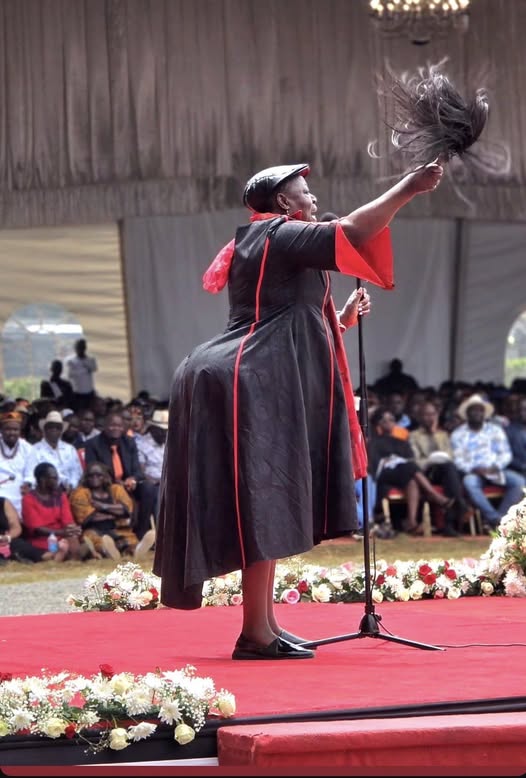
Ruth Odinga has mounted a fierce defence of her late brother Raila Odinga’s political legacy, warning that attempts to claim special access to his private thinking or to “sell” the Orange Democratic Movement risk betraying the sacrifices that birthed Kenya’s multiparty democracy.
Speaking at her Nyahera home after hosting veterans of the multiparty reform struggle, Odinga used the reflective gathering to draw a sharp line between remembrance and what she described as political opportunism. She said the moment was heavy with nostalgia, recalling comrades who paid the ultimate price during the fight for political freedoms. “Some died along the way,” she said, adding that the struggle was not an abstract chapter of history but a lived reality for many families.
At the centre of her remarks was a pointed rebuttal of claims by politicians who suggest they held privileged, private conversations with Raila on national issues. Odinga dismissed such assertions outright. “Anyone telling Kenyans that Raila had a series of private conversations with him on a wide range of issues is lying and must be called out,” she said.
She portrayed Raila as a forthright leader who spoke his mind publicly and engaged people across social and political divides without secrecy. “Jakom had a way of speaking his mind and would make public his stand on national issues,” she said. According to her, that openness made it implausible for anyone to claim a monopoly over his thoughts or intentions.
Odinga also addressed internal dynamics within ODM, invoking Nairobi Senator and party secretary-general Edwin Sifuna to underline her point that Raila related broadly within the movement. “Talking of Baba’s sons, Edwin Sifuna was equally his son and used to talk to him,” she said, adding that no individual should claim to have been closer to Raila than others who worked with him over the years.
Beyond defending Raila’s character, Odinga sought to redirect attention to unfinished national business. She urged politicians to abandon what she called “sideshows” and focus on implementing the 10-point agenda of the National Dialogue Committee report. She revealed that compensation for victims of election-related violence weighed heavily on Raila’s mind in his final days. “Baba died asking about compensation for election violence victims. It is no secret,” she said.
Her most stinging warning was reserved for those she accused of undermining ODM itself. Without naming names, Odinga claimed that some figures had already “sold” the party and even been given timelines to complete the transaction. “Do not sell the ODM party,” she said. “Those who want to sell the party do not know the struggles and deaths, and detentions that birthed multiparty democracy and subsequently the ODM party.”
As debate intensifies over possible political realignments ahead of the 2027 elections, Odinga said she was not opposed to negotiations but cautioned against blind accommodation. “I am not against negotiations ahead of 2027 elections. But that should not make us yes-men,” she said, posing a question she argued ODM must answer honestly: if the party were to join government, on what conditions?
She warned that entering talks from a position of weakness could hollow out the party. “We risk negotiating ourselves to oblivion if we don’t work on the party strength, which would give us the numbers we put on the table,” she said.
Framing ODM as a vehicle rooted in popular struggle rather than elite bargaining, Odinga concluded with a reminder of the party’s founding ethos. “ODM is a party by the people for the people,” she said.
Her remarks are likely to resonate within a party grappling with succession debates, external courtship and internal suspicion following Raila’s death. By anchoring her message in history, legacy and unfinished reform promises, Odinga signalled that the battle over ODM’s future will be fought not just over alliances, but over the meaning of the struggle that created it.


