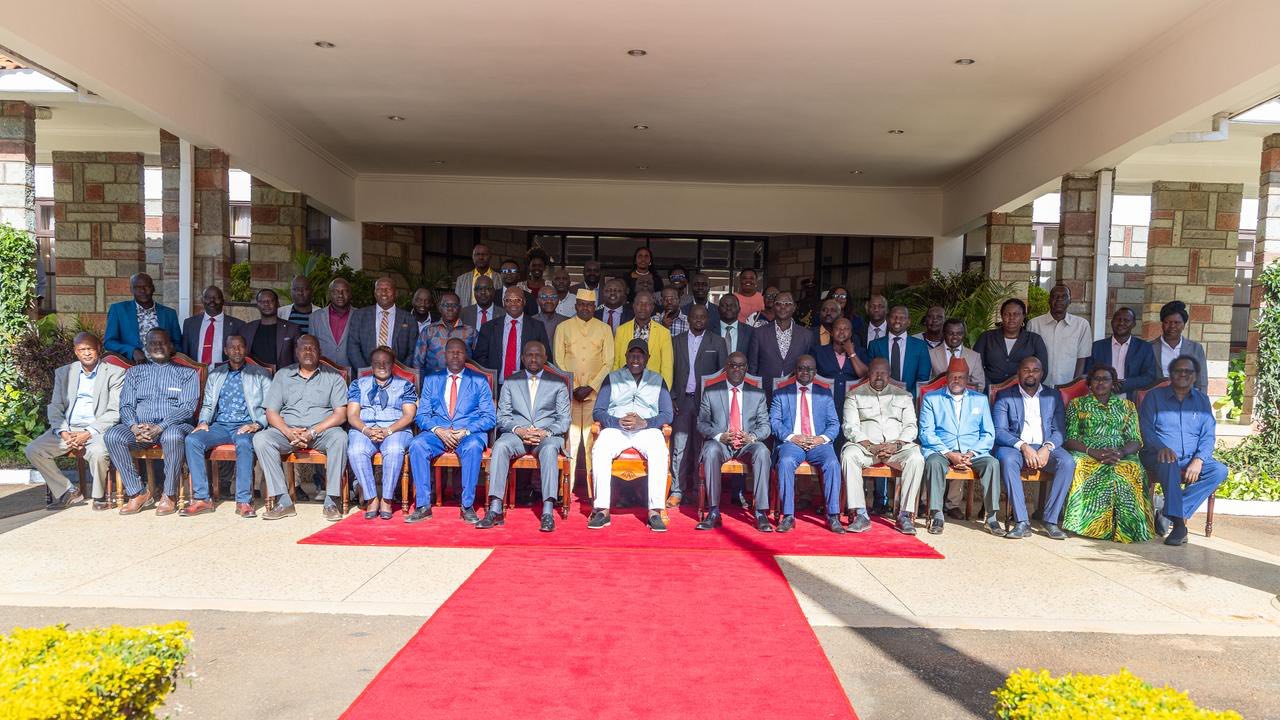
President William Ruto on Tuesday signalled a renewed push to align local politics with his long-term development agenda after praising leaders from West Pokot County for setting aside differences to work together for the region’s growth.
Speaking at Eldoret State Lodge in Uasin Gishu County, Ruto said unity among political leaders was critical to unlocking development in areas that have suffered decades of marginalisation. He argued that internal divisions had slowed progress in West Pokot, leaving residents without reliable roads, electricity and water.
“I am impressed by the unity of leaders from West Pokot who have agreed to work together for the benefit of their people,” Ruto said. “This teamwork will accelerate the transformation of the county and ensure that no region is left behind because of politics.”
The President said the government would prioritise modernisation of road networks to open up remote areas, expand electricity connectivity to spur small businesses, and enhance water supplies to ease the burden on households, particularly women and children who walk long distances in search of water.
Ruto framed the commitments as part of his broader development vision stretching to 2037, which aims to address regional inequalities and lift historically marginalised communities into the national economic mainstream. He said progress would depend on cooperation between national and county leaders rather than rivalry.
Leaders from West Pokot who attended the meeting said the show of unity marked a turning point for a county long associated with insecurity, poor infrastructure and limited public services. They pledged to support national programmes and work jointly to ensure projects are implemented on the ground.
For residents, the promises carry high stakes. Poor roads have isolated farmers from markets, limited electricity has constrained enterprise, and water shortages have remained a daily struggle. The government says coordinated leadership will be key to translating policy pledges into tangible change as it pursues its long-term development agenda toward 2037.


