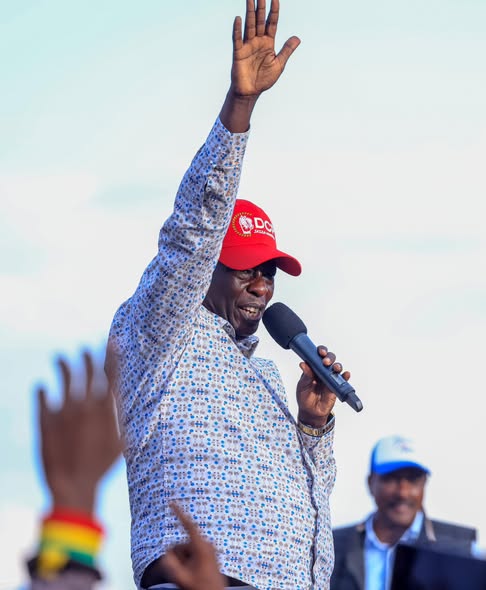
Former Deputy President Rigathi Gachagua has launched a blistering critique of leadership in Northern Kenya, blaming entrenched poverty and underdevelopment in the region on what he described as chronic failures of accountability rather than lack of resources.
Speaking after a meeting in Nairobi with businessman Fazul Mahamed Mahamed, attended by DCP party deputy leader Cleophas Malala, Mr Gachagua said Northern Kenya had become “the ailing silent patient of our Republic,” despite receiving vast public and donor funding over the years.
“Somalis and Kikuyus are, by culture and practice, business people. Across Kenya and especially in Nairobi they are the foundation of our economy,” Mr Gachagua said, drawing parallels between the Somali philosophy of “soo maal” — the obligation to seek sustenance — and the Kikuyu concept of “witeithie,” the moral duty to fend for oneself.
Northern Kenya has historically been among the most marginalised regions in the country, a legacy rooted in colonial-era neglect, post-independence security operations, and limited state investment. The introduction of devolution in 2013 was intended to reverse this imbalance by channelling resources and decision-making power closer to local communities, particularly in arid and semi-arid areas.
Counties such as Mandera, Garissa, Wajir, Marsabit and Isiolo have since received significant allocations through the equitable share, the National Government Constituencies Development Fund, the Equalisation Fund meant to bridge historical gaps, and infrastructure funding from agencies such as the Kenya Roads Board.
Mr Gachagua argued that the persistent suffering in the region could no longer be explained by marginalisation alone. According to him, the five counties have received more than Sh1 trillion since devolution began, in addition to substantial donor support.
“Beyond domestic financing, trillions more have flowed into the region through multilateral development finance institutions, bilateral partners, UN agencies and international NGOs,” he said. “Yet, despite this massive inflow of resources, there is no tangible progress to show on the ground.”
He placed the blame squarely on political leadership, accusing some leaders from the region of treating public office as a personal investment opportunity. He claimed many spend most of their time in Nairobi, investing in real estate, instead of delivering basic services to their constituents.
“This is not a failure of the people. It is a failure of leadership and accountability,” he said. “They build apartments in every corner of Nairobi instead of translating public resources into water, roads, schools and health facilities back home.”
Mr Gachagua’s remarks come at a time when the performance of county governments is under increasing scrutiny, with repeated reports by the Auditor-General highlighting weak oversight, stalled projects and misuse of public funds across several devolved units.
Positioning himself as an ally of the Somali community, Mr Gachagua said his engagement with leaders from Northern Kenya was driven by a desire to confront long-standing governance failures.
“I am a friend of the Somali community,” he said. “Accountability is not hostility. It is the beginning of recovery.”


