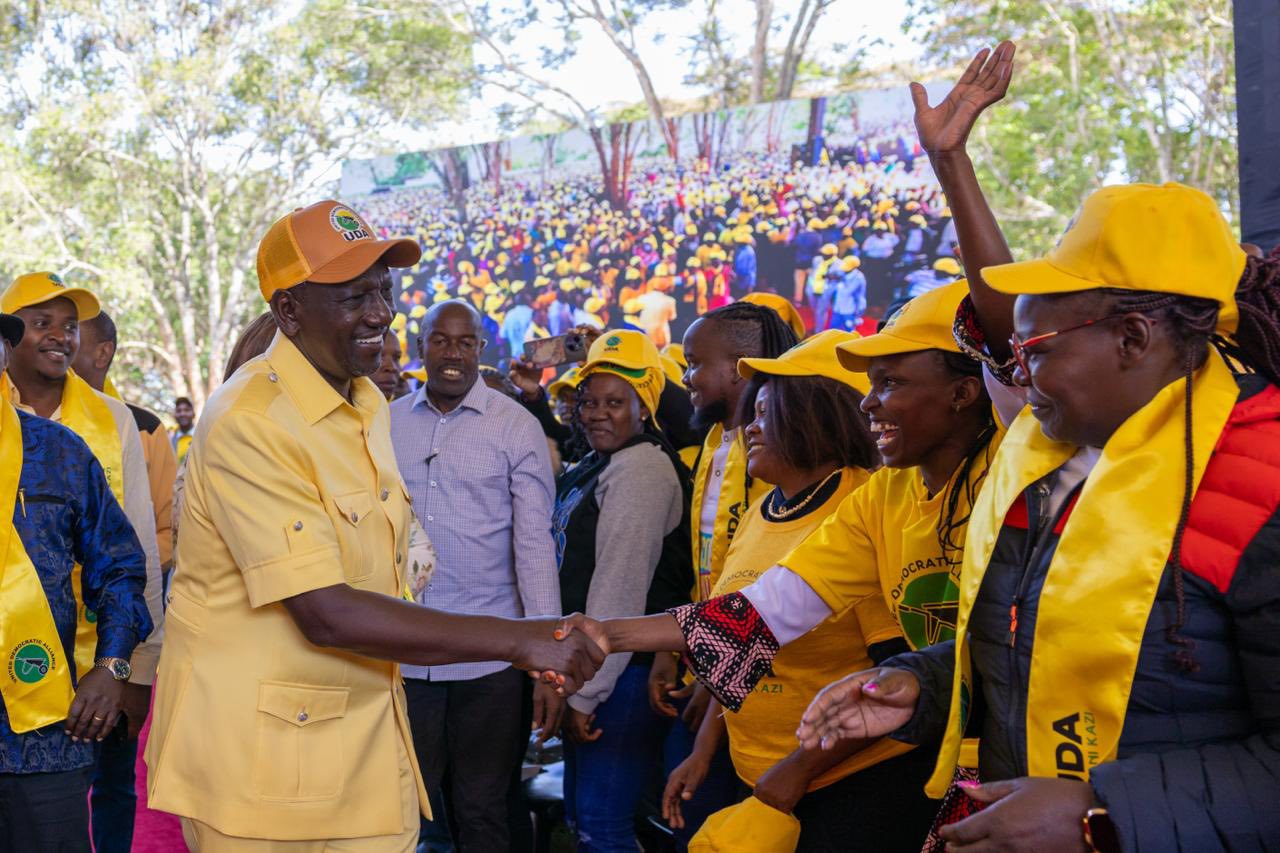
President William Ruto has signalled a fresh legal battle that could reshape how government policy is made in Kenya, announcing plans to seek a court interpretation on whether a ruling party’s manifesto amounts to sufficient public participation once endorsed at the ballot.
Speaking in remarks shared by digital strategist Dennis Itumbi, the President argued that voters, by electing a party on the strength of its manifesto, effectively approve the policy agenda outlined in it. In his view, that electoral endorsement should carry legal weight and limit courts from routinely blocking the implementation of manifesto promises.
“The argument is simple but important,” Ruto said. “A ruling party’s manifesto is endorsed by the majority through the ballot. That vote should count as sufficient public participation.”
The President’s position comes amid a series of court decisions that have stalled or overturned government programmes, with judges citing inadequate public participation or procedural flaws. Ruto contends that such rulings risk undermining the will of voters who, he says, already expressed their preferences during elections.
On that basis, he believes courts should exercise restraint when asked to stop policies that were explicitly outlined during campaigns. “The people already decided, at the election, how they want to be governed,” he said.
The proposal, however, has ignited debate among politicians, legal experts and civil society groups, who warn that equating elections with blanket public participation could weaken constitutional safeguards.
In a reflective note accompanying the remarks, Itumbi framed the issue as a broader democratic dilemma. “This raises the next big question,” he wrote. “Is an election itself the highest form of public participation, or must every policy promise still pass fresh legal and participatory tests?”
Ruto himself acknowledged the political consequences of failing to deliver on campaign pledges, arguing that accountability ultimately lies with voters, not the courts. “A leader elected on a manifesto but who fails to implement it will ultimately answer to the people,” he said, adding that voters are unlikely to excuse broken promises on the grounds that “the courts delayed us.”
Kenya’s 2010 Constitution places heavy emphasis on public participation, requiring citizens to be involved in legislative and policy-making processes. Courts have repeatedly interpreted this to mean that even popular government initiatives must undergo consultations beyond the ballot box.
This tension has played out in high-profile cases involving housing levies, tax measures and administrative reforms, where judges have ruled that the government failed to adequately involve the public despite campaigning on those ideas.
Critics argue that Ruto’s approach risks reducing public participation to a once-every-five-years event, shutting out dissenting voices between elections. They also question whether voters can realistically be said to approve every detailed policy contained in a manifesto.
“There is a danger in assuming that a vote for a party equals consent to every future regulation and law,” said one constitutional lawyer, who noted that manifestos are often broad and lack specifics that later emerge in legislation.
Others counter that public participation processes have increasingly been weaponised by political opponents to frustrate the government’s agenda. Itumbi posed that concern directly: “In that scenario, will those who lost an election agree with the policies, or will public participation become a platform for opposition?”
Supporters of the President say the courts should respect electoral outcomes and avoid stepping into what they see as political territory. They argue that repeated legal challenges slow development and create uncertainty for investors and citizens alike.
The planned court move is expected to seek clarity on the hierarchy between electoral mandates and participatory requirements, a question that has long lingered in Kenya’s constitutional practice but has never been decisively settled.
Whether the judiciary will accept Ruto’s framing remains uncertain but legal analysts say any ruling is likely to tread carefully, balancing the sovereignty of the people expressed through elections with constitutional demands for inclusivity and accountability.


