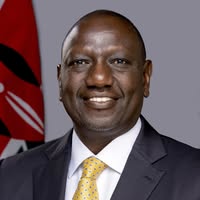
President William Ruto walked into the ODM@20 founders’ dinner in Mombasa on Saturday night, stepping back into a movement he helped shape in its infancy and later fought bitterly for more than a decade. The dinner, held at the windswept Mama Ngina Waterfront, opened the second day of the Orange Democratic Movement’s three-day anniversary celebration—an emotional commemoration taking place in the shadow of Raila Odinga’s death and the party’s uncertain future without its longtime leader.
ODM’s milestone, marking two decades of political battles, street protests, electoral heartbreak and ideological resilience, has been charged with nostalgia and introspection. But it was Ruto’s presence—unexpected only a few years ago—that defined the night, bridging old animosities and reminding Kenyans of a political history that rarely moves in straight lines.
For many inside the hall, the moment evoked the party’s origins. ODM was born out of the 2005 constitutional referendum rebellion, when Raila’s “No” campaign fractured the government and redrew Kenya’s political map. Among his key allies at the time was a young, ambitious William Ruto, who mobilised the Rift Valley and became one of ODM’s most energetic foot soldiers. Their partnership carried the party into the violent 2007 elections, where ODM came within striking distance of power before the disputed vote plunged the country into crisis and forced a grand coalition government.
The alliance fell apart soon after, turning Raila and Ruto into fierce rivals whose conflict shaped three consecutive election cycles. A generation of Kenyans grew up knowing them not as allies but as political adversaries, each accusing the other of betrayal and political treachery.
That is why Ruto’s return to an ODM celebration, months after Raila’s passing, felt like a chapter closing—and another opening. He arrived with senior members of his administration, underscoring the weight he assigns to the cooperation agreement he and Raila signed on March 7, 2025. The MoU, which the two men insisted was not a merger, committed them to shared governance priorities and national stability at a moment when public anger, economic shocks and the Gen Z protests had left the political order shaken.
Former Mombasa governor Hassan Joho, now part of the broad-based government, argued that Ruto’s appearance is less surprising when viewed through the party’s historical lens. “A fact is a fact. The truth is that President William Ruto is a founding member of ODM. That cannot be changed, regardless of subsequent events,” he said on Citizen TV, recalling the early lineup of Raila, Ruto, Henry Kosgey, Franklin Bett and Najib Balala.
Inside the venue, ODM officials framed the anniversary as a reaffirmation of the movement’s founding promise rather than a ceremonial reunion. The party’s organisers said the commemoration is meant to honour its commitment to champion justice, inclusion and political accountability—values that animated its rise and sustained its supporters through years of opposition trenches.
Ruto, in recent months, has been careful to describe the ODM cooperation as temporary and issue-driven, not a realignment for the 2027 elections. He has said the pact’s purpose is to “foster unity of purpose,” arguing that Kenya needed political calm to confront economic turbulence and growing public frustration.
Raila, before his death, defended the partnership in similarly stark terms. At a burial in Homa Bay in August, he said he had no regrets. “It was necessary to take emergency measures at a time when the country was about to collapse,” he told mourners, insisting the deal had helped stabilise the nation.
ODM’s 20-year journey—born in rebellion, tested by trauma, fractured by ambition and recently stitched together by political necessity—has come full circle in Mombasa. And Ruto’s presence, in the party’s moment of reflection and mourning, highlighted a complex bond with Raila: a partnership forged in struggle, shattered by rivalry and revived in the final chapter of Raila’s life.


