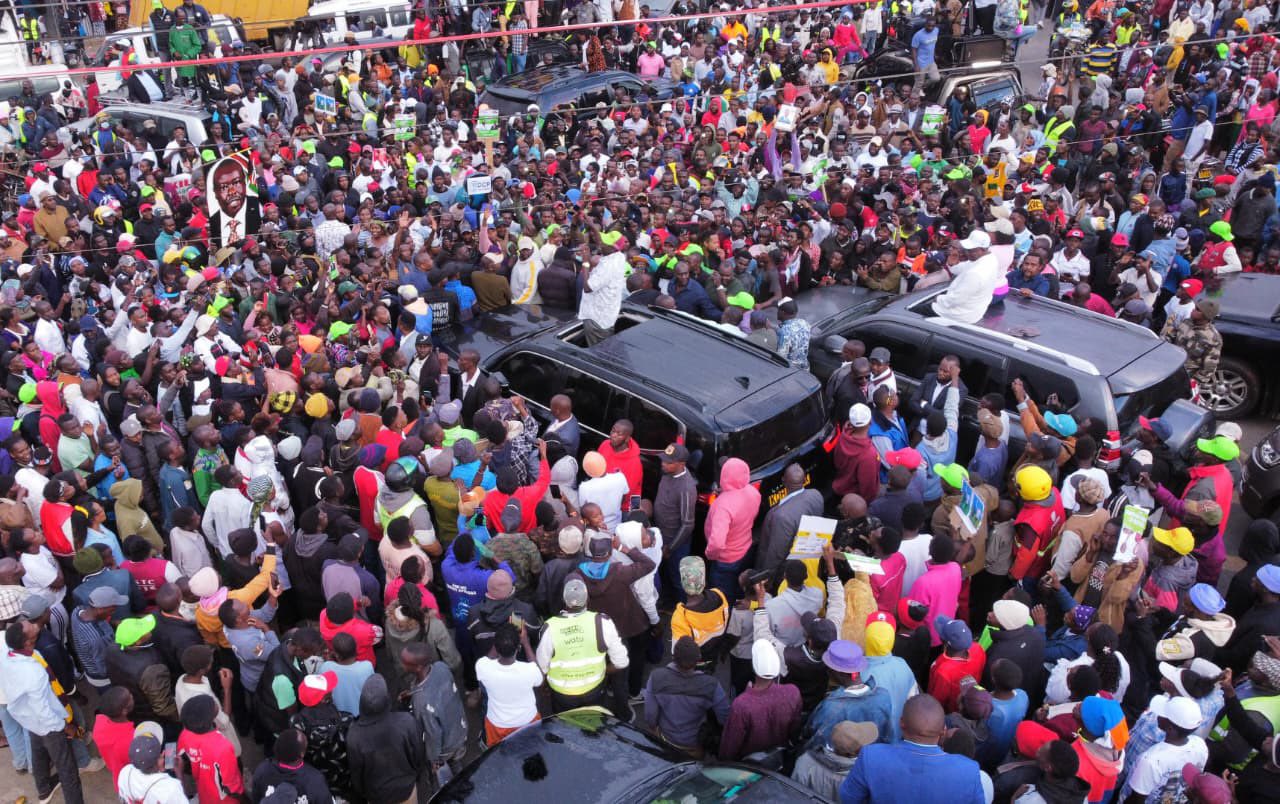
Former Deputy President Rigathi Gachagua has accused the government of neglecting residents of Tigania West Constituency, saying the area suffers from some of the worst road networks in the country.
Speaking during a meeting with residents at Kianjai Market, Gachagua said several key roads in the region have repeatedly been promised by leaders but remain incomplete years later.
“The people of Tigania West have told us that they have the worst roads network in the history of our Republic,” he said.
The former deputy president singled out the Kianjai–Urru–Mikinduri road, the Kamoja road linking Kianjai to Isiolo, and the St Anne–Miomponi road as projects that have been launched and re-launched over the years but never fully implemented.
“The notorious Kianjai–Urru–Mikinduri Road, Kamoja (Kianjai–Isiolo) Road and St Anne–Miomponi Road have been launched and re-launched time and again and used as campaign tools for decades as residents suffer. Shame,” he said.
Gachagua said development projects such as roads should not be used to reward or punish regions based on political affiliation.
“It is time roads are developed across the country without discrimination and the people of Tigania West are not an exception in any sense,” he added.
Background
Gachagua’s remarks come amid growing political tensions following his dramatic fallout with President William Ruto that culminated in his impeachment in 2024. Since leaving office, the former deputy president has embarked on a series of political tours across the country, sharply criticizing the government and accusing it of sidelining regions that supported him.
His rallies have increasingly carried the slogan “Fagia Wote,” loosely translated to mean “sweep them all,” a phrase his allies say reflects public frustration with leaders accused of failing to deliver development.
The Mt Kenya region, once a stronghold of the ruling coalition, has in recent months witnessed rising political activity as leaders reposition themselves ahead of the 2027 general election.
During the meeting in Kianjai, residents complained that poor road conditions have made transport difficult, affecting the movement of farm produce and access to markets and health facilities in the largely agricultural constituency.
Gachagua thanked the residents for attending the meeting and urged leaders to prioritize infrastructure development in neglected areas.
“Thank you Kianjai and God bless you,” he said.


