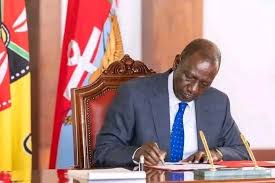
President William Ruto has officially assented to the National Infrastructure Bill, 2026, setting the stage for the creation of a Ksh.5 trillion investment fund designed to finance critical infrastructure projects across the country.
The legislation was sponsored by National Assembly Majority Leader Kimani Ichung’wah and approved by Parliament as part of the government’s strategy to strengthen long-term infrastructure development.
Under the new law, the National Infrastructure Fund will channel investments into sectors such as transport, energy, irrigation, ports and railway development.
The government plans to mobilise the Ksh.5 trillion over the next decade through an investment-driven approach that seeks to attract private capital rather than relying heavily on borrowing or higher taxes.
According to President Ruto, the first major project to benefit from the fund will be the expansion of Jomo Kenyatta International Airport, Kenya’s main international gateway.
The airport upgrade will be financed through a partnership involving approximately Ksh.20 billion in equity from the new fund alongside contributions from local institutional investors.
Ruto said the model being adopted by Kenya has been successfully implemented in several countries, citing examples of national infrastructure investment funds in nations such as India, Canada, Ghana, Nigeria, South Africa and the United Kingdom.
He also noted that Kenya has significant domestic financial capacity, pointing out that pension fund assets grew by about Ksh.700 billion last year to reach roughly Ksh.2.81 trillion.
The new infrastructure fund will be overseen by a board consisting of eight members, including four independent directors selected competitively, three public officials and a chief executive officer.
Oversight will also be provided by a governing council chaired by National Treasury Cabinet Secretary John Mbadi, alongside Kamau Thugge, the governor of the Central Bank of Kenya, the Attorney General and six additional members drawn from outside the public service.
The council will guide the fund’s overall strategy, formulate investment policies and oversee the appointment of the board’s directors.
Several major development initiatives have already been listed as potential beneficiaries of the fund, including the Loosuk–Lessos electricity transmission line, the Galana-Kulalu irrigation scheme, the Rironi–Naivasha–Mau Summit highway and the planned extension of the Standard Gauge Railway to Malaba.


