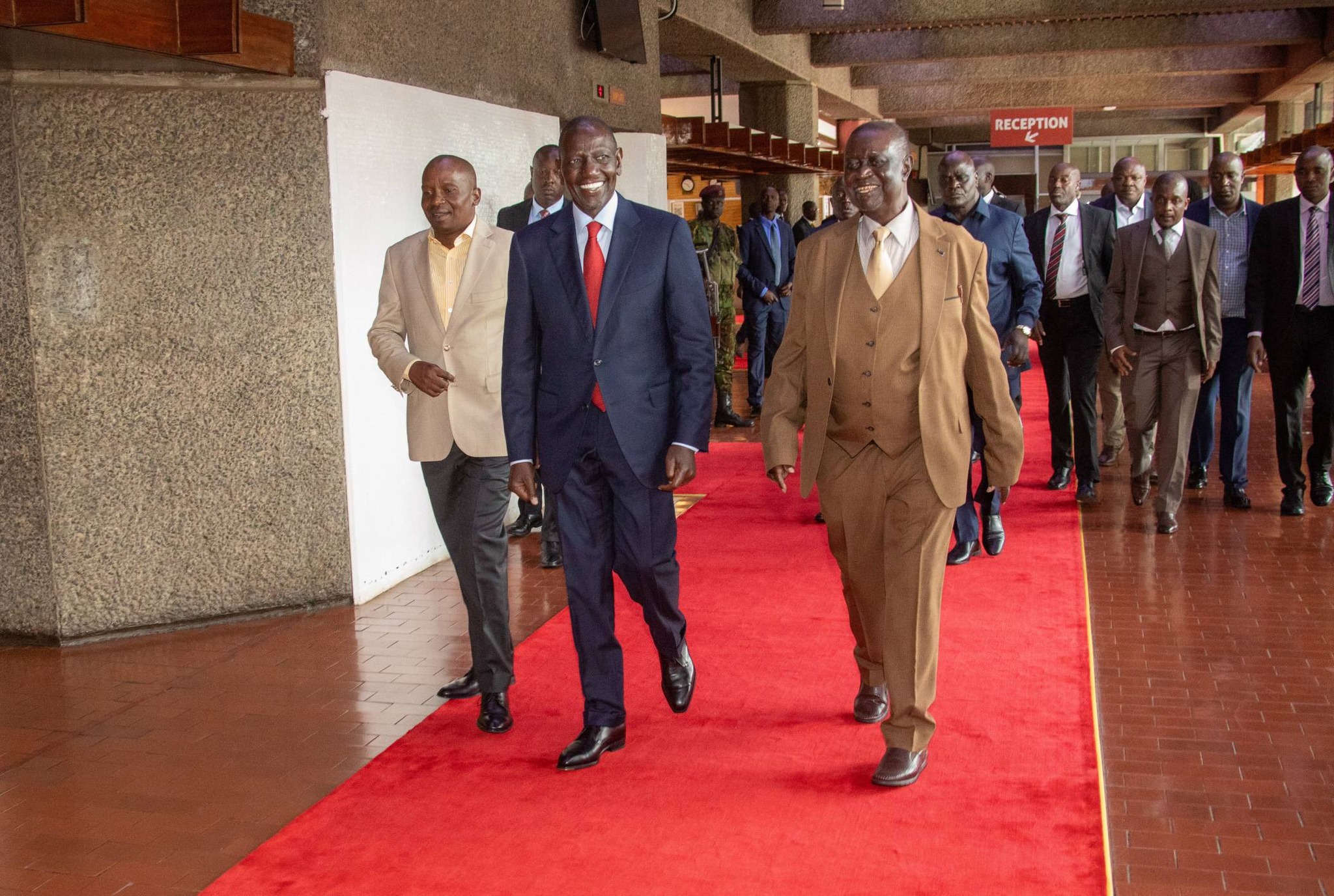
President William Ruto on Tuesday defended the performance of the broad-based government, saying the arrangement between the United Democratic Alliance and the Orange Democratic Movement was delivering on its promises to Kenyans.
Speaking during a joint parliamentary group meeting of the two parties at the Kenya International Convention Centre in Nairobi, the President said the government had made progress in implementing its 10-point agenda aimed at stabilising the country and improving livelihoods.
“The broad-based government continues to deliver on its mandate to the people, including the 10-point agenda,” Ruto said.
He cited efforts to unite the country politically, stabilise the economy and reduce the cost of living, noting that inflation had eased as the administration rolled out measures to support households.
Ruto also highlighted reforms in the health sector, saying the government had expanded coverage under the Social Health Authority as part of efforts to achieve universal health coverage.
The President said the administration was also pushing agricultural reforms to increase productivity while investing in infrastructure projects across the country.
“We have embarked on ambitious infrastructure development across the country, expanded job opportunities for our youth, and continue to strengthen devolution by increasing funding to counties,” he said.
On justice and governance, Ruto said the government had initiated reforms in the police service and compensation programmes for victims affected during past protests.
He also urged the Kenya National Commission on Human Rights to propose legislation to Parliament aimed at protecting protesters during demonstrations.
“We also call on the Kenya National Human Rights Commission to propose a law to Parliament on the protection of protestors,” the President said.
During the meeting, lawmakers from UDA and ODM agreed to form a parliamentary mediation committee to fast-track the implementation of pending reforms proposed under the National Dialogue Committee process.
The committee will handle outstanding legislative items arising from the bipartisan talks that followed the political tensions witnessed after the 2022 elections.
The broad-based government emerged from the negotiations between Ruto’s administration and opposition leader Raila Odinga after months of anti-government protests in 2023 over the high cost of living and electoral reforms. The talks, held under the National Dialogue Committee framework, paved the way for cooperation between the ruling coalition and ODM.
Following the agreement, several ODM figures began working with the government, a move that reshaped Kenya’s political landscape and effectively brought the opposition party closer to the administration.
The arrangement, however, has triggered internal tensions within ODM, particularly after the death of party leader Raila Odinga, which left a leadership vacuum and sparked a struggle over the party’s direction.
A public disagreement recently erupted between Oburu Odinga and Edwin Sifuna, exposing divisions within the party over its cooperation with the government.
Oburu, Raila’s elder brother and a senior figure in ODM, has rallied members to remain united behind the broad-based arrangement, arguing that the partnership with the government is necessary to advance reforms and development.
But Sifuna, the party’s secretary-general, has warned against ODM losing its identity as an opposition movement, saying the party must remain accountable to its supporters.
The tensions have highlighted the delicate balance ODM faces as it navigates its relationship with the government while trying to maintain unity after Raila’s death.
Despite the divisions, Ruto insisted the cooperation between UDA and ODM was focused on delivering reforms and stabilising the country’s politics and economy.


