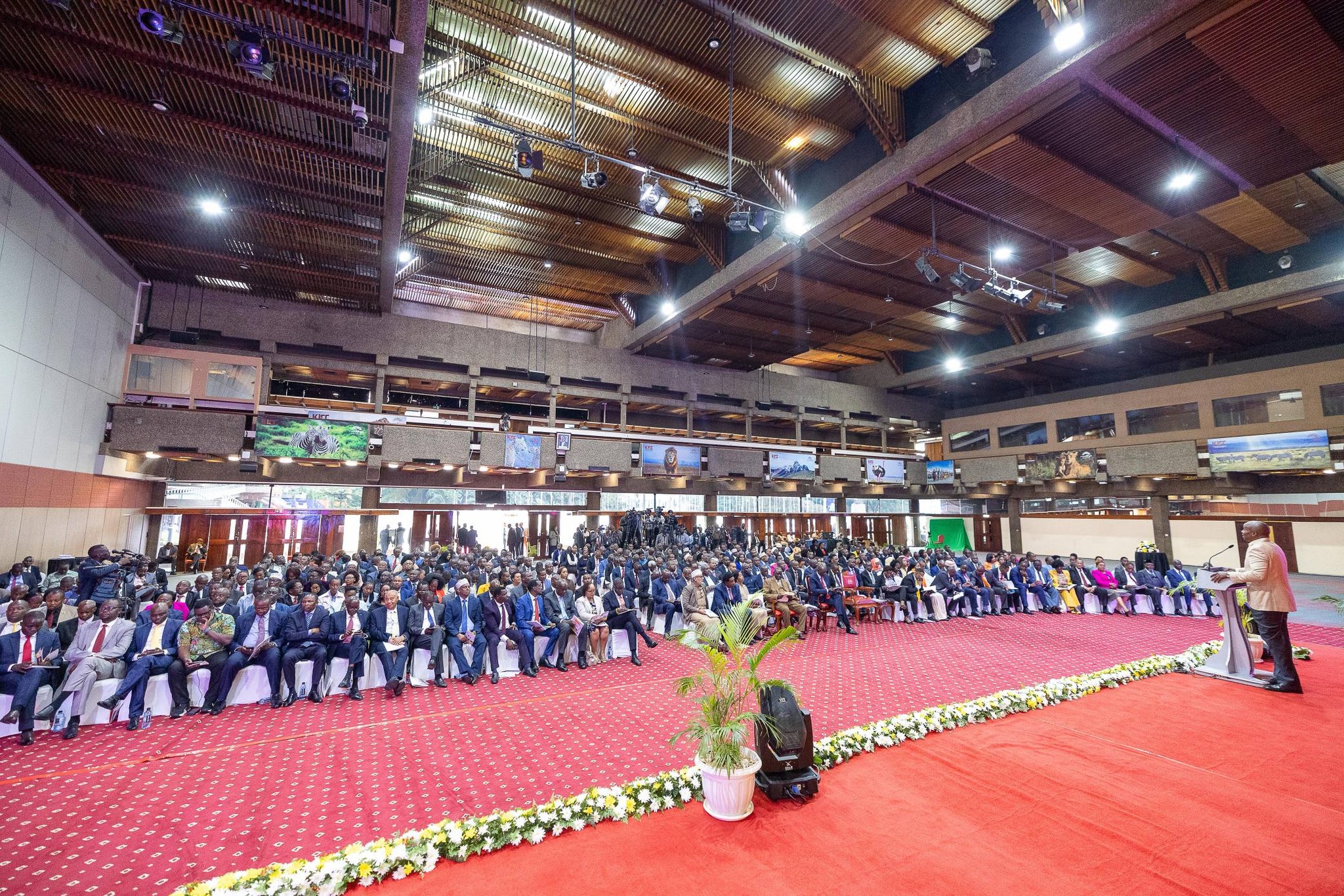
Deputy President Kithure Kindiki on Tuesday defended the government’s economic record, saying Kenya had made “significant strides” in stabilising key indicators since 2022 under President William Ruto.
Speaking at a joint parliamentary group meeting between the United Democratic Alliance and the Orange Democratic Movement at the Kenyatta International Convention Centre, Kindiki presented what he described as the administration’s three-year scorecard.
“Our currency remains stable, exchanging at Sh129 to the dollar compared to Sh165 in 2022, while inflation has dropped to 4.3 per cent from a high of 9.6 per cent,” Kindiki said.
He said foreign exchange reserves had more than doubled from $5.7 billion in 2022 to $14.6 billion, while Treasury bill interest rates had fallen from 16.75 per cent to 8.75 per cent, easing access to credit.
Kindiki also pointed to improvements at the Nairobi Securities Exchange and said Kenya had become the sixth-largest economy in Africa after overtaking Ethiopia and Angola.
The Deputy President listed gains in agriculture, saying production of tea, coffee, milk, beef and sugar had increased while fertiliser prices had fallen from Sh7,000 to Sh2,500 per bag.
He added that 7.9 million animals had been vaccinated and that the Kenya Leather Industrial Park in Kenanie, Machakos County, was nearing completion.
Kindiki also highlighted investments in the blue economy, including the completion of the Sh2.6 billion Shimoni Fish Port and Sh3.2 billion in grants to beach management units along the Indian Ocean and Lake Victoria.
On employment, he said the government had created jobs through programmes such as Kazi kwa Ground, Climate Worx, Kazi Mtandaoni and Kazi Majuu.
“The Kazi kwa Ground programme has created 500,000 jobs through affordable housing and market projects, while Climate Worx has generated 142,000 jobs,” he said.
He added that the government had increased the education budget from Sh500 billion to Sh702 billion, employed 100,000 teachers and built 23,000 classrooms.
Kindiki said enrolment in technical training institutions had more than doubled while funding to the Higher Education Loans Board had risen from Sh17 billion to Sh41 billion.
In healthcare, he said the government’s universal health coverage programme, Taifa Care, had enrolled 29.8 million Kenyans, up from seven million in 2022.
The Deputy President said the administration had also expanded electricity connections, completed thousands of kilometres of fibre optic cable and resumed stalled road projects after settling Sh177 billion in pending bills owed to contractors.
“I am happy to present on behalf of the team leader of the Broad-Based Administration, President William Ruto, the scorecard for three years,” Kindiki said.
However, the government’s performance claims have drawn criticism from former Deputy President Rigathi Gachagua, who has repeatedly dismissed the administration’s track record.
Gachagua, who has since fallen out with President Ruto, has argued that the economic hardships facing many Kenyans contradict the government’s positive outlook.
“The government keeps speaking about economic indicators, but ordinary Kenyans are struggling with the high cost of living,” he said in recent remarks, accusing the administration of focusing on statistics rather than people’s livelihoods.
The political tensions come months after a dramatic shift in the country’s leadership structure that saw Kindiki rise to the deputy presidency.
Kindiki, who previously served as Interior Cabinet Secretary, was nominated by President Ruto to replace Gachagua after the latter’s relationship with the president deteriorated following months of political infighting within the ruling coalition.
The fallout exposed deep divisions within the Kenya Kwanza administration, particularly in the Mt Kenya region where Gachagua had positioned himself as the region’s political kingpin.
Kindiki’s appointment was widely interpreted as part of Ruto’s attempt to stabilise his government and rebuild alliances in Parliament.
It also coincided with the emergence of what the administration has termed a “broad-based government,” a political arrangement that brought together members of the ruling UDA party and sections of the opposition ODM in Parliament.
The cooperation emerged after months of political tensions and street protests that had rocked the country, prompting negotiations between government allies and opposition leaders aimed at easing the political climate.
Since then, lawmakers from ODM have increasingly worked with the government in passing legislation and supporting key programmes.
.


