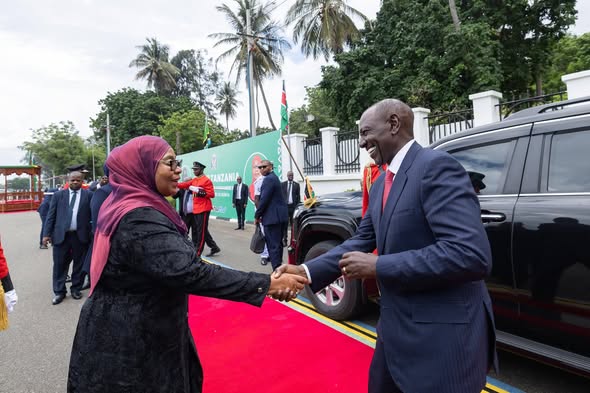
President William Samoei Ruto has reaffirmed Kenya’s commitment to strengthening bilateral ties with Tanzania following a two-day State Visit to Dodoma, even as opposition leaders question the tangible benefits of such engagements.
In a statement after concluding the visit, Ruto thanked Tanzanian President Samia Suluhu Hassan and citizens for what he described as exceptional hospitality, terming the trip historic.
“Asante sana President Samia Suluhu Hassan, my dear sister, and the people of Tanzania for the exceptional warmth and hospitality extended to us during the historic State Visit to your great country,” Ruto said.
The President said Kenya would fully implement agreements signed during the visit, aimed at enhancing trade, infrastructure development, and economic cooperation. He emphasised the need for closer collaboration under the East African Community (EAC), calling for deeper integration to drive shared prosperity.
“We commit to fully play our part in advancing the implementation of the agreements we have signed in pursuit of mutual and shared growth,” he said.
The visit comes against the backdrop of a historically complex relationship between Kenya and Tanzania, often marked by periodic trade disputes, including restrictions on agricultural products, tourism-related tensions, and cross-border business regulations. In recent years, however, both governments have signalled a shift towards cooperation, with multiple bilateral meetings aimed at easing trade barriers and improving coordination within the EAC framework.
Analysts say the latest visit builds on ongoing efforts to harmonise policies in key sectors such as transport, energy, and regional trade corridors, which are critical to boosting intra-East African commerce.
However, opposition leaders have criticised the trip, arguing that such high-level visits have yet to translate into meaningful economic relief for ordinary citizens. Some have accused the government of prioritising diplomatic optics over domestic concerns, including the high cost of living and unemployment.
Nairobi Senator Edwin W. Sifuna has previously questioned the government’s broader economic strategy, calling for greater transparency and accountability in how international agreements benefit Kenyans.
Other opposition figures linked to the Linda Mwananchi initiative have also pushed for the public disclosure of bilateral agreements, arguing that citizens should understand the terms and expected outcomes of such deals.
They maintain that while regional cooperation is important, the government must demonstrate how these partnerships will address local economic challenges and improve livelihoods.
Ruto, however, maintained that strengthening regional ties remains central to Kenya’s economic agenda, noting that closer cooperation with Tanzania and other EAC member states will unlock new opportunities for growth and investment.
The President concluded his visit with a farewell at State House in Dodoma, expressing optimism about the future of Kenya-Tanzania relations.


