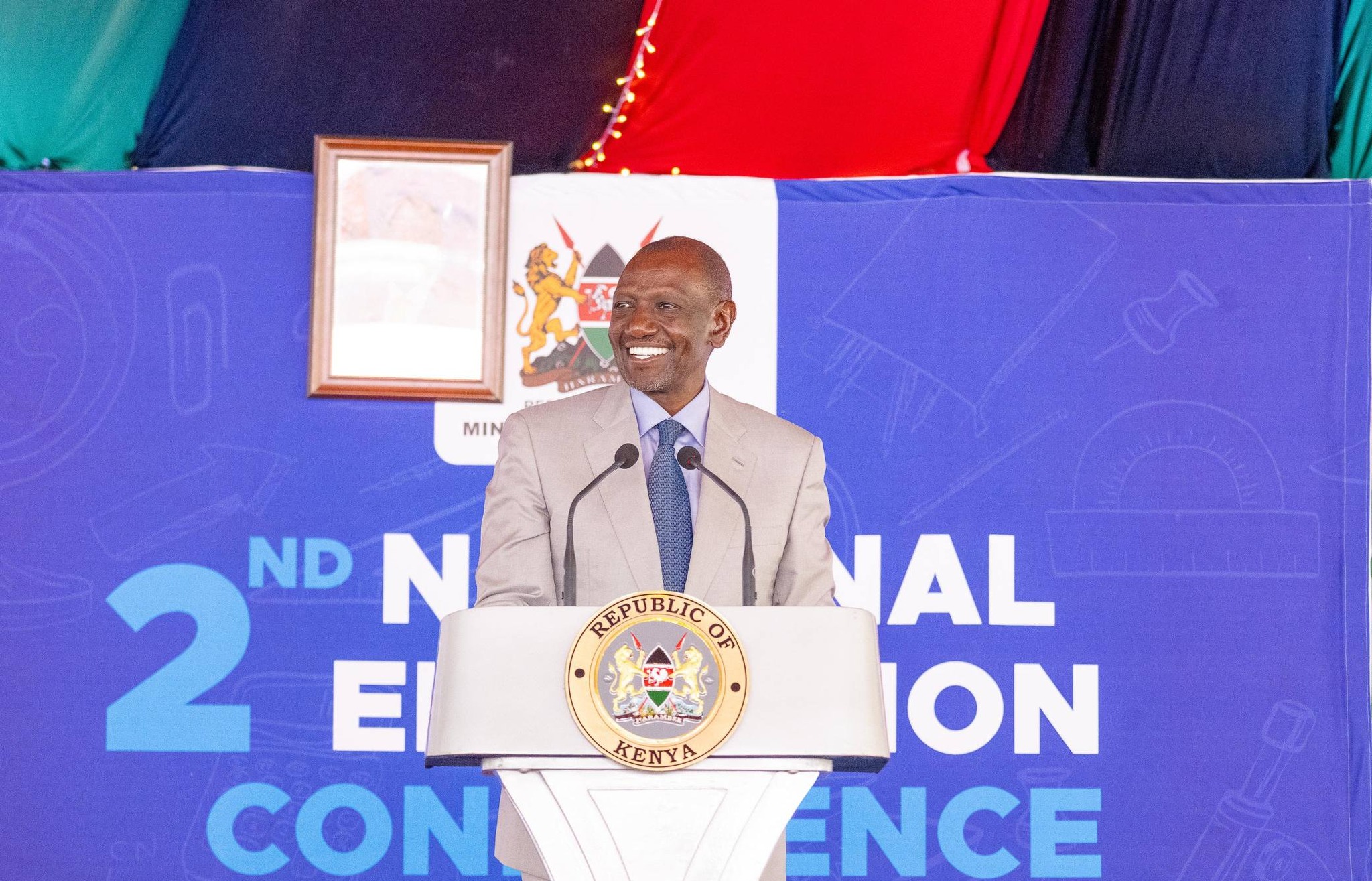
President William Samoei Ruto has defended his administration’s sweeping education reforms, insisting that increased funding, teacher recruitment and infrastructure expansion are steadily transforming learning across the country, even as stakeholders continue to raise concerns over implementation challenges.
Opening the Second National Education Conference in Naivasha, Nakuru County, Ruto said the government had significantly expanded investment in education, raising the budget from about KSh500 billion in 2022 to more than KSh702 billion in the current financial year.
“We have continued to broaden and deepen reforms in the education sector, the central pillar of economic development and progress as a people and a society,” Ruto said.
He added that the increased funding underscores what he called the government’s “unwavering commitment to quality, access and inclusion in education for all.”
According to the President, the government has recruited 100,000 teachers, constructed 23,000 classrooms nationwide, and embarked on the building of 1,600 laboratories in secondary schools, describing the interventions as critical in easing congestion and improving learning conditions.
“These measures are helping ease congestion and improve the learning environment for our children,” he said.
Ruto also defended ongoing reforms to the Competency-Based Education (CBE) system, which has faced criticism from teachers’ unions and education experts over preparedness, resources and rollout pace.
“We have also comprehensively reviewed the Competency-Based Education system to address challenges and address the needs, aspirations, and realities of our nation,” he said.
In higher education, the President reiterated support for the new student-centred funding model, which has been at the centre of public debate since its introduction.
He said the system is designed “to expand access, enhance equity, and ensure that no deserving learner is left behind because of financial constraints.”
Ruto further said the government is using the conference to assess progress and challenges in the education sector.
“Opened the Second National Education Conference in Naivasha, Nakuru County, to take stock of the progress we have made, reflect candidly on the challenges that remain, and renew our collective resolve to transform education into the greatest driver of national development,” he said.
Despite the government’s assurances, teachers, civil society groups and parents continue to raise concerns over the pace and structure of reforms.
Teachers’ unions have questioned whether schools are sufficiently prepared for the demands of the CBE system, particularly in terms of training, infrastructure and learning materials.
Parents, on the other hand, have raised concerns about rising education costs, especially school uniforms and related expenses, arguing that the burden continues to grow despite government promises of affordability.
Civil society organisations have also warned of widening inequalities between well-resourced and under-resourced schools, saying implementation gaps risk deepening disparities in learning outcomes.
Ruto acknowledged some of these concerns, calling for broader national dialogue on cost and access issues in education.
“At the same time, we need a national conversation on the prohibitively high cost of school uniforms, efficient provision of bursaries and the establishment of comprehensive schools, ranging from early childhood education to senior school,” he said.
The education reforms remain one of the flagship policy areas of the Kenya Kwanza administration, but also among the most contested, with stakeholders calling for faster resolution of funding delays, curriculum challenges and resource gaps in schools.


