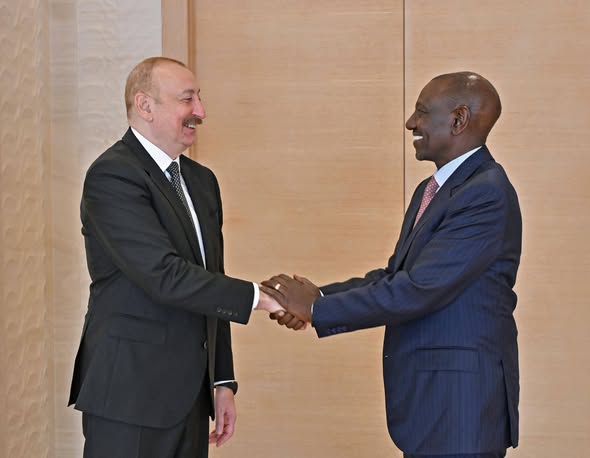
President William Ruto on Sunday used his meeting with Ilham Aliyev in Baku to reinforce what is increasingly emerging as the centrepiece of his expected 2027 re-election campaign — selling himself as a leader capable of attracting foreign investment and delivering mega economic projects despite growing public anger over the high cost of living.
Ruto met Aliyev at the Baku Olympic Stadium on the sidelines of the World Urban Forum, where the two leaders discussed cooperation in oil and gas, renewable energy, affordable housing and trade.
The President said Kenya and Azerbaijan were exploring strategic partnerships aimed at unlocking opportunities for both countries, including investments in Kenya’s proposed oil refinery project and support for the government’s affordable housing agenda.
But analysts say the significance of the visit goes beyond diplomacy, coming at a time when Ruto is under mounting political pressure ahead of the 2027 General Election, where he is expected to seek a second term.
With many Kenyans struggling under heavy taxation, expensive fuel, unemployment and the rising cost of basic commodities, the economy is likely to become the defining issue of the next presidential race.
Ruto’s administration has, in recent months, intensified foreign trips and investment campaigns as the President seeks to convince voters that his government is laying the groundwork for long-term economic transformation.
The Azerbaijan talks focused heavily on energy — an area that has become politically sensitive due to the impact of fuel and electricity prices on households and businesses.
Among the key issues discussed was Azerbaijan’s interest in Kenya’s proposed oil refinery project aimed at serving the East African region. If implemented, the project could help Kenya reduce reliance on imported refined fuel and position itself as a regional energy hub.
For Ruto, such projects could become powerful campaign tools in 2027, especially if his administration can show progress in job creation and industrial growth before the elections.
The President also sought investments to scale up the affordable housing programme, one of his flagship promises since taking office in 2022.
The programme has, however, attracted sharp criticism from opposition leaders and sections of the public over mandatory housing deductions and claims that ordinary Kenyans are being overburdened at a time of economic hardship.
Despite the criticism, Ruto’s allies view the housing programme as central to his re-election message, arguing that it will eventually create employment and make home ownership accessible to low-income earners.
Political analysts say Ruto is increasingly shaping his political survival around development-driven messaging, hoping that visible projects and foreign-backed investments will neutralise growing dissatisfaction among voters.
The President also pushed for expanded markets for Kenyan tea, horticultural products and agricultural exports, a move likely aimed at strengthening support in farming regions where economic frustrations have been rising.
Kenya’s agricultural sector remains politically influential, with millions of households depending on tea, coffee and horticulture for survival. Any success in opening new markets could provide Ruto with much-needed political capital as campaigns begin to take shape.
Opposition leaders have already signalled that they intend to make the cost of living, taxation and unemployment central issues in the 2027 campaigns, setting the stage for what could become a fierce political contest over the state of the economy.
Against that backdrop, Ruto’s Azerbaijan visit reflects an administration increasingly aware that the road to re-election may depend less on political rhetoric and more on whether Kenyans feel tangible economic improvement in their daily lives before they return to the ballot in 2027.


