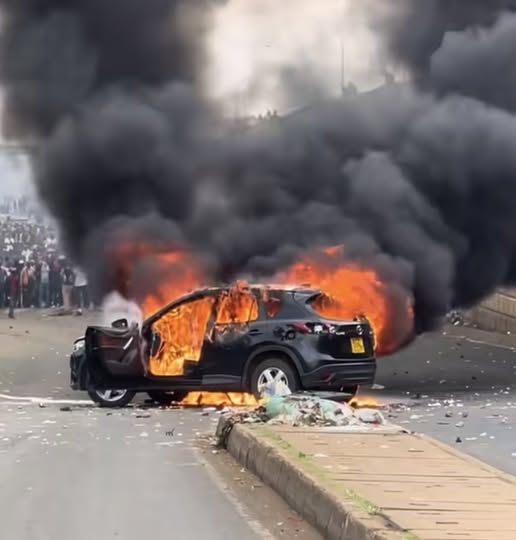
Kenya was plunged into widespread disruption on Monday after fuel price hikes triggered protests, a transport shutdown, and clashes between police and demonstrators in several towns, exposing deepening anger over the cost of living and mounting pressure on President William Ruto’s administration to respond.
From Nairobi to Mombasa, Kisumu, Nakuru, and Eldoret, public transport largely ground to a halt as matatus, boda bodas, and long-distance trucks stayed off the roads. Major highways that typically pulse with morning traffic were unusually quiet, punctuated instead by roadblocks, burning tyres, and scattered groups of protesters demanding lower fuel prices.
For thousands of commuters, the crisis began before sunrise.
“I left home at 4 a.m. and still couldn’t get transport,” said Nairobi resident Peter Mwangi, who walked several kilometres to work in the central business district. “Every time fuel goes up, it is the ordinary worker who suffers first and longest.”
In many parts of Nairobi, stranded passengers queued at bus stops that never filled. Some resorted to walking long distances, while others remained at home, unable to afford the sharply increased fares introduced by operators in recent days.
Transport operators say they had no choice.
“We are bleeding,” said Joseph Kamau, a member of the Matatu Operators Association. “Diesel prices have pushed us into a corner. Either fares go up or the industry collapses. There is no middle ground anymore.”
In Mombasa, the disruption spread to freight movement at the port, where truck drivers parked their vehicles in protest, raising fears of delayed cargo clearance and potential shortages of essential goods inland.
“We are not moving because it does not make sense anymore,” said a long-distance truck driver in Changamwe who identified himself only as Hassan. “You fill fuel, and by the time you reach Nairobi, you have made almost nothing.”
Small traders across the country said the effects were already visible in markets, with transport costs quickly filtering into food prices.
“Even tomatoes are expensive now,” said Kisumu vendor Aisha Mohammed. “Customers complain, but what can we do? Transport from the farm has doubled.”
As the protests intensified, police were deployed in major urban centres, where they fired tear gas to disperse groups attempting to block roads. Authorities said they were trying to maintain order while allowing lawful demonstrations.
“We are dealing with isolated incidents of violence and illegal obstruction of roads,” said a senior police officer in Nairobi. “Security teams are on the ground to ensure public safety and protect property.”
The unrest was sparked by the latest fuel price review by the Energy and Petroleum Regulatory Authority (EPRA), which increased petrol and diesel prices significantly, citing rising global crude oil costs, currency depreciation, and changes in international supply dynamics.
Energy experts say the increase has acted as a trigger in an already fragile economy.
“This is not just about fuel—it is about the broader cost-of-living crisis,” said energy economist Linda Achieng. “Transport, food, and electricity costs are all interconnected. When fuel rises sharply, everything else follows.”
The political pressure quickly escalated, with opposition leaders and some lawmakers urging immediate government intervention, including tax relief measures or temporary fuel subsidies to ease pressure on households and transport operators.
“The situation is becoming unsustainable,” said a UDA MP who did not want to be mentioned “Kenyans are being pushed to the edge, and the state cannot remain silent.”
At the centre of the unfolding crisis, President William Ruto was reported to be outside the country on an official engagement at the time of the protests. State House had not issued a detailed public statement on the unrest by Monday afternoon, a silence that fuelled public debate over the government’s immediate response to the crisis.
Government officials, however, said consultations were ongoing between the Ministry of Energy, EPRA, and transport sector representatives in a bid to restore normalcy and prevent further escalation.
“We are engaging stakeholders across the transport sector to find a workable solution,” a government official said, without providing details on potential relief measures.
By midday, uncertainty still hung over major towns. Some operators hinted at a possible return to service if talks progress, while others warned that without concrete action on fuel prices, the shutdown could continue into the week.
For commuters like Mwangi, the crisis felt less like a protest and more like a breaking point.
“This is becoming unbearable,” he said, standing outside a closed matatu stage. “We are just surviving from one shock to another.”


