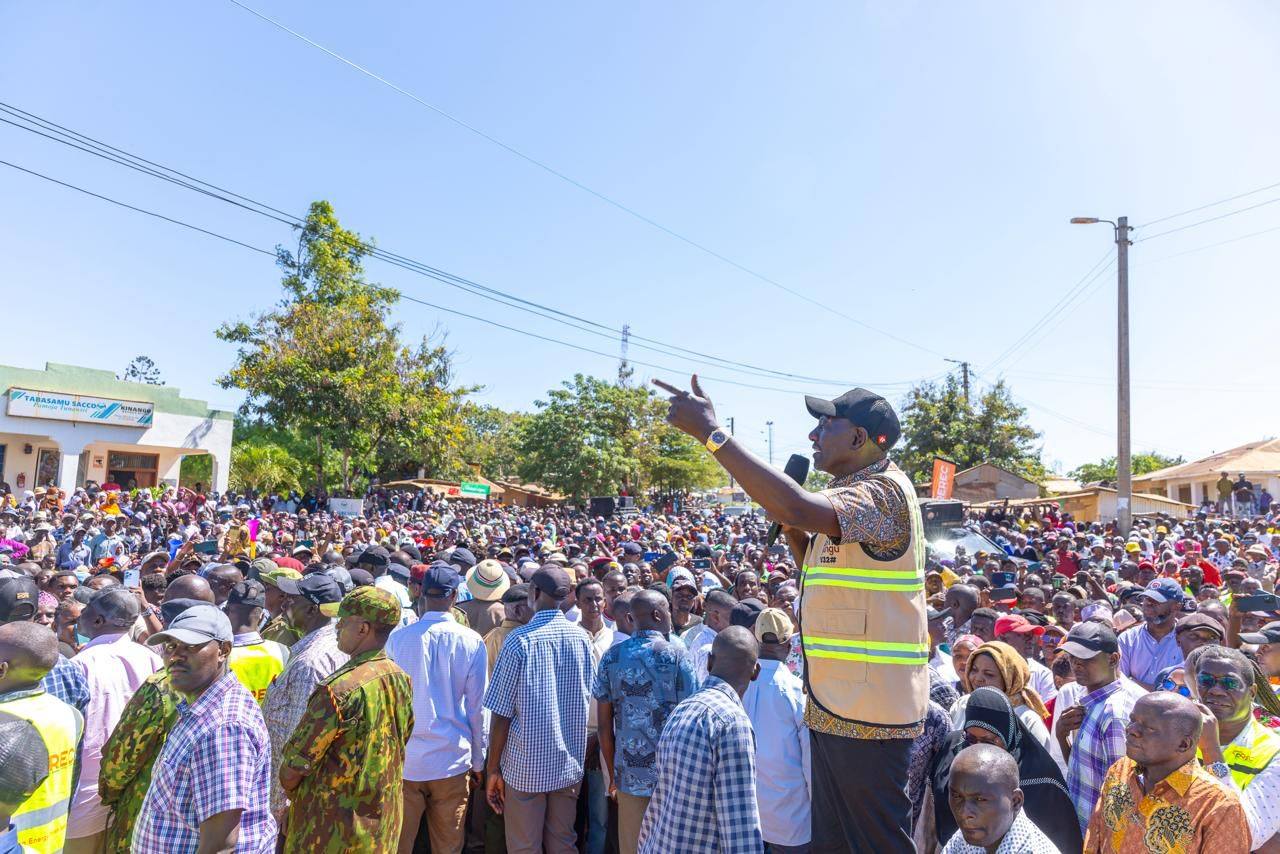
President William Ruto is intensifying his political and development footprint in the Coast region, traditionally a stronghold of the Orange Democratic Movement, as new infrastructure projects and grassroots engagements begin to reshape local political loyalties ahead of future elections.
The renewed push comes as the President positions his administration as focused on correcting historical inequalities in resource allocation, with Kwale County emerging as one of the key entry points of the government’s strategy.
“We are implementing transformative development projects across the Coast region to ensure the region, which has lagged behind for far too long, becomes a central part of the country’s development journey,” President William Ruto said during a tour of the area.
He added that the government’s broader goal is equitable development across all regions. “Our objective is to ensure fair distribution of resources so that every region of the country benefits equally from our national development programmes,” he said.
In Kinango, Kinango, the President laid the foundation stone for a modern market, part of six similar facilities being developed across Kwale County. The initiative is designed to formalise trade, support small-scale traders and stimulate local economic activity in rural and peri-urban centres.
The Diani Modern Market in Diani has already been completed, with officials saying it is expected to strengthen tourism-linked commerce and expand opportunities for small businesses operating along the South Coast corridor.
Alongside the market projects, the government also flagged off the KSh29 million Kinango Last-Mile Connectivity Project, which will connect more than 400 households to electricity. Authorities further announced an expanded electrification programme worth KSh1.8 billion targeting 15,000 additional households in Kwale County before the end of the year.
The development drive is increasingly being interpreted in political circles as part of a broader strategy by Ruto to make inroads into regions that have historically voted overwhelmingly for ODM.
For years, the Coast has been one of the most reliable bases for ODM, shaped by the influence of veteran opposition leader Raila Odinga and the party’s strong grassroots networks in the region.
However, shifting political dynamics within ODM, combined with the growing visibility of state-led projects in the Coast, are beginning to alter the region’s political arithmetic.
Local leaders are now split between those who continue to defend ODM’s dominance and those who argue that development delivery, rather than party loyalty, will increasingly determine voter behaviour.
Some elected leaders have publicly welcomed the government’s infrastructure investments, arguing that the Coast has for decades lagged behind in markets, roads and electrification, and that current interventions are long overdue.
Others, however, view the intensified development push as a calculated political strategy aimed at weakening ODM’s traditional hold by linking service delivery directly to the national government.
Political observers say the Coast is gradually shifting from a predictable opposition bloc to a competitive political battleground, where development projects, local alliances and national political narratives are increasingly intertwined.
“The Coast is no longer politically static. Voters are responding to both long-standing loyalties and immediate development gains,” one analyst said.
The Kinango and Diani projects are part of a wider rollout of infrastructure programmes across the coastal counties, with markets, electricity connections and transport-related investments forming the backbone of the government’s engagement in the region.
As construction sites expand and electrification projects take shape, the Coast is emerging as a key testing ground for the President’s strategy to consolidate support beyond traditional political bases, even as ODM works to maintain its historical influence in the region.


