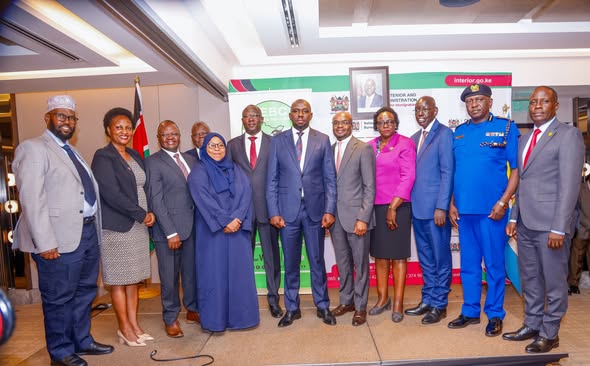
The Independent Electoral and Boundaries Commission (IEBC) has intensified early preparations for the 2027 General Election through renewed coordination with the Ministry of Interior and National Administration, focusing on voter registration, election security, and conflict prevention.
The consultative meeting held in Nairobi brought together senior officials from both institutions to address long-standing challenges in the electoral process, including issuance of national identity cards, security preparedness, and peacebuilding mechanisms ahead of the polls.
Interior Cabinet Secretary Kipchumba Murkomen assured the electoral agency of the Ministry’s commitment to sustained cooperation, saying inter-agency coordination would be key to delivering a credible and peaceful election.
“The Ministry remains committed to continuous collaboration and consultation to ensure that the 2027 General Election is credible, peaceful, and reflective of the fundamental principles of good governance,” Murkomen said.
IEBC Chairperson Erastus Ethekon thanked the Ministry for its support during recent electoral exercises, including the Enhanced Continuous Voter Registration drive and by-elections held on Thursday, May 14, which he said were conducted peacefully.
“Today’s engagement is both timely and necessary. Elections are not the responsibility of a single institution. Successful elections require strong coordination, continuous consultation, and mutual support among institutions charged with safeguarding democracy, peace, security, and the rule of law,” Ethekon said.
He added that early coordination between institutions will be critical in ensuring the credibility of the 2027 polls, noting that planning gaps often translate into disputes during election periods.
“The success of the 2027 General Election will largely depend on how effectively institutions coordinate and collaborate today,” he said, reaffirming IEBC’s commitment to work with the Ministry of Interior, development partners, and other stakeholders.
The engagement also underscored concerns over access to national identity cards, a persistent challenge that has affected voter registration, particularly among young people and first-time voters. Both institutions noted that improved access to IDs would be key in expanding the voter roll ahead of the polls.
Discussions further touched on conflict prevention strategies, with emphasis on early warning systems, civic education, and enhanced security coordination to avert election-related violence.
The Ministry of Interior signaled readiness to deploy administrative and security structures at the grassroots level to support electoral preparedness and ensure stability during the election period.
Background
The meeting comes as the IEBC embarks on rebuilding public confidence after the disputed 2022 General Election, which triggered legal challenges and renewed scrutiny of electoral management in Kenya. The polls, which saw William Ruto elected President, were largely peaceful but marked by political tension and competing claims over the final outcome.
Since then, the Commission has undergone leadership changes and reforms aimed at strengthening transparency, with renewed focus on voter registration, technology management, and stakeholder engagement. The current IEBC leadership has prioritized early collaboration with security agencies, civil society, and political actors to avoid the last-minute coordination challenges that have previously characterized election cycles in Kenya.
The Ministry of Interior, which plays a central role in election security through the National Police Service and county administration structures, has repeatedly been cited as a critical partner in ensuring peaceful elections, particularly in hotspot regions where political competition often turns volatile.
With less than two years to the 2027 polls, both institutions are now seeking to institutionalize continuous coordination as part of broader efforts to strengthen Kenya’s electoral integrity and democratic stability.


