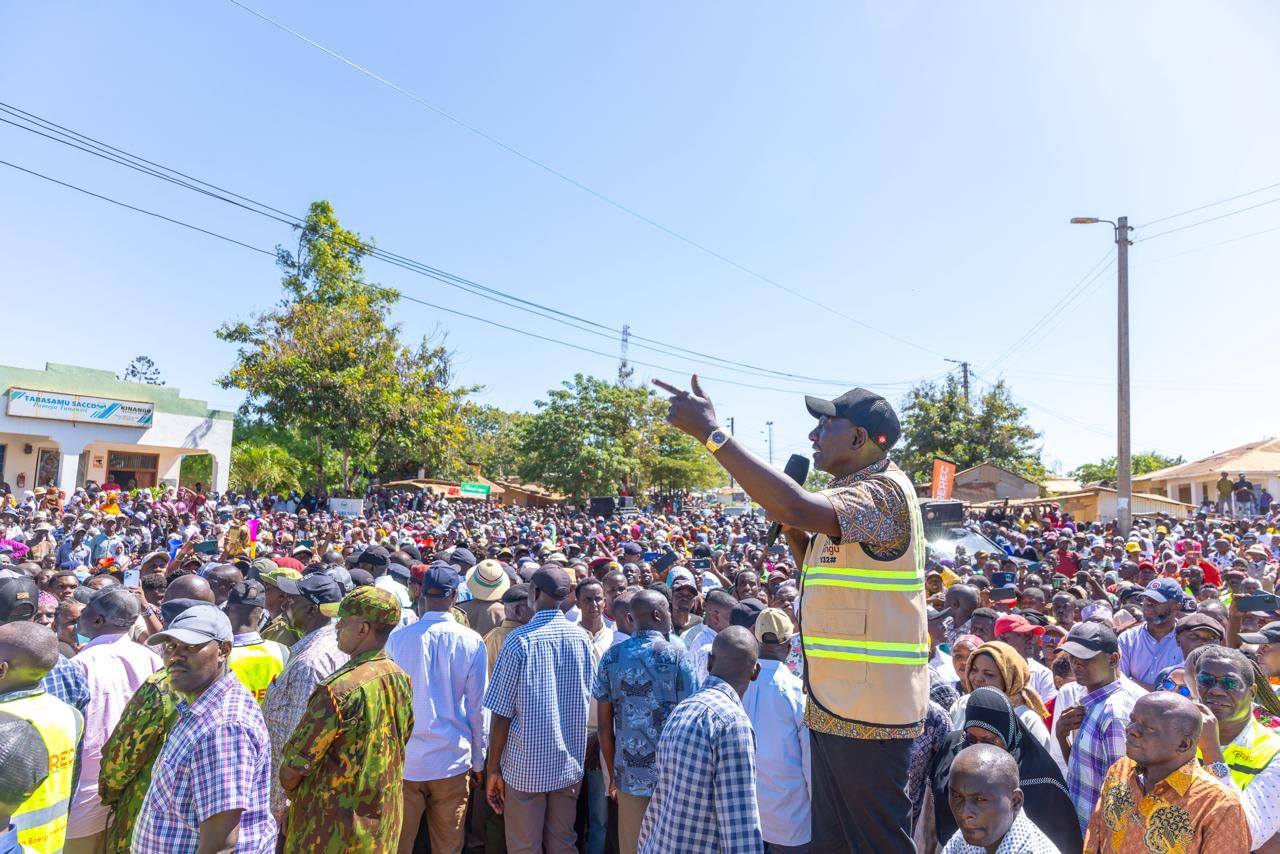
President William Ruto’s development tour of Kilifi and Kwale counties has doubled as a political statement ahead of the 2027 elections, with a series of flagship projects rolled out across the Coast region framed as proof of his administration’s delivery agenda.
At Mkuluni in Ganze Constituency, Kilifi County, Ruto laid the foundation stone for a KSh70 million modern market, one of 10 planned across the county. He also flagged off a KSh244 million Last Mile Connectivity Programme aimed at expanding electricity access to rural households and small businesses.
“Our word is our bond. We remain steadfast in delivering on our commitment to uplift those at the bottom of the economic pyramid and expand opportunities for every Kenyan to prosper,” the President said, in remarks that underscored his government’s development narrative.
In Kwale County, he handed over the Diani Modern Market in Msambweni Constituency, a KSh193 million facility designed to accommodate about 300 traders and fitted with running water, cold storage, an ICT hub and a children’s playground. He also launched additional electricity connectivity projects, including a KSh119 million programme in Msambweni and a KSh362 million rollout in Ngathini village targeting 3,980 households.
In Lunga Lunga Constituency, Ruto laid the foundation stone for a KSh139 million modern market, part of six similar projects underway in the county, reinforcing his administration’s push for structured trade infrastructure in the coastal economy.
Overall, the government says it is investing KSh1.8 billion to connect more than 15,000 households in Kwale County to electricity, alongside the construction of 3,600 student hostel units across universities, TVET institutions and KMTC colleges.
At Lungalunga Technical and Vocational College, the President launched a KSh260 million hostel project and announced sponsorships for more than 250 students to pursue short technical courses.
Background
The Coast region remains a politically sensitive bloc ahead of the 2027 polls, with successive governments using infrastructure and service delivery projects to win voter confidence in an area long affected by unemployment, low electrification levels and underdeveloped trade infrastructure. The latest presidential tour signals an intensifying competition for regional support, with development projects increasingly doubling as campaign messaging.


