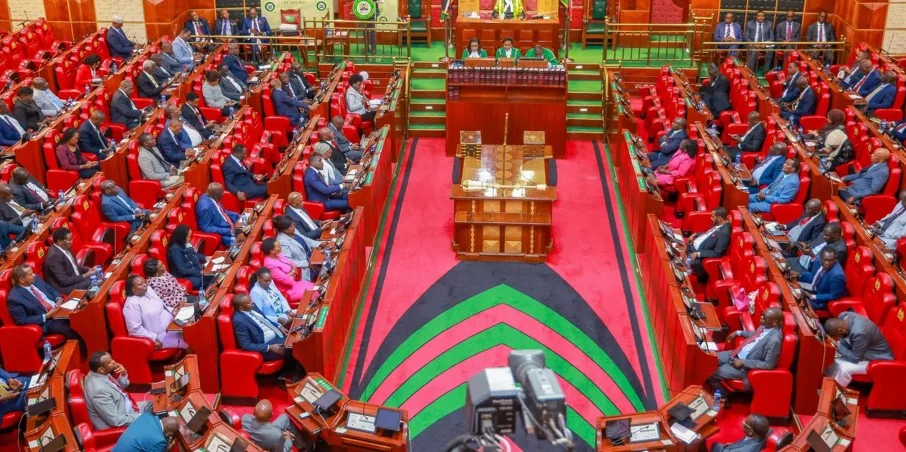
The National Assembly is set for a high-stakes vote on the Finance Bill 2026, with lawmakers expected to determine the fate of the controversial legislation in a session that could have far-reaching political and economic implications.
The vote comes a day after heated exchanges and dramatic scenes in Parliament during the bill’s Second Reading, where government and opposition lawmakers clashed over provisions contained in the 124-page proposal.
Although the Kenya Kwanza administration appears to command sufficient numbers to push the bill through, the debate has revealed deep divisions within the political class and highlighted emerging alliances that could shape the 2027 General Election.
The opposition, now comprising a broad coalition of parties and political figures, has mounted strong resistance to the bill, arguing that several provisions would increase the cost of living and place an additional burden on ordinary Kenyans.
Among the concerns raised are proposals affecting workers, digital transactions, taxation on second-hand clothing, and expanded powers for the Kenya Revenue Authority (KRA).
Opposition leaders have claimed that the bill removes certain tax relief measures for lower-income earners while introducing new levies that could affect consumers and businesses.
Critics have also questioned provisions they say could grant tax authorities wider access to personal and financial information, arguing that such measures may raise constitutional and privacy concerns.
Several lawmakers have further warned that taxing some manufacturing inputs could hurt local industries and undermine efforts to create jobs.
The opposition has also accused the government of rushing the legislative process and failing to adequately incorporate views collected during public participation.
However, government allies have defended the bill, arguing that it is necessary to support revenue collection, fund public services, and maintain fiscal stability.
The Finance Bill debate has also become a test of political strength following significant realignments in Parliament over the past year.
While official party affiliations within the House remain largely unchanged, voting patterns have shifted considerably as lawmakers reposition themselves ahead of the next election cycle.
The ruling coalition and its allies are estimated to command approximately 204 MPs, giving President William Ruto's administration a comfortable advantage in key parliamentary votes.
This bloc consists primarily of United Democratic Alliance (UDA) legislators, allied Kenya Kwanza parties, and a section of Orange Democratic Movement (ODM) leaders who support the Broad-Based Government arrangement.
On the other side, the opposition has consolidated an estimated 115 MPs drawn from Wiper, DAP-Kenya, Jubilee, KANU, rebel ODM lawmakers, and allies of former Deputy President Rigathi Gachagua.
The growing cooperation among these groups has strengthened the opposition's voice in Parliament, even though it remains numerically disadvantaged.
Political observers note that while the government is widely expected to secure passage of the bill, the vote represents more than a legislative exercise.
Instead, it is increasingly being viewed as a preview of the political contest that is likely to dominate the run-up to the 2027 General Election, with both camps using the Finance Bill debate to define their positions on taxation, governance, and economic management.
As MPs take their positions for the final vote, attention will be focused not only on the outcome of the legislation but also on the emerging political formations that are beginning to reshape Kenya’s electoral landscape.