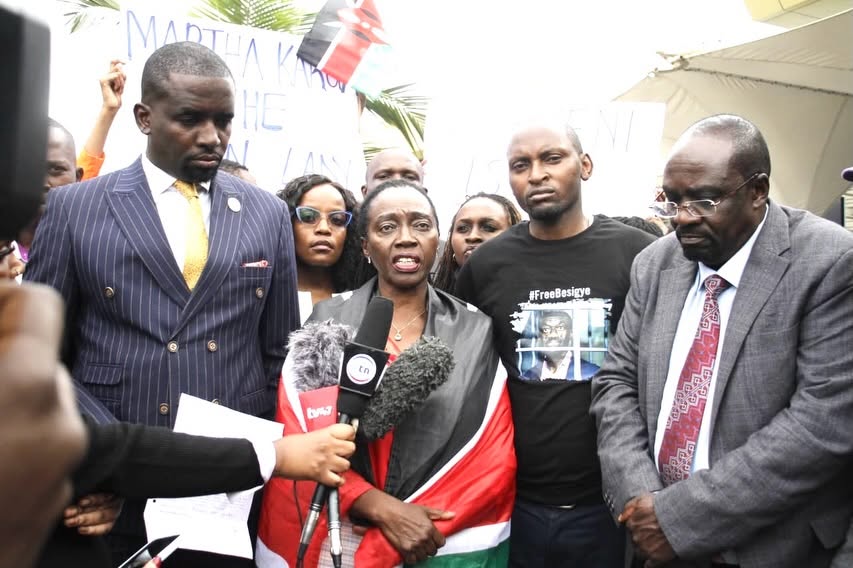
Veteran Kenyan politician and Senior Counsel Martha Karua has accused Ugandan authorities of violating her rights after she was detained and deported while travelling to Kampala to observe court proceedings involving opposition leader Dr Kizza Besigye and his co-accused Hajji Obeid Lutale.
The incident has sparked outrage among legal practitioners, civil society organisations and pro-democracy activists across East Africa, who view the move as a setback to regional commitments on the rule of law, access to justice and democratic freedoms.
In a statement released after her return to Kenya, Ms Karua said she had travelled to Uganda alongside Law Society of Kenya President Charles Kanjama to attend proceedings related to the case involving Dr Besigye, a longtime critic of Ugandan President Yoweri Museveni's government.
However, she said she was denied the opportunity to attend court after being detained and subsequently deported.
"A few days ago, my co-counsel in the Besigye case, Erias Lukwago, was arrested and detained in Uganda. Today, alongside Law Society of Kenya President Charles Kanjama, I travelled to Uganda to attend court proceedings concerning his case. Instead, I was unlawfully detained and deported," Ms Karua said.
The former Justice Minister thanked individuals, professional bodies and civil society groups who expressed solidarity following the incident.
"The right to legal representation, a fair hearing, and equal protection under the law are not privileges reserved for a few. They are safeguards for all of us," she said.
Growing concern
The deportation has intensified concerns about the treatment of opposition figures and their legal representatives in Uganda, where Dr Besigye has faced a series of legal battles linked to his political activities.
Mr Erias Lukwago, the Lord Mayor of Kampala and one of Uganda's leading opposition lawyers, had earlier reported being arrested and detained, prompting concern among rights groups and legal organisations monitoring the case.
Dr Besigye, a four-time presidential candidate, remains one of President Museveni's most prominent political challengers. His supporters have repeatedly accused authorities of using state institutions to suppress dissent, claims the Ugandan government has consistently denied.
Law Society response
Law Society of Kenya President Charles Kanjama, who accompanied Ms Karua on the trip, is understood to have sought access to the court proceedings as part of a broader effort by legal professionals in the region to monitor adherence to fair trial standards.
Legal practitioners have argued that the detention and deportation of advocates seeking to observe judicial proceedings raises serious questions about transparency and access to justice within the East African Community.
Several lawyers' associations across the region have called for an explanation from Ugandan authorities, warning that restrictions on legal representation and court observation could undermine public confidence in judicial processes.
Regional solidarity
Civil society organisations in Kenya, Uganda and Tanzania condemned the deportation, describing it as an attack on democratic principles and the independence of legal practice.
Human rights defenders noted that lawyers play a critical role in safeguarding constitutional rights and ensuring accused persons receive fair hearings.
"The defence of justice is never the responsibility of one person alone," Ms Karua said while acknowledging the support she had received from professional bodies and democracy advocates across the region.
Rights groups have also renewed calls for authorities in Uganda to guarantee fair treatment for Dr Besigye, Mr Lutale and all individuals facing politically sensitive prosecutions.
Questions for East African integration
The incident is likely to reignite debate over the East African Community's commitment to democratic governance, human rights and the free movement of citizens within the region.
Analysts say the detention of a senior advocate and former Kenyan minister could strain relations between legal and political actors in Kenya and Uganda, particularly as calls grow for greater accountability and adherence to regional treaties.
For Ms Karua, however, the matter extends beyond her personal experience.
"Erias Lukwago still deserves justice. Dr Kizza Besigye and Hajji Obeid Lutale still deserve justice," she said.
"And across our region, there remain many citizens whose rights, freedoms and dignity depend on our willingness to defend these principles whenever they are threatened."
As pressure mounts on Ugandan authorities to explain the circumstances surrounding the deportation, regional legal bodies and human rights organisations are expected to continue pushing for greater transparency in the handling of politically significant cases.