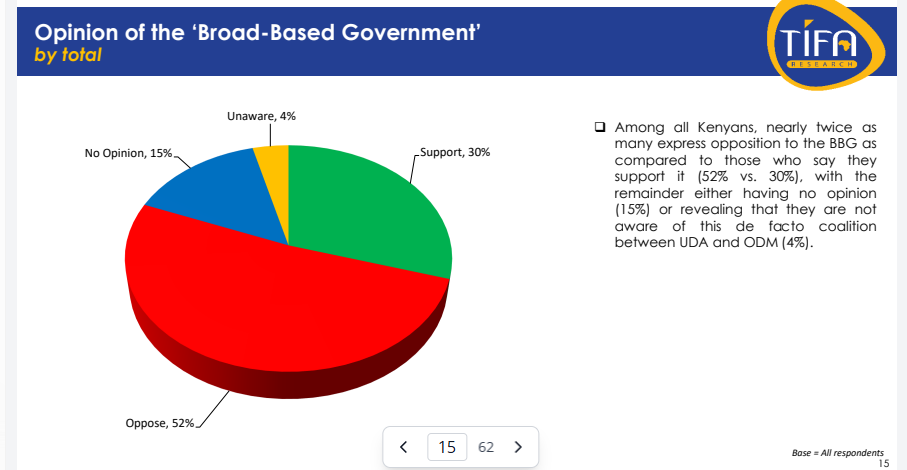
A majority of Kenyans oppose the Broad-Based Government (BBG) arrangement between President William Ruto and the late former Prime Minister Raila Odinga, according to a new TIFA Research survey released on Wednesday, September 9, 2026.
The poll found that 52 per cent of respondents were opposed to the political arrangement, while 30 per cent supported it. Another 15 per cent said they had no opinion, while 4 per cent indicated they were unaware of the arrangement.
The findings suggest that opposition to the BBG is nearly twice as high as support, pointing to continued public dissatisfaction with the political partnership.
BBG Faces Unease Among Supporters
TIFA said it has been monitoring public attitudes towards the Broad-Based Government for more than a year, with the arrangement continuing to generate concern among the core supporters of both Ruto and the late Raila.
The polling firm particularly highlighted unease within the Orange Democratic Movement (ODM), where sections of the party’s support base have questioned the direction taken by its leadership.
The BBG was established in the aftermath of the Gen-Z protests of June 2024, with its initial objective presented as addressing some of the issues raised during the demonstrations and strengthening the legitimacy of the Kenya Kwanza administration.
ODM Position Fuels Internal Disquiet
According to TIFA, much of the dissatisfaction within ODM stems from the party leadership’s position that the BBG should extend beyond a temporary political arrangement.
The party has maintained that it intends to support Ruto’s bid for a second term and, if he wins, pursue a more formal power-sharing arrangement.
TIFA noted that this position has become increasingly contentious as the 2027 General Election approaches, particularly among ODM supporters who may have expected the arrangement to remain focused on short-term reforms and implementation of an agreed agenda.
ODM Divisions Deepen Ahead of 2027
The latest survey comes as ODM faces growing internal divisions between its mainstream leadership and the dissident Linda Mwananchi faction.
The two camps have increasingly adopted different political positions, with the Linda Mwananchi movement emerging as a significant force within the wider opposition landscape.
The TIFA findings therefore highlight not only declining enthusiasm for the BBG among the broader public but also the political difficulties facing parties and leaders associated with the arrangement as Kenya moves closer to the 2027 General Election.