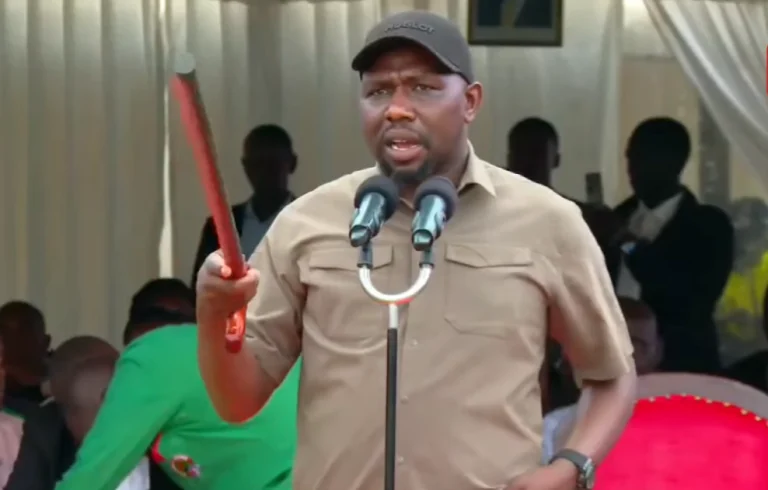
Interior Cabinet Secretary Kipchumba Murkomen has called on the Independent Electoral and Boundaries Commission (IEBC) to take decisive action against political candidates involved in electoral violence, voter intimidation and ethnic incitement ahead of the 2027 General Election.
Appearing before the National Assembly on Wednesday, November 4, 2026, Murkomen urged the commission to enforce the electoral code of conduct fairly and ensure that candidates who violate its provisions face the consequences prescribed by law.
He said the IEBC should consider petitioning the High Court to disqualify candidates where sufficient evidence and legal requirements support such action.
Murkomen maintained that candidates who engage in violence and intimidation, either directly or through their agents and supporters, should be held accountable.
He further urged the commission to initiate court proceedings in cases that meet the statutory threshold, noting that the High Court has the authority to disqualify candidates.
The Cabinet Secretary also called for individuals suspected of committing criminal offences during the electoral period to be investigated by the Directorate of Criminal Investigations (DCI) and prosecuted where evidence supports charges.
He emphasised that electoral violence should not be tolerated, warning against allowing individuals involved in intimidation and other unlawful conduct to escape accountability.
Murkomen Outlines 2027 Election Security Roadmap
During his appearance before Parliament, Murkomen also presented details of a 16-month security roadmap prepared by the National Police Service to guide preparations for the 2027 General Election.
The plan covers the period between September 2026 and December 2027 and consists of 28 activities organised into six phases.
The phases will focus on stakeholder engagement and preparatory activities, operational planning, training, election operations and post-election evaluation.
Murkomen said the National Police Service was strengthening intelligence-led and preventive policing as part of efforts to minimise security threats before and during the elections.
The preparations include identifying and mapping areas considered vulnerable to election-related violence, as well as improving coordination between security agencies.
Police officers will also undergo training to ensure they can protect voters, candidates, electoral officials and critical election infrastructure throughout the electoral period.
Police Pledge Neutrality and Respect for Human Rights
Murkomen said the implementation of the security roadmap would be guided by political neutrality, professionalism, accountability and respect for human rights.
He maintained that security agencies must provide an environment in which all political players can participate in the electoral process without intimidation, fear or disruption.
The government’s preparations are intended to strengthen the capacity of police officers to prevent violence, respond to security incidents and protect the integrity of the electoral process.
The roadmap also provides for a post-election review to assess the effectiveness of security operations and identify areas requiring improvement.
With the 2027 General Election approaching, Murkomen's remarks place renewed emphasis on the responsibility of electoral and security institutions to prevent violence, enforce the law and safeguard the rights of voters and candidates.